Back To Blog
 How to Source Products from China: Complete Guide for 2027
Sourcing products from China remains one of the most effective ways for businesses to access global manufacturing capabilities, competitive wholesale pricing, and extensive product customization opportunities.
Whether we operate an e-commerce store, Amazon FBA business, dropshipping website, retail shop, or established import company, understanding how to source products from China can help us reduce procurement costs, improve product quality, and build a more resilient supply chain.
China offers a vast manufacturing ecosystem covering electronics, clothing, furniture, packaging, machinery, beauty accessories, household goods, and thousands of other product categories. However, successful sourcing requires more than finding the cheapest supplier.
We must identify reliable manufacturers, compare sourcing platforms, verify supplier credentials, negotiate favorable terms, inspect product quality, calculate landed costs, and understand international shipping and customs requirements.
The most effective way to source products from China in 2027 is to identify a suitable supplier, verify its legitimacy, order samples, negotiate clear manufacturing terms, implement quality control, and arrange compliant international shipping before scaling purchases.
This comprehensive guide explains the entire China sourcing process, from selecting profitable products to establishing long-term supplier relationships.
What Is Product Sourcing from China?
Product sourcing from China is the process of finding, evaluating, and purchasing goods from Chinese manufacturers, wholesalers, trading companies, or sourcing agents for personal business use or commercial resale.
Instead of purchasing merchandise from domestic distributors, businesses may import directly from Chinese suppliers to access factory pricing, customized production, and larger product selections.
There are four common sourcing approaches:
-
Direct factory sourcing: Purchasing products from manufacturers that produce goods in their own facilities.
-
Wholesale sourcing: Buying existing merchandise from wholesalers or trading companies.
-
Private-label sourcing: Purchasing products manufactured by suppliers and selling them under our own brand.
-
Custom manufacturing: Working with a factory to develop products according to our specifications, designs, and technical requirements.
Each approach offers different advantages in pricing, flexibility, minimum order quantities, and production control.
For example, a small online retailer may begin by purchasing 100 units of an existing product from a wholesaler. As sales increase, the business might negotiate directly with a factory to manufacture customized products with branded packaging.
Why Source Products from China in 2027?
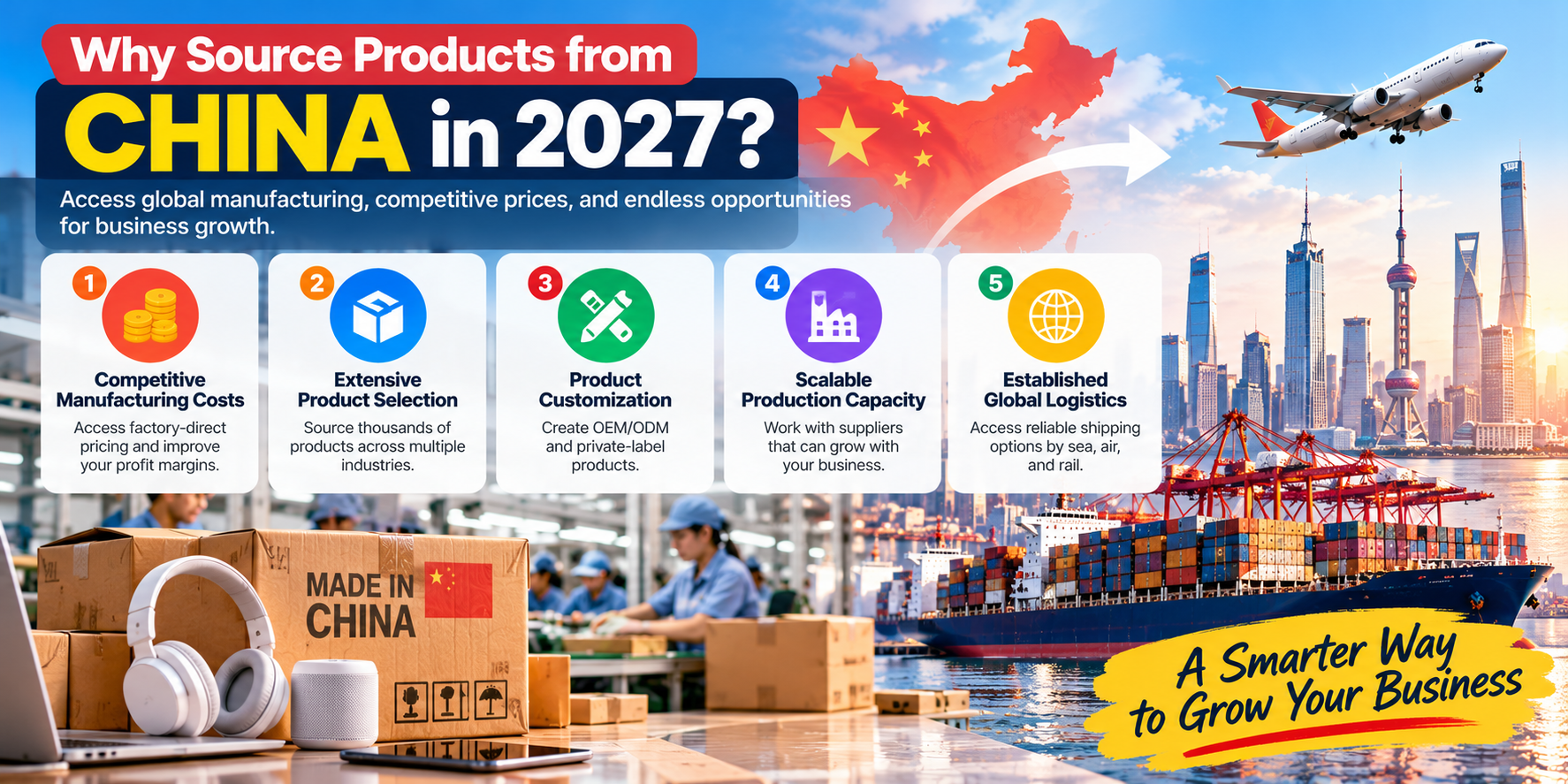
China continues to be an important sourcing destination because of its established manufacturing infrastructure, extensive supplier networks, and experience serving international buyers.
1. Competitive Manufacturing Costs
Chinese manufacturers can offer competitive production costs through economies of scale, specialized manufacturing clusters, and established supplier relationships.
However, China is not automatically the cheapest sourcing destination for every product.
We should compare the total landed cost rather than relying exclusively on factory quotations.
2. Extensive Product Selection
Chinese suppliers manufacture products across a broad range of industries, including:
-
Consumer electronics and accessories
-
Apparel, footwear, and textiles
-
Home and kitchen products
-
Furniture and interior decoration
-
Beauty accessories and packaging
-
Automotive parts
-
Industrial machinery
-
Sports and outdoor equipment
-
Toys and promotional merchandise
This diversity allows businesses to source multiple product categories through established procurement networks.
3. Product Customization and Private Labeling
Many manufacturers offer original equipment manufacturing (OEM) and original design manufacturing (ODM) services.
OEM manufacturing generally involves producing goods according to a buyer's specifications or design.
ODM manufacturing typically involves selecting or modifying designs developed by the manufacturer.
Both models can support private-label businesses, although the level of customization, design ownership, and tooling requirements must be clarified contractually.
4. Scalable Production Capacity
China has manufacturing facilities serving businesses ranging from small startups to multinational companies.
As order volumes grow, qualified suppliers may offer improved unit pricing, dedicated production schedules, and more advanced customization.
5. Established International Logistics
Major Chinese manufacturing and export regions have access to extensive port, airport, freight forwarding, and customs infrastructure.
This supports international shipping by sea, air, rail where available, and courier services.
How to Source Products from China: 10 Essential Steps
Step 1: Research Products and Market Demand
Identify products with realistic demand, sustainable margins, manageable shipping costs, and clear customer needs. Evaluate competition, seasonality, return rates, and applicable product regulations.
Step 2: Find Chinese Manufacturers and Suppliers
Search established B2B marketplaces, manufacturer directories, trade fairs, and sourcing networks. Create a shortlist of suppliers capable of meeting our product specifications.
Step 3: Verify Supplier Legitimacy
Request business registration details, factory information, relevant certifications, production references, and independent inspection opportunities.
Step 4: Request Product Samples
Evaluate materials, dimensions, functionality, finishing, packaging, and consistency with our requirements before approving mass production.
Step 5: Negotiate Pricing and Terms
Discuss unit prices, minimum order quantities, payment milestones, manufacturing lead times, defect allowances, and shipping responsibilities.
Step 6: Finalize a Purchase Agreement
Document product specifications, quality standards, delivery dates, intellectual property rights, inspection conditions, and remedies for nonconforming goods.
Step 7: Monitor Production and Quality
Use production updates, independent inspections, product testing, and pre-shipment checks to identify problems before goods leave the factory.
Step 8: Arrange International Shipping
Compare sea freight, air freight, courier services, and appropriate Incoterms based on cargo volume, delivery urgency, and commercial responsibilities.
Step 9: Complete Customs Clearance
Confirm HS classification, customs value, country of origin, import permits, taxes, and destination-market compliance requirements.
Step 10: Evaluate and Scale Supplier Relationships
Monitor product quality, delivery performance, defect rates, landed costs, and communication. Expand order volumes only after satisfactory results.
Best Websites to Source Products from China in 2027
Finding the right sourcing platform is one of the first decisions businesses must make.
Different marketplaces serve different purchasing needs.
-
1. Alibaba
Alibaba.com connects international buyers with manufacturers and trading companies. It is useful for requesting quotations, comparing minimum order quantities, discussing customization, and finding suppliers for larger orders.
Website: alibaba.com
-
2.1688
1688 primarily serves the Chinese domestic market. It can provide access to local wholesalers and manufacturers, but overseas buyers may need assistance with language, payments, domestic shipping, and export arrangements.
Website: 1688.com
-
3. Made-in-China
Made-in-China.com offers supplier directories covering industrial equipment, electronics, construction materials, machinery, and consumer products.
Website: made-in-china.com
- 4. Global Sources
Global Sources provides online supplier discovery and organizes sourcing exhibitions, particularly for electronics, lifestyle products, and other consumer categories.
Website: globalsources.com
-
5. DHgate
DHgate connects buyers with independent sellers offering merchandise across numerous categories. It can be useful for evaluating existing products in smaller quantities, although seller verification and product authenticity remain important.
Website: dhgate.com
China Sourcing Platform Comparison
|
Platform |
Primary use |
Typical buyer |
|
Alibaba.com |
Wholesale, OEM, ODM |
Importers and brands |
|
1688.com |
Domestic wholesale sourcing |
Buyers using China-based support |
|
Made-in-China.com |
Manufacturer discovery |
Industrial and commercial buyers |
|
Global Sources |
B2B sourcing and trade shows |
Established importers |
|
DHgate |
Smaller wholesale and retail orders |
Small retailers and product testers |
Minimum order quantities, supplier screening, payment arrangements, and buyer protections vary by seller and transaction.
How to Find Reliable Manufacturers in China
Finding suppliers is relatively straightforward. Identifying suppliers capable of consistently delivering acceptable products requires more detailed research.
Search Using Specific Product Requirements
Generic searches such as "clothing supplier China" may produce thousands of results.
More specific searches can help us identify suitable manufacturers.
Examples include:
-
Custom cotton T-shirt manufacturer China
-
OEM stainless steel water bottle supplier
-
Private-label skincare packaging manufacturer
-
Wholesale kitchen accessories manufacturer
-
Custom cardboard packaging factory China
We should include relevant specifications such as materials, dimensions, certifications, manufacturing processes, and target quantities.
Compare Multiple Suppliers
We recommend requesting quotations from at least three to five qualified suppliers before selecting a manufacturing partner.
This gives us a clearer understanding of market pricing, minimum order quantities, production capabilities, and available customization.
A quotation should include unit pricing, sample costs, tooling fees, packaging costs, lead times, payment terms, and applicable Incoterms.
Distinguish Manufacturers from Trading Companies
A manufacturer typically operates production facilities, while a trading company sources goods from other suppliers.
Neither business model is inherently unsuitable.
Factories may provide better control over custom production, while trading companies can offer broader product selections and coordinate purchases across multiple factories.
The appropriate choice depends on our order size, technical requirements, and procurement capabilities.
How to Verify a Chinese Supplier Before Ordering
Supplier verification is one of the most important stages of international sourcing.
We should never assume that an attractive website, professional product photographs, or a marketplace verification badge guarantees supplier reliability.
Check Business Registration
Request the supplier's legal company name, registered address, and Chinese business license.
Where applicable, verify the business through China's official enterprise registration information system.
Ensure the legal entity matches the company named on contracts and payment documentation.
Verify Manufacturing Capabilities
Ask suppliers about their factory location, production equipment, employee count, manufacturing processes, and monthly capacity.
For substantial orders, arrange a factory visit or independent audit.
A factory audit can help establish whether the supplier has the equipment, personnel, and management systems required for production.
Request Relevant Certifications
Depending on the product, suppliers may need to provide evidence of quality management systems, testing, or compliance with destination-market requirements.
For example, ISO 9001 certification may provide information about a company's quality management system, but it does not independently establish that a particular product complies with applicable safety regulations.
We should verify certificate authenticity, scope, validity, and the issuing organization.
Watch for Supplier Red Flags
Potential warning signs include unusually low quotations, refusal to provide company information, inconsistent banking details, vague specifications, and pressure to pay immediately.
Other concerns include reluctance to permit independent inspections and repeated changes to contractual terms.
A supplier's willingness to answer detailed technical questions is often more informative than polished marketing materials.
How to Contact Chinese Suppliers and Request Quotations
A professional request for quotation (RFQ) helps suppliers understand our requirements and provide comparable offers.
We should include the product name, specifications, materials, expected order quantity, packaging requirements, delivery destination, and desired production timeline.
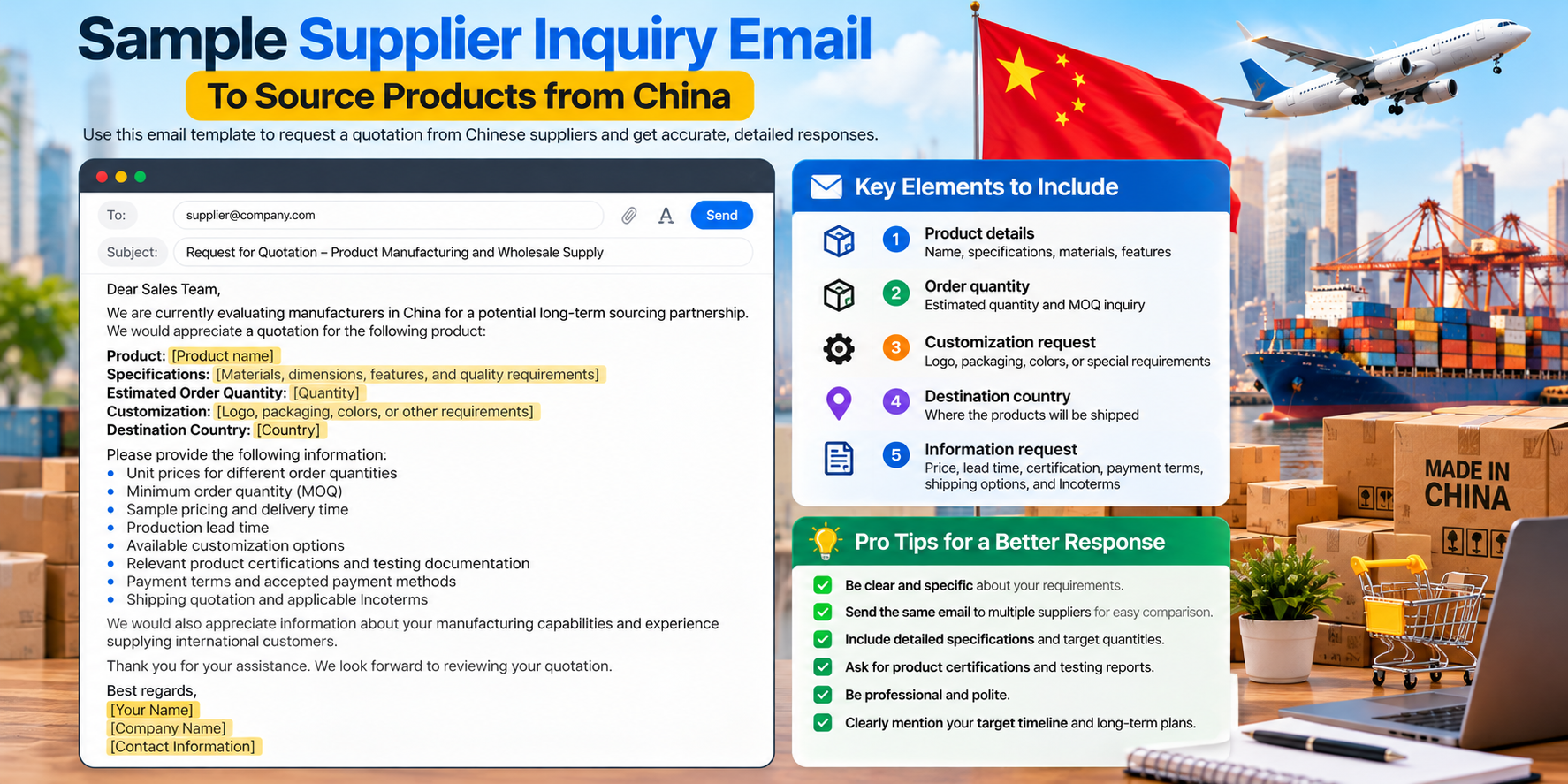
Sending the same RFQ to multiple suppliers makes quotations easier to compare and reduces misunderstandings.
Understanding Minimum Order Quantities (MOQ)
The minimum order quantity, commonly called MOQ, is the smallest quantity a supplier is willing to produce or sell under specified commercial terms.
MOQs vary significantly depending on the product, manufacturing process, customization, and supplier.
Existing stock products may be available in relatively small quantities, while custom molds, specialized materials, and printed packaging often require larger orders.
How to Negotiate Lower MOQs
Businesses purchasing from China for the first time may not want to commit to large inventory volumes.
We can sometimes negotiate smaller initial orders by selecting existing designs, limiting color variations, using standard packaging, or accepting a higher unit price.
For example, a manufacturer requiring 1,000 units for fully customized packaging might offer a smaller trial order with generic packaging and an applied label.
The supplier must confirm whether such arrangements are feasible.
How Much Does It Cost to Source Products from China?
The actual cost of importing products extends beyond the supplier's quoted price.
A complete sourcing budget should account for manufacturing, packaging, quality inspection, transportation, customs charges, and domestic delivery.
China Sourcing Cost Breakdown
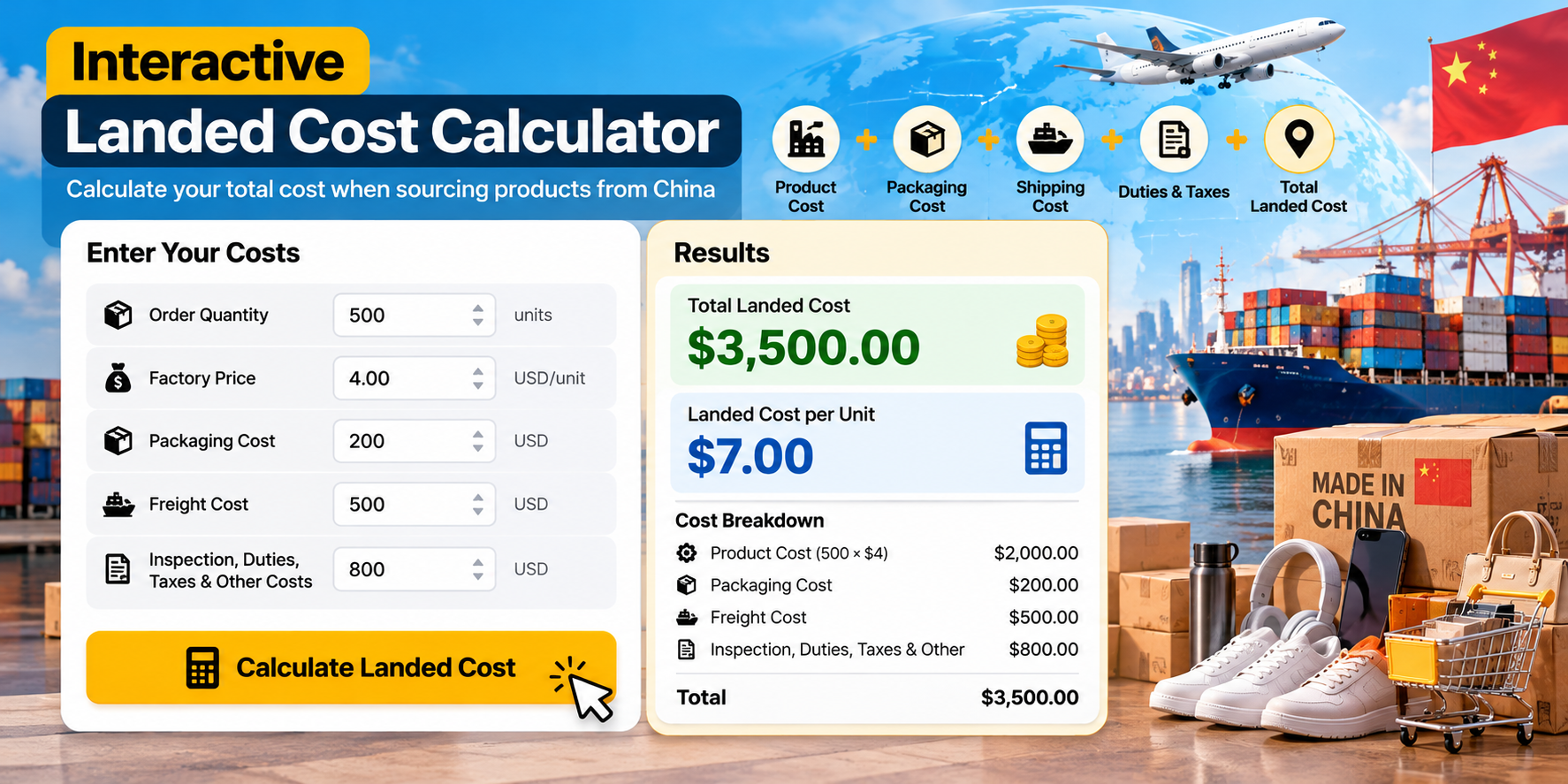
The following is an illustrative calculation for an order of 500 units. These are hypothetical figures, not current market quotations.
|
Expense |
Example cost |
|---|---|
|
Product manufacturing (500 × $4) |
$2,000 |
|
Custom packaging |
$200 |
|
Product inspection |
$250 |
|
International freight |
$500 |
|
Import duties and taxes |
$300 |
|
Customs and handling |
$150 |
|
Domestic delivery |
$100 |
|
Total landed cost |
$3,500 |
Illustrative landed cost per unit
$7.00
Total $3,500 ÷ 500 units
Although the supplier's unit price is $4, the estimated landed cost is $7 per unit after additional expenses.
The difference matters when calculating profit margins.
Interactive Landed Cost Calculator
How to Negotiate with Chinese Manufacturers
Successful negotiations should balance price, quality, production capacity, and long-term commercial sustainability.
Negotiate Based on Volume
Suppliers may offer lower unit prices for larger orders because manufacturing setup costs can be spread across more units.
However, purchasing excessive inventory solely to obtain a discount can create storage costs and cash-flow problems.
Compare Equivalent Specifications
Two suppliers may quote different prices because they use different materials, manufacturing methods, or quality standards.
We should ensure quotations refer to equivalent products before negotiating.
Discuss Payment Milestones
Some manufacturers may request a deposit before production and the remaining balance before shipment.
Payment structures vary by supplier, order size, and commercial relationship.
We should avoid paying the full amount to an unverified supplier without appropriate safeguards.
Agree on Defect and Rework Procedures
Contracts should explain how defective products will be handled.
Possible remedies include rework, replacement, price adjustments, or other agreed compensation.
Clear acceptance criteria reduce the likelihood of disputes.
Quality Control When Sourcing Products from China
Product inspection is essential when ordering merchandise from an overseas supplier.
A sample that meets expectations does not guarantee that every item in a production batch will have identical quality.
Pre-Production Inspection
Before manufacturing begins, verify raw materials, approved samples, specifications, and production readiness.
During-Production Inspection
Inspections during manufacturing can identify problems early enough for corrective action.
This can be particularly valuable for large or technically complex orders.
Pre-Shipment Inspection
A pre-shipment inspection evaluates finished products before they leave the factory.
Inspectors may check product appearance, dimensions, functionality, packaging, quantities, and workmanship.
For batch inspections, we can use a documented sampling plan and agreed acceptance criteria.
Laboratory Testing
Certain products require specialized testing rather than visual inspection alone.
Electrical safety, chemical content, mechanical hazards, and material performance may need evaluation by qualified laboratories.
A passed factory inspection is not a substitute for legally required product certification or testing.
Shipping Products from China: Sea Freight vs Air Freight
Choosing the right shipping method affects cost, inventory planning, and delivery reliability.
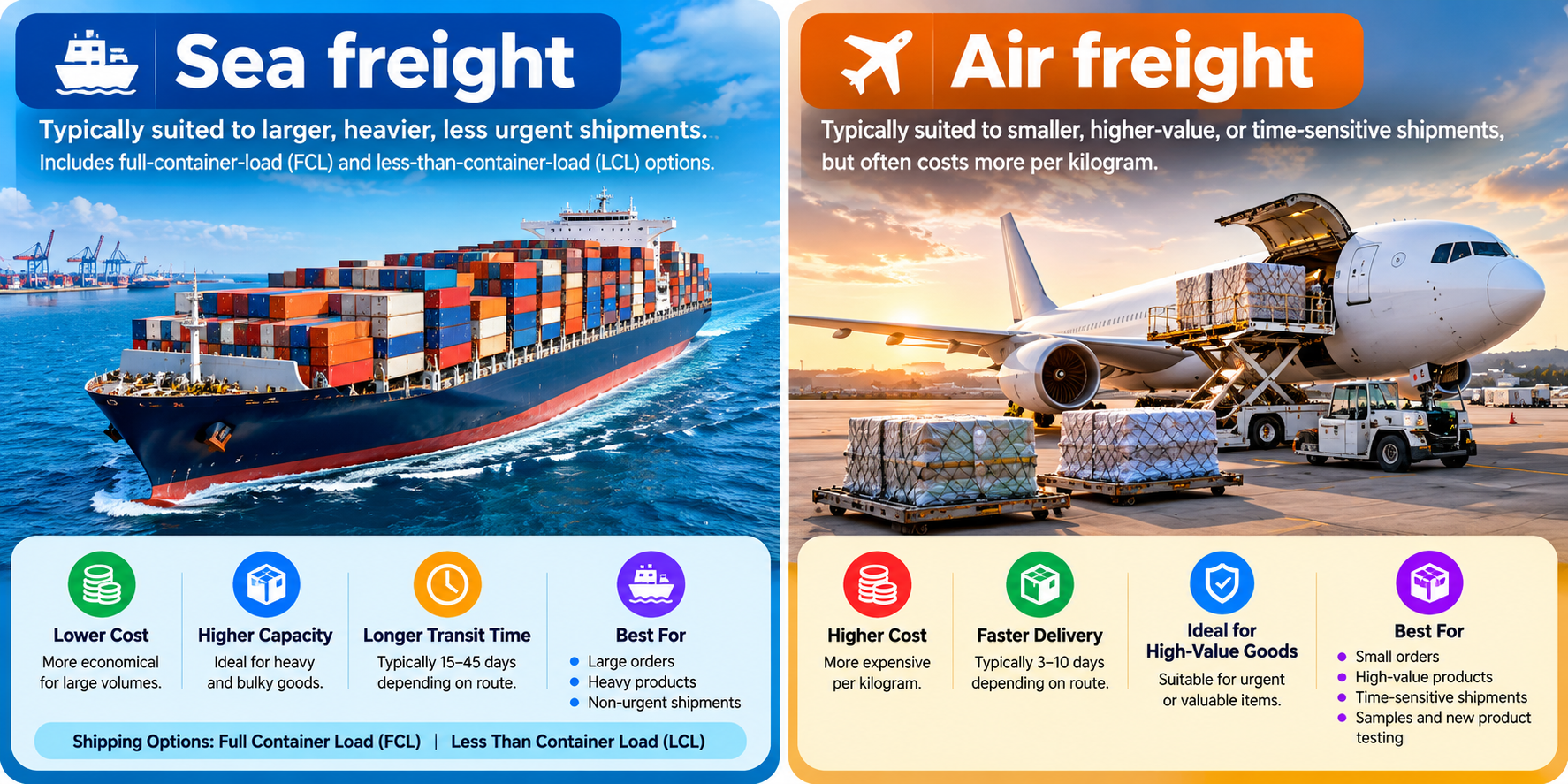
Shipping Method Comparison
|
Method |
Relative cost |
Typical suitability |
|---|---|---|
|
Sea freight |
Often lowest for large cargo volumes |
Bulk inventory and heavy products |
|
Air freight |
Generally higher |
Urgent or high-value shipments |
|
Express courier |
Often high per unit of weight |
Samples and small parcels |
|
Rail freight |
Route-dependent |
Certain China–Eurasia routes |
Actual transit times depend on routes, port congestion, customs, weather, and carrier schedules.
We recommend obtaining quotations from multiple freight forwarders and checking whether charges include pickup, origin handling, destination fees, customs brokerage, and final delivery.
Understanding EXW, FOB, CIF, and DDP Shipping Terms
International commercial terms determine which party is responsible for particular transportation tasks, costs, and risks.
The International Chamber of Commerce's Incoterms® 2020 rules provide standardized definitions for 11 trade terms.
EXW — Ex Works
Under EXW, the seller makes goods available at a named location, typically its premises.
The buyer assumes substantial responsibility for transportation and associated arrangements.
FOB — Free on Board
FOB applies to sea and inland waterway transport.
The seller delivers goods on board the nominated vessel at the named port, with risk transferring at that point under the rule.
CIF — Cost, Insurance and Freight
Under CIF, the seller arranges and pays for carriage and specified insurance to the named destination port.
However, the risk of loss or damage transfers when the goods are loaded on board at the shipment port, not when they arrive.
DDP — Delivered Duty Paid
DDP places extensive delivery, import clearance, and duty-payment responsibilities on the seller.
It may appear convenient, but buyers must verify that the seller can legally and properly fulfill the import obligations in the destination country.
We should always specify the named place and applicable Incoterms version in the purchase agreement.
Import Duties, Customs, and Product Compliance
Import regulations vary by country, product type, material composition, and intended use.
Before importing, we should determine the correct tariff classification, applicable taxes, labeling requirements, and product safety obligations.
Importing from China to the United States
U.S. importers should review product classification under the Harmonized Tariff Schedule of the United States (HTSUS), country-of-origin rules, applicable duties, and any additional trade measures.
U.S. Customs and Border Protection explains that accurate product descriptions, origin information, composition, and intended use are important for determining classification and entry requirements.
Importing from China to the European Union
EU importers must ensure products meet applicable European safety, health, environmental, and documentation requirements.
For products subject to CE marking rules, importers have responsibilities relating to conformity documentation, traceability, and compliance. Not every product requires CE marking.
Importing from China to Other Countries
Businesses importing into the United Kingdom, Australia, Canada, Malaysia, or other destinations should consult the relevant customs and product regulatory authorities.
Requirements may involve electrical certifications, consumer safety rules, labeling, food-contact standards, wireless equipment approvals, or product-specific import permits.
Essential Shipping Documents
Depending on the transaction, documentation may include a commercial invoice, packing list, bill of lading or air waybill, customs declaration, certificate of origin, and relevant test reports or permits.
Accurate documentation reduces the risk of customs delays, penalties, and shipment disputes.
Best Cities in China for Product Sourcing
[uploading:China’s Top Sourcing Cities Guide.png]
China's manufacturing capabilities are distributed across specialized industrial regions.
Choosing the appropriate region can help us identify suppliers with relevant expertise, established supply chains, and suitable production capabilities.
Shenzhen — Electronics and Technology
Shenzhen is a major destination for sourcing consumer electronics, mobile accessories, smart devices, electronic components, and hardware products.
Guangzhou — Fashion and Consumer Goods
Guangzhou offers extensive wholesale markets and supplier networks covering clothing, footwear, bags, accessories, and beauty-related merchandise.
Yiwu — Small Commodities
Yiwu is known for wholesale merchandise, including household accessories, gifts, stationery, decorations, and promotional products.
Dongguan — Manufacturing and Components
Dongguan has manufacturing capabilities across electronics, plastics, metalworking, furniture, packaging, and industrial components.
Ningbo — Hardware and Industrial Products
Ningbo has supplier networks covering household appliances, hardware, plastics, machinery components, and export-oriented manufacturing.
How to Source Products from China Without Visiting the Country
Businesses do not necessarily need to travel to China to establish supplier relationships.
Remote sourcing can be managed through B2B platforms, video calls, independent inspection companies, freight forwarders, and professional sourcing agents.
A practical remote sourcing process involves identifying potential suppliers, requesting quotations, verifying business credentials, ordering samples, and arranging independent quality inspections.
We should request production photographs and video updates, but recognize that these are not substitutes for independent verification.
For high-value orders, an independent factory audit may be worthwhile before making a substantial financial commitment.
Should We Hire a China Sourcing Agent?
A China sourcing agent assists international buyers with supplier discovery, communication, negotiation, order management, inspections, and logistics coordination.
Sourcing agents can be useful when businesses face language barriers, require multiple suppliers, or lack experience managing Chinese manufacturing relationships.
However, agents also introduce additional costs and potential conflicts of interest.
Before hiring an agent, we should clarify their fee structure, responsibilities, supplier relationships, inspection procedures, and disclosure of commissions.
An agent should not automatically be considered independent simply because they operate separately from the supplier.
Common Mistakes to Avoid When Sourcing from China
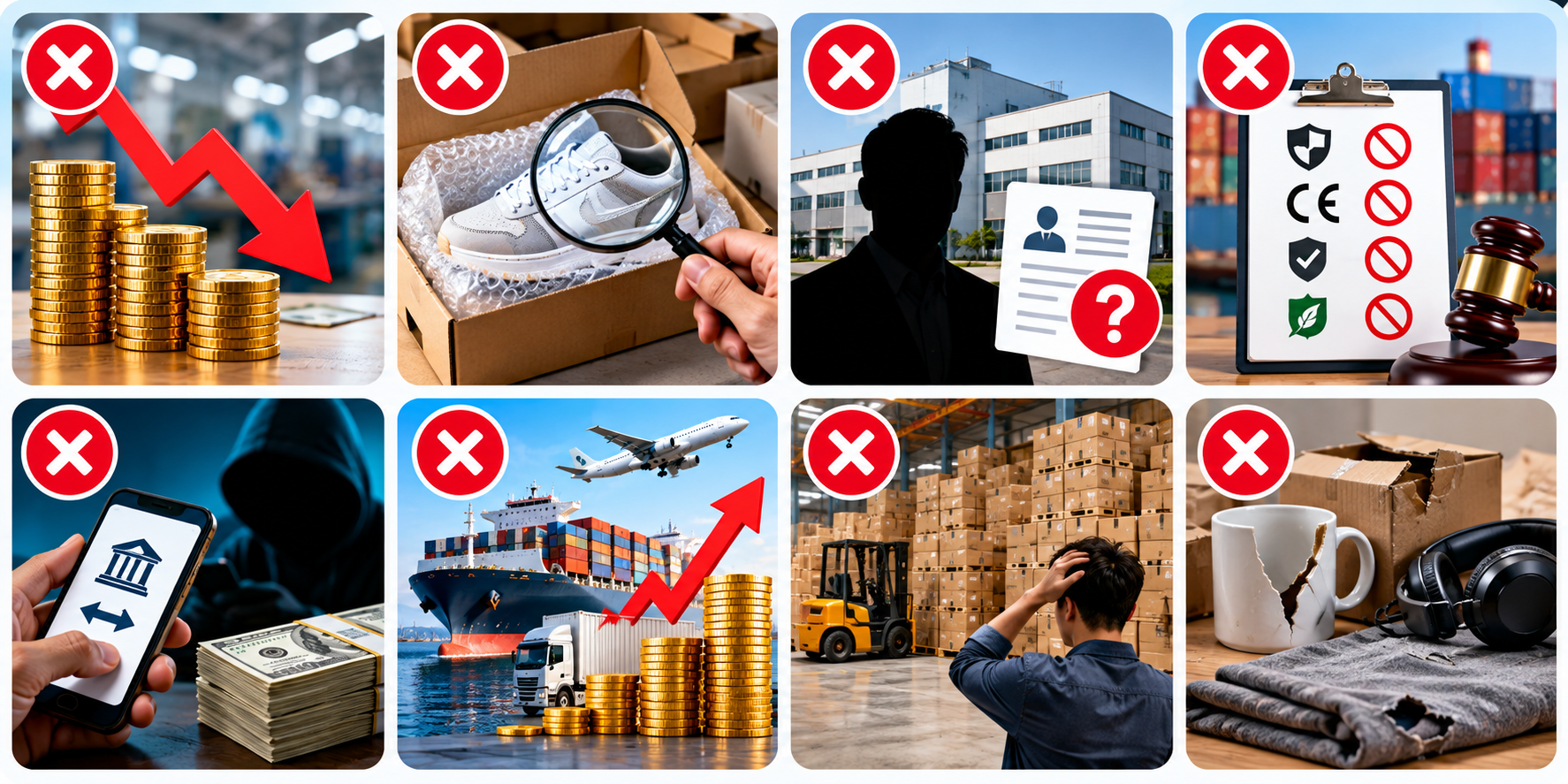
Many sourcing problems can be prevented through careful planning.
Choosing the Cheapest Supplier
The lowest quotation may exclude essential costs or reflect inferior materials and manufacturing standards.
We should compare equivalent specifications and total landed costs.
Skipping Product Samples
Ordering large quantities without evaluating samples creates unnecessary quality risks.
Samples help us confirm materials, construction, dimensions, and product functionality.
Failing to Verify Suppliers
A professional-looking supplier profile does not establish manufacturing capabilities or financial reliability.
Independent verification is particularly important for substantial orders.
Ignoring Product Regulations
Importing products without checking destination-market requirements can result in shipment delays, rejected goods, penalties, or recalls.
Paying Without Clear Agreements
Informal arrangements may leave buyers with limited options when suppliers deliver late or manufacture incorrect products.
Written agreements should establish measurable quality and delivery obligations.
Underestimating Shipping Costs
Freight charges, customs duties, insurance, and destination handling fees can significantly increase the final product cost.
Ordering Too Much Inventory
Large orders may reduce unit costs but increase financial exposure, warehousing expenses, and the risk of unsold stock.
We recommend validating demand before committing to substantial inventory volumes.
China Sourcing Strategies for Small Businesses in 2027
Small businesses should prioritize controlled experimentation rather than immediate large-scale purchasing.
Start with Low-Risk Products
Products with straightforward specifications, manageable shipping costs, and limited regulatory complexity can be easier to evaluate.
For example, simple non-electrical home accessories may involve fewer technical challenges than wireless electronics or safety-critical products.
Build a Shortlist of Suppliers
Rather than depending on the first available manufacturer, we should maintain alternative suppliers capable of producing comparable merchandise.
This can help reduce disruption if a supplier experiences delays or quality problems.
Test Products Before Scaling
We recommend ordering samples and placing a manageable initial production order.
After receiving the goods, we can evaluate customer feedback, return rates, manufacturing consistency, and profitability.
Develop Long-Term Supplier Relationships
Reliable suppliers may offer advantages such as improved communication, better production planning, and greater flexibility for repeat orders.
However, even established relationships require documented specifications and ongoing quality monitoring.
Use Digital Tools to Improve Procurement
Inventory management systems, supplier databases, collaborative documents, and automated reporting can help us track quotations, lead times, defects, and reorder schedules.
Artificial intelligence can assist with comparing supplier responses, organizing product specifications, and analyzing procurement data.
Nevertheless, AI-generated recommendations should not replace supplier verification, physical testing, or legal compliance reviews.
Frequently Asked Questions About Sourcing Products from China
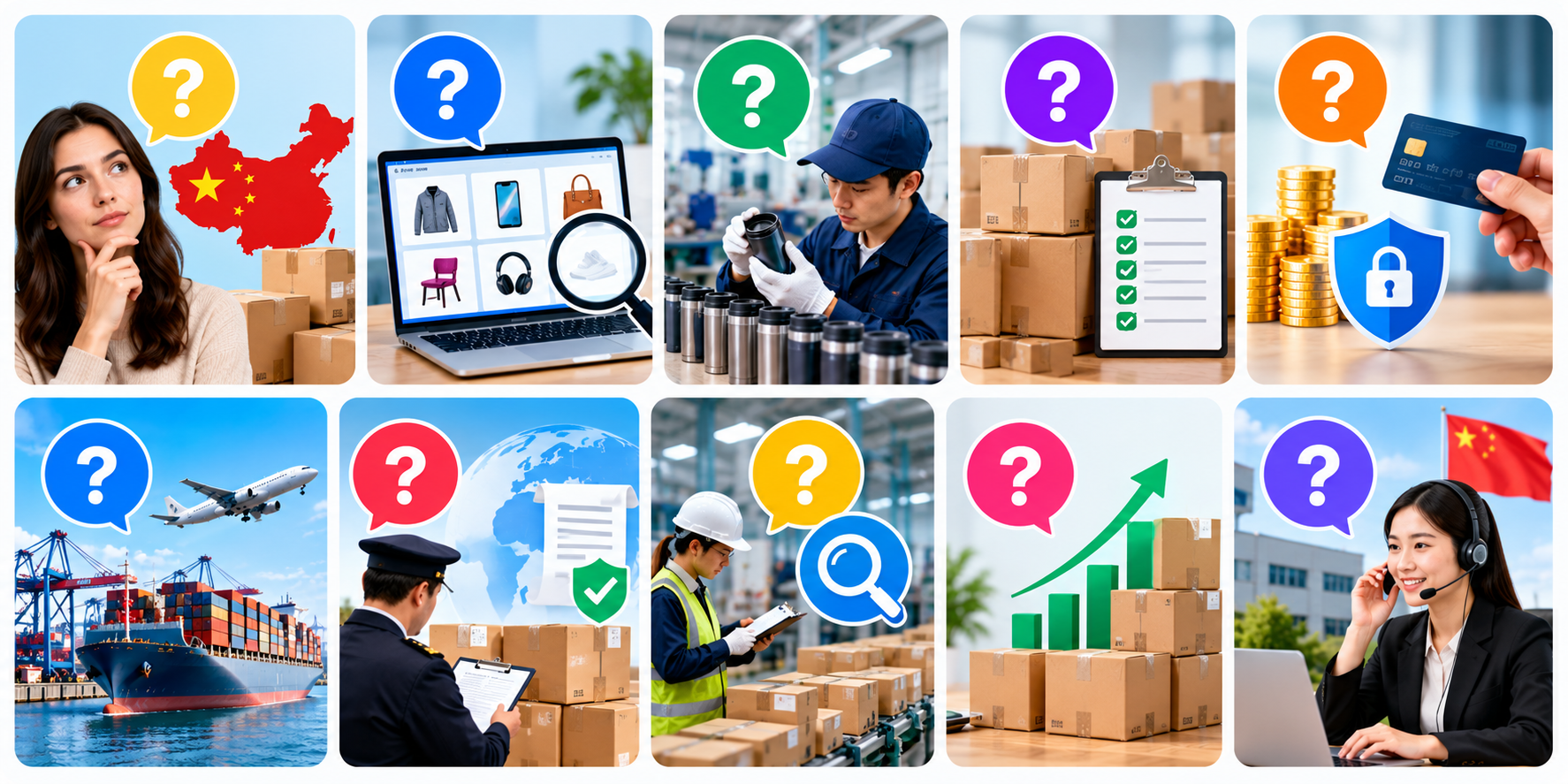
1. How Do Beginners Source Products from China?
Beginners can start by identifying a product, researching suppliers on platforms such as Alibaba.com or Made-in-China.com, comparing quotations, verifying suppliers, and ordering samples.
Before placing a larger order, we recommend calculating landed costs, confirming import requirements, and establishing quality inspection procedures.
2. What Is the Best Website to Source Products from China?
Alibaba.com is a widely used platform for international B2B sourcing. Other useful options include 1688.com, Made-in-China.com, Global Sources, and DHgate.
The appropriate platform depends on product category, order quantity, customization needs, and procurement experience.
3. Can We Buy Directly from Chinese Manufacturers?
Yes. Many Chinese manufacturers sell directly to international businesses.
Direct sourcing can provide access to customization and factory pricing, although minimum order quantities and production requirements may apply.
4. How Much Money Do We Need to Start Sourcing from China?
The required budget depends on the product, MOQ, sample costs, shipping method, inspection requirements, and import charges.
A small test order may require substantially less capital than custom manufacturing involving molds, tooling, or specialized certifications.
We recommend preparing a complete budget before committing to an order.
5. Is It Safe to Source Products from China?
Sourcing from China can be commercially viable and relatively secure when businesses verify suppliers, use appropriate contracts, order samples, inspect products, and follow relevant import regulations.
Risks increase when buyers transfer large payments to unverified suppliers or approve production without clear specifications.
6. How Do We Find Real Factories in China?
We can identify factories through B2B directories, trade exhibitions, industry associations, and sourcing networks.
To verify manufacturing capabilities, request business registration information, production details, factory visits, or independent audits.
7. What Is the Cheapest Way to Ship Products from China?
Sea freight is often cost-effective for large or heavy shipments, but the most economical option depends on shipment volume, weight, route, and destination charges.
For small parcels, courier or consolidated shipping services may be more practical.
8. How Long Does Manufacturing in China Take?
Manufacturing lead times vary according to product complexity, materials, order quantity, production capacity, and customization.
We should request a written production schedule covering material procurement, manufacturing, inspection, and dispatch.
9. Can We Source Products from China Without an Agent?
Yes. Many businesses source directly through online marketplaces and communicate with manufacturers remotely.
However, sourcing agents can help with supplier verification, language barriers, factory coordination, and inspections.
10. Is Alibaba Better Than 1688 for Sourcing?
Alibaba.com generally provides a more internationally oriented sourcing experience, while 1688.com primarily serves China's domestic wholesale market.
1688 may offer attractive supplier options, but overseas buyers can face additional challenges with payments, language, and logistics.
11. What Products Are Good to Source from China?
Potential categories include home accessories, packaging, apparel, stationery, storage products, and promotional merchandise.
Product selection should depend on market demand, competition, compliance obligations, landed costs, and expected margins rather than sourcing price alone.
12. What Is the Difference Between OEM and ODM?
OEM generally involves manufacturing products according to buyer-provided designs or specifications.
ODM typically involves purchasing or modifying products based on a manufacturer's existing designs.
Contractual arrangements determine intellectual property ownership and customization rights.
13. How Can We Avoid Scams When Importing from China?
We recommend verifying the supplier's legal identity, checking payment details, requesting samples, using written agreements, arranging independent inspections, and avoiding unexplained changes to banking instructions.
14. Do We Need an Import License to Buy from China?
Import licensing requirements depend on the destination country and product category.
Some goods can be imported without a product-specific license, while regulated products may require permits, registrations, certifications, or other approvals.
15. Is Sourcing from China Still Profitable in 2027?
Sourcing from China can support profitable businesses when products have sufficient demand and selling prices exceed all relevant costs.
Profitability depends on manufacturing expenses, freight, customs charges, marketing, platform fees, returns, inventory costs, and competition.
Because 2027 is still ahead, we should reassess applicable trade rules, tariffs, and supplier quotations before making purchasing decisions.
Final Thoughts: How to Source Products from China Successfully in 2027
Sourcing products from China offers businesses access to extensive manufacturing capabilities, competitive supplier networks, and opportunities to develop customized merchandise.
However, successful international procurement depends on much more than securing an attractive unit price.
We must evaluate product demand, select qualified suppliers, verify manufacturing capabilities, establish clear contractual terms, implement quality control, and understand the full costs of importing goods.
Our recommended sourcing strategy for 2027 is to start with verified suppliers and small test orders, measure actual landed costs and product quality, and increase purchasing volumes only after demonstrating consistent results.
By combining supplier due diligence, disciplined financial planning, quality assurance, and compliant international logistics, we can build a more dependable and scalable sourcing operation.
Here are some related articles you may find interesting: