Back To Blog
 Plush Toys Wholesale: Top-Selling Styles & Reliable Suppliers from China
The global demand for plush toys wholesale continues to create opportunities for toy retailers, importers, distributors, gift shops, e-commerce businesses, and promotional merchandise companies.
From adorable stuffed animals to customized character plushies, these soft and appealing products attract customers across different age groups and markets.
China remains one of the world's leading manufacturing hubs for wholesale plush toys, offering extensive production capabilities, competitive manufacturing costs, flexible customization, and a wide selection of designs.
Whether we are sourcing traditional teddy bears, trendy kawaii plush toys, or custom promotional stuffed animals, working with experienced plush toy manufacturers in China can help us develop a profitable and sustainable product line.
In this comprehensive guide, we explore the best-selling wholesale plush toy styles, major manufacturing regions in China, supplier selection strategies, customization options, quality standards, pricing considerations, and international shipping methods.
1. Why Source Wholesale Plush Toys from China?
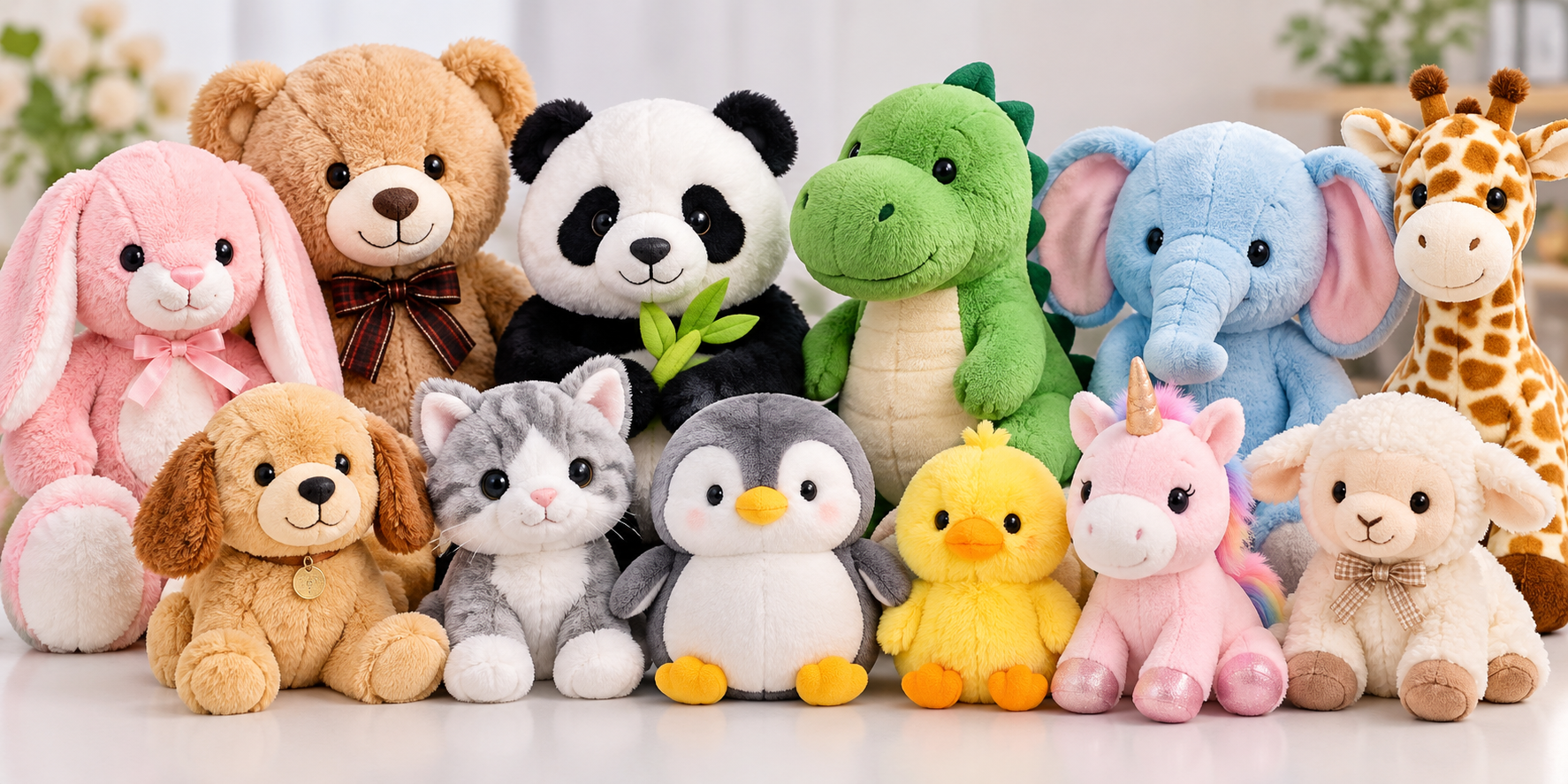
China has established a comprehensive manufacturing ecosystem for stuffed animals and soft toys.
Its production network includes fabric suppliers, embroidery specialists, filling material manufacturers, packaging companies, quality inspection providers, and international logistics services.
By sourcing directly from China plush toy factories, we can benefit from several commercial advantages.
Competitive Wholesale Pricing
Chinese manufacturers can often offer competitive unit prices through large-scale production, specialized manufacturing processes, and established raw material supply chains.
When purchasing plush toys in bulk, we can negotiate pricing based on order quantity, design complexity, material selection, packaging requirements, and production schedules.
However, we should evaluate the total landed cost, rather than focusing exclusively on the quoted factory price.
Extensive Product Selection
China's wholesale plush toy market offers products across numerous categories, including:
-
Classic teddy bears and stuffed animals
-
Kawaii plush toys and cartoon-inspired designs
-
Giant plush toys and oversized stuffed animals
-
Baby plush toys and soft comforters
-
Custom mascot plush toys
-
Promotional stuffed animals
-
Seasonal Christmas and Valentine's Day plush toys
-
Plush keychains and bag charms
-
Interactive and electronic plush toys
-
Eco-friendly stuffed animals made with recycled materials
This extensive selection allows us to serve different customer demographics and retail channels.
OEM and ODM Manufacturing Capabilities
Many Chinese plush toy suppliers provide OEM (Original Equipment Manufacturer) and ODM (Original Design Manufacturer) services.
With OEM production, we can provide our own artwork, patterns, specifications, or product concepts for manufacturing.
With ODM services, we can select existing factory designs and customize certain features, such as colors, embroidery, accessories, labels, and packaging.
Both options allow us to develop differentiated merchandise and establish a recognizable brand identity.
2. Top-Selling Wholesale Plush Toy Styles
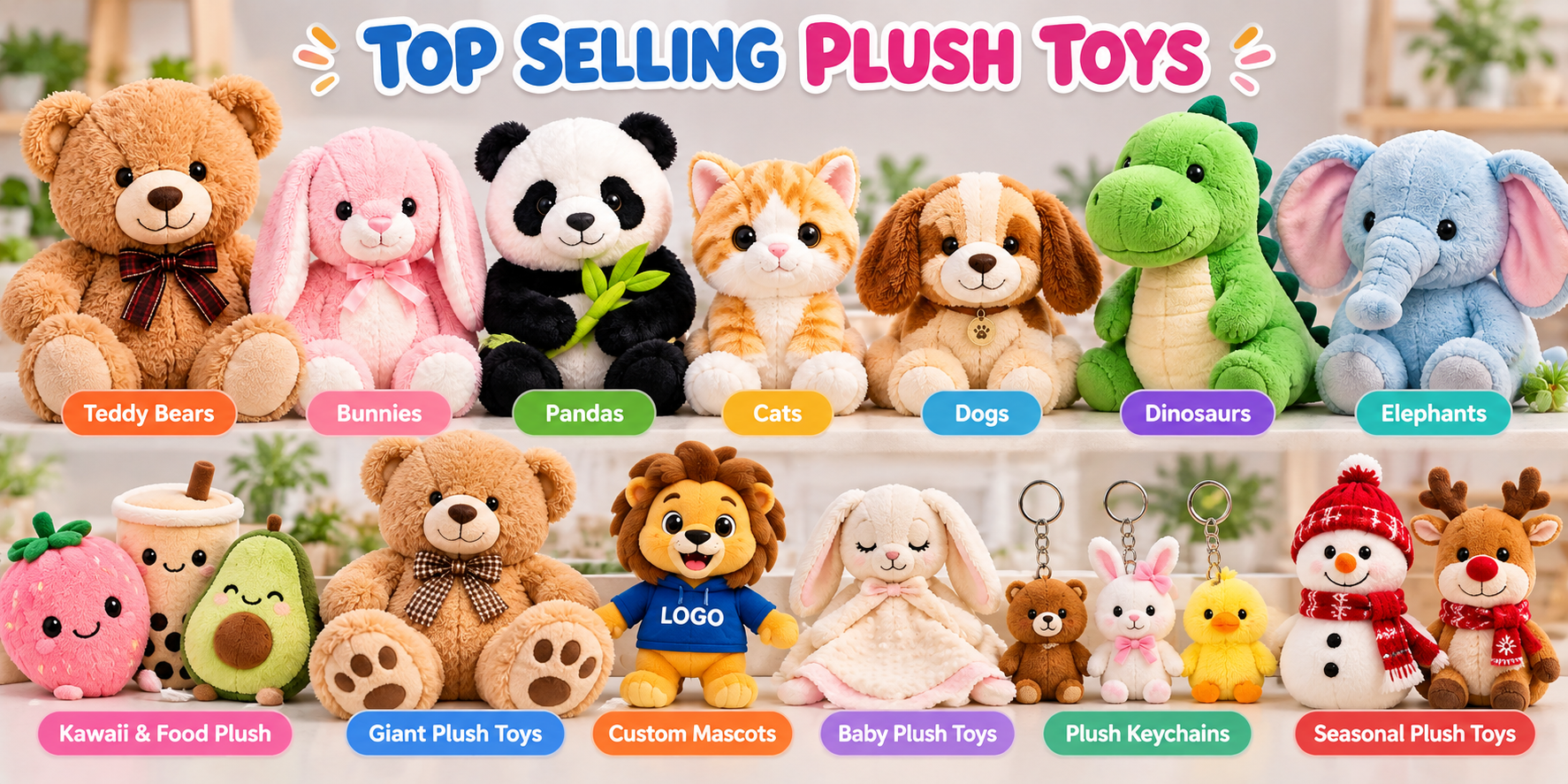
Choosing the right plush toy categories is essential for developing a commercially successful inventory.
Although sales performance varies by country, season, retail channel, and consumer preferences, the following categories are established product segments worth evaluating.
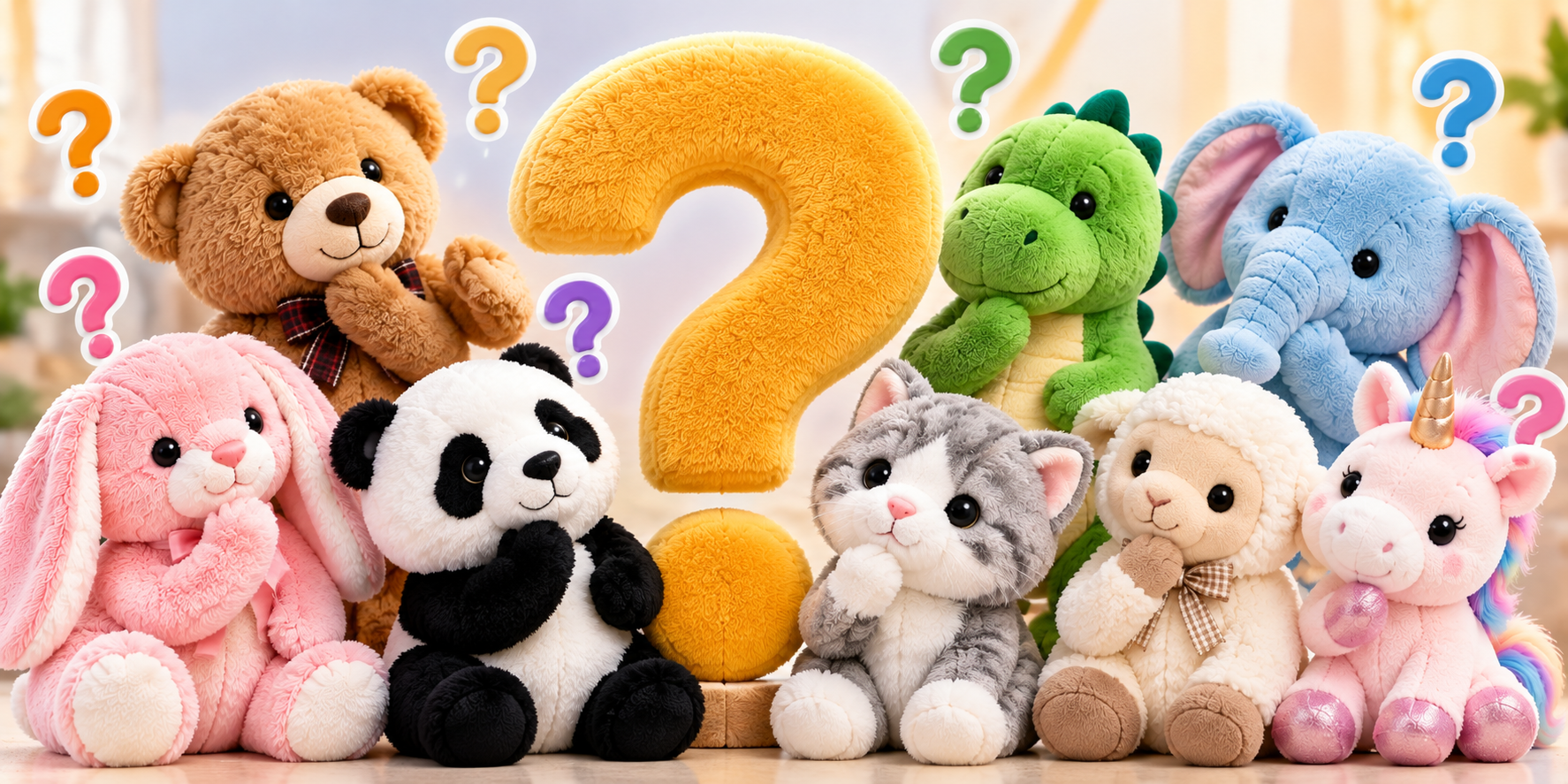
2.1 Classic Teddy Bears Wholesale
Wholesale teddy bears remain a core category in the stuffed animal market.
Their familiar appearance and broad gifting appeal make them suitable for birthdays, Valentine's Day, anniversaries, baby showers, and general retail sales.
Popular design variations include traditional brown teddy bears, pastel-colored bears, teddy bears holding hearts, graduation bears, and personalized teddy bears featuring embroidered names or messages.
For retail distribution, we recommend considering several sizes, such as 15 cm, 25 cm, 40 cm, and 60 cm. Smaller sizes work well for impulse purchases, while larger teddy bears can attract customers seeking premium gifts.
When sourcing teddy bears wholesale, we should evaluate fabric softness, stitching strength, facial symmetry, filling consistency, and packaging efficiency.
2.2 Kawaii Plush Toys Wholesale
Kawaii plush toys feature cute expressions, rounded shapes, soft colors, and simplified character designs.
Common products include smiling strawberries, plush bunnies, cartoon cats, miniature dinosaurs, smiling clouds, and food-shaped stuffed toys.
These designs are especially relevant to gift retailers, novelty shops, lifestyle stores, and online businesses targeting customers interested in cute accessories and decorative collectibles.
We can develop a cohesive kawaii plush collection by maintaining consistent design elements across multiple characters.
For example, a collection of six animal characters with matching facial expressions and coordinated colors can encourage customers to purchase multiple products.
2.3 Giant Plush Toys Wholesale
Oversized stuffed animals create a strong visual impact in retail environments.
Popular giant plush products include teddy bears, rabbits, elephants, dinosaurs, and oversized character cushions.
These products are often purchased as gifts or decorative accessories.
When sourcing giant plush toys wholesale, we should pay particular attention to transportation expenses.
Large stuffed animals occupy substantial shipping volume, which can significantly increase freight costs.
Vacuum compression may reduce shipping volume for suitable designs, but we must test whether the product fully recovers its intended shape and appearance after unpacking.
2.4 Custom Mascot Plush Toys
Custom mascot plush toys are widely used by brands, sports organizations, schools, entertainment companies, and event organizers.
They transform a visual identity or illustrated character into a physical product.
A typical custom plush development process includes artwork evaluation, pattern creation, material selection, prototype production, sample approval, bulk manufacturing, and final inspection.
We should provide manufacturers with detailed character illustrations, dimensions, color references, embroidery specifications, and any necessary branding requirements.
For proprietary characters, it is also important to clarify intellectual property ownership and manufacturing confidentiality.
2.5 Baby Plush Toys and Soft Comforters
Baby plush toys represent a specialized category requiring careful attention to product safety.
Products may include soft animal comforters, simple fabric dolls, sensory plush toys, and age-appropriate stuffed animals.
For toys intended for children under three, we should prioritize designs that avoid detachable small parts, exposed fasteners, loose decorations, and other foreseeable hazards.
Embroidered facial features can be preferable to attached plastic eyes for certain infant-oriented designs, provided the complete product meets applicable safety requirements.
We should also ensure that labeling, age grading, and testing reflect the intended market and actual product characteristics.
2.6 Plush Keychains and Mini Stuffed Animals
Mini plush toys and plush bag charms are attractive for retailers seeking compact products with accessible price points.
Their small size can make them easier to display, store, and ship than larger stuffed animals.
Popular designs include miniature bears, rabbits, cats, fruit characters, and branded mascots.
When developing plush keychains, we should evaluate attachment strength, metal hardware quality, and potential small-part hazards.
These products may also serve as promotional gifts, event merchandise, or accessories for bags and backpacks.
3. Major Plush Toy Manufacturing Regions in China
China's plush toy manufacturing industry is concentrated in several established production and trading regions.
Understanding these locations helps us identify suitable suppliers and evaluate sourcing options.
|
Manufacturing region |
Common sourcing advantages |
Suitable buyers |
|---|---|---|
|
Yangzhou, Jiangsu |
Established stuffed toy manufacturing and supplier networks |
Importers, wholesalers, custom plush buyers |
|
Dongguan, Guangdong |
OEM manufacturing, product development, export services |
Brands and custom merchandise businesses |
|
Shenzhen, Guangdong |
Electronics integration and product development resources |
Buyers of interactive or electronic plush toys |
|
Yiwu, Zhejiang |
Wholesale trading networks and broad merchandise selection |
Small retailers and mixed-product importers |
|
Qingdao, Shandong |
Textile-related manufacturing and export infrastructure |
Buyers seeking additional factory sourcing options |
Yangzhou: An Established Plush Toy Production Center
Yangzhou is well known for its stuffed toy manufacturing industry.
The region has a developed network of plush toy factories, textile suppliers, and supporting businesses.
We can explore Yangzhou suppliers for conventional stuffed animals, custom character plush toys, promotional products, and bulk wholesale orders.
Dongguan: Custom Plush Toy Manufacturing
Dongguan is an important manufacturing center in southern China.
Its wider industrial ecosystem supports custom product development, materials sourcing, packaging, and international trade.
For businesses developing original plush characters, suppliers in Dongguan may offer services covering sampling, production engineering, embroidery, and branded packaging.
Yiwu: Wholesale Plush Toy Trading
Yiwu is especially useful for buyers who want to explore different products and compare multiple suppliers.
Its wholesale trading environment provides access to numerous merchandise categories, including toys and gift products.
However, we should distinguish between manufacturers and trading companies.
A trading company may offer useful sourcing and consolidation services, but it does not necessarily operate its own plush toy factory.
4. How to Find Reliable Plush Toy Suppliers in China
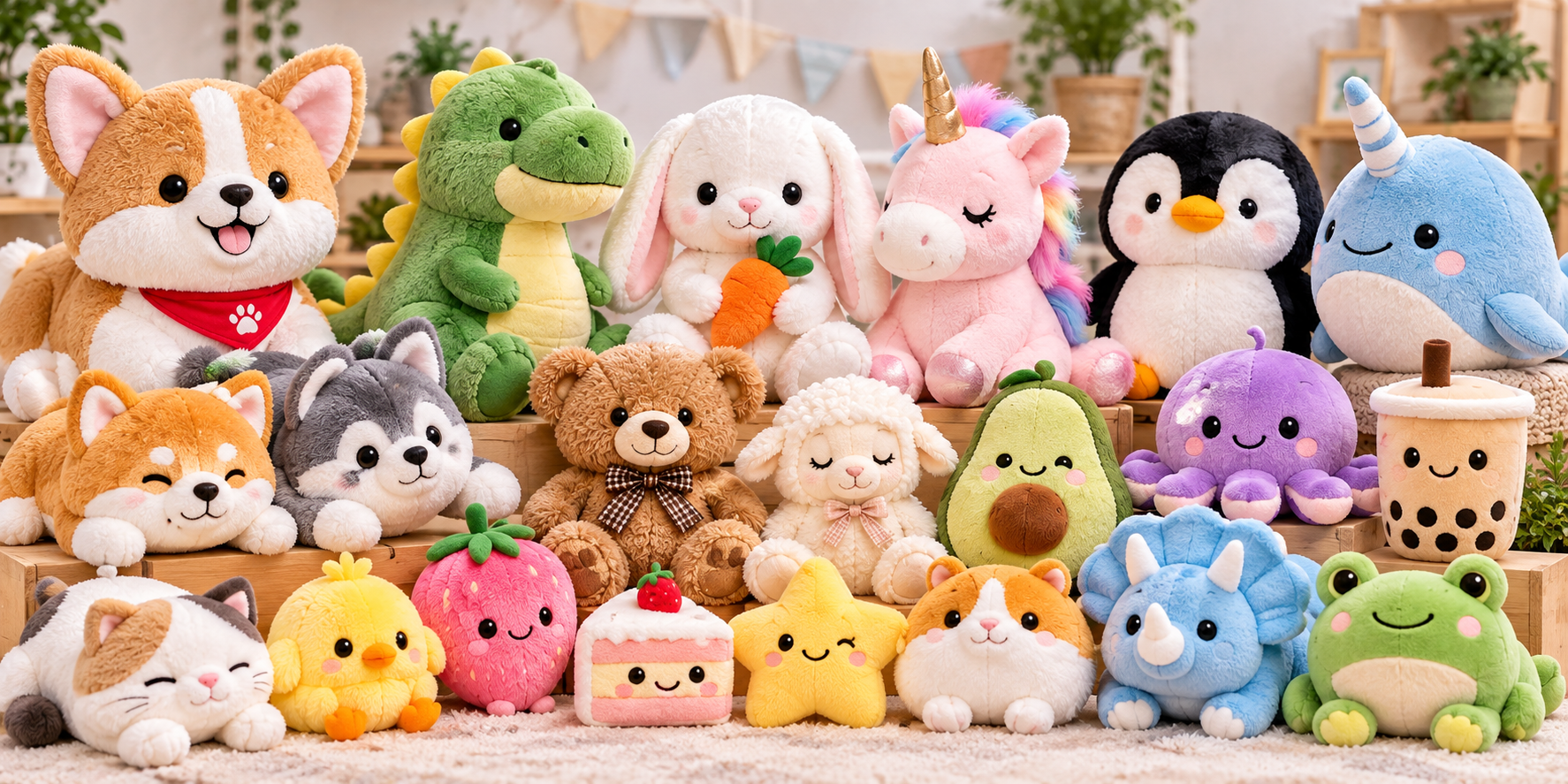
Selecting a dependable manufacturer is one of the most important steps in wholesale sourcing.
A competitive quotation alone does not guarantee consistent product quality, regulatory compliance, or reliable delivery.
We recommend evaluating suppliers through a structured qualification process.
Verify the Supplier's Business Credentials
Before placing a substantial order, we should request the supplier's legal business name, business registration information, factory address, and relevant production details.
Where practical, we can conduct a factory audit or commission an independent inspection.
We should also confirm whether the supplier manufactures products directly or outsources production to another facility.
Evaluate Manufacturing Experience
An experienced stuffed animal manufacturer should be able to explain its production capabilities, common materials, sampling process, and quality control procedures.
Useful questions include:
-
What types of plush toys does the factory specialize in?
-
Can the manufacturer produce original designs?
-
What is the minimum order quantity?
-
How long does prototype development take?
-
What is the estimated bulk production lead time?
-
Which safety standards can the factory support?
-
Can the supplier arrange independent laboratory testing?
-
How are defective products handled?
Clear, detailed responses can help us assess the supplier's operational capabilities.
Request Physical Samples
We should never rely solely on catalog photographs when evaluating a new plush toy supplier.
Physical samples allow us to inspect material texture, embroidery accuracy, seam construction, stuffing density, product dimensions, and overall appearance.
For custom products, we should approve a final pre-production sample before mass manufacturing begins.
That approved sample should become a reference for subsequent quality inspections.
Assess Communication and Reliability
Professional communication is an important indicator of supplier performance.
A reliable manufacturer should provide realistic timelines, clear quotations, documented specifications, and timely updates.
We should be cautious of suppliers who make unsupported certification claims, refuse reasonable verification requests, or repeatedly change commercial terms.
5. Wholesale Plush Toy Pricing and Minimum Order Quantities
The cost of wholesale plush toys depends on several variables.
These include product size, fabric type, pattern complexity, embroidery details, filling materials, order volume, packaging, and testing requirements.
The following figures are illustrative budgeting ranges, not verified current factory quotations.
|
Plush toy category |
Illustrative unit cost (USD) |
Possible MOQ |
|---|---|---|
|
Mini plush keychains |
$0.60–$2.50 |
500–2,000 pieces |
|
Small stuffed animals |
$1.20–$4.00 |
300–1,000 pieces |
|
Medium plush toys |
$2.50–$7.00 |
300–1,000 pieces |
|
Large stuffed animals |
$6.00–$18.00 |
200–500 pieces |
|
Custom mascot plush toys |
$3.00–$12.00 |
300–1,000 pieces |
|
Giant plush toys |
$12.00–$40.00+ |
100–500 pieces |
Actual prices and minimum quantities may fall outside these ranges. We should obtain written quotations based on the exact specifications and quantities required.
Factors That Influence Plush Toy Manufacturing Costs
Fabric selection: Premium plush fabrics, specialty textures, and certified recycled materials may increase costs.
Product dimensions: Larger toys generally require more fabric, stuffing, and transportation space.
Design complexity: Intricate shapes, multiple fabric panels, embroidery, and accessories can increase labor requirements.
Order volume: Larger production runs may distribute setup expenses across more units.
Packaging: Custom printed boxes, hangtags, display packaging, and branded bags add costs.
Compliance: Laboratory testing, product documentation, and required labeling must be included in the sourcing budget.
To protect profitability, we should compare quotations using consistent specifications and delivery terms.
6. Custom Plush Toy Manufacturing: From Design to Bulk Production
Developing custom plush toys allows us to offer distinctive products rather than competing exclusively on price.
A well-managed manufacturing process helps reduce design errors and production delays.
Step 1: Develop the plush toy concept
We prepare illustrations, dimensions, intended age grading, color references, materials, and branding requirements.
Step 2: Create a prototype
The manufacturer develops patterns, cuts fabric, assembles the sample, and adds embroidery or other design features.
Step 3: Review and approve the sample
We evaluate appearance, dimensions, safety, softness, and construction. Necessary revisions are completed before approval.
Step 4: Begin bulk production
The factory sources materials, cuts fabric, completes embroidery, sews components, inserts stuffing, and finishes the products.
Step 5: Inspect, package, and ship
We verify production quality, required testing, labeling, carton specifications, and shipment documentation before dispatch.
For complex custom designs, we should allow sufficient time for sampling and revisions rather than committing to unrealistic launch dates.
7. Plush Toy Safety Standards and Quality Control
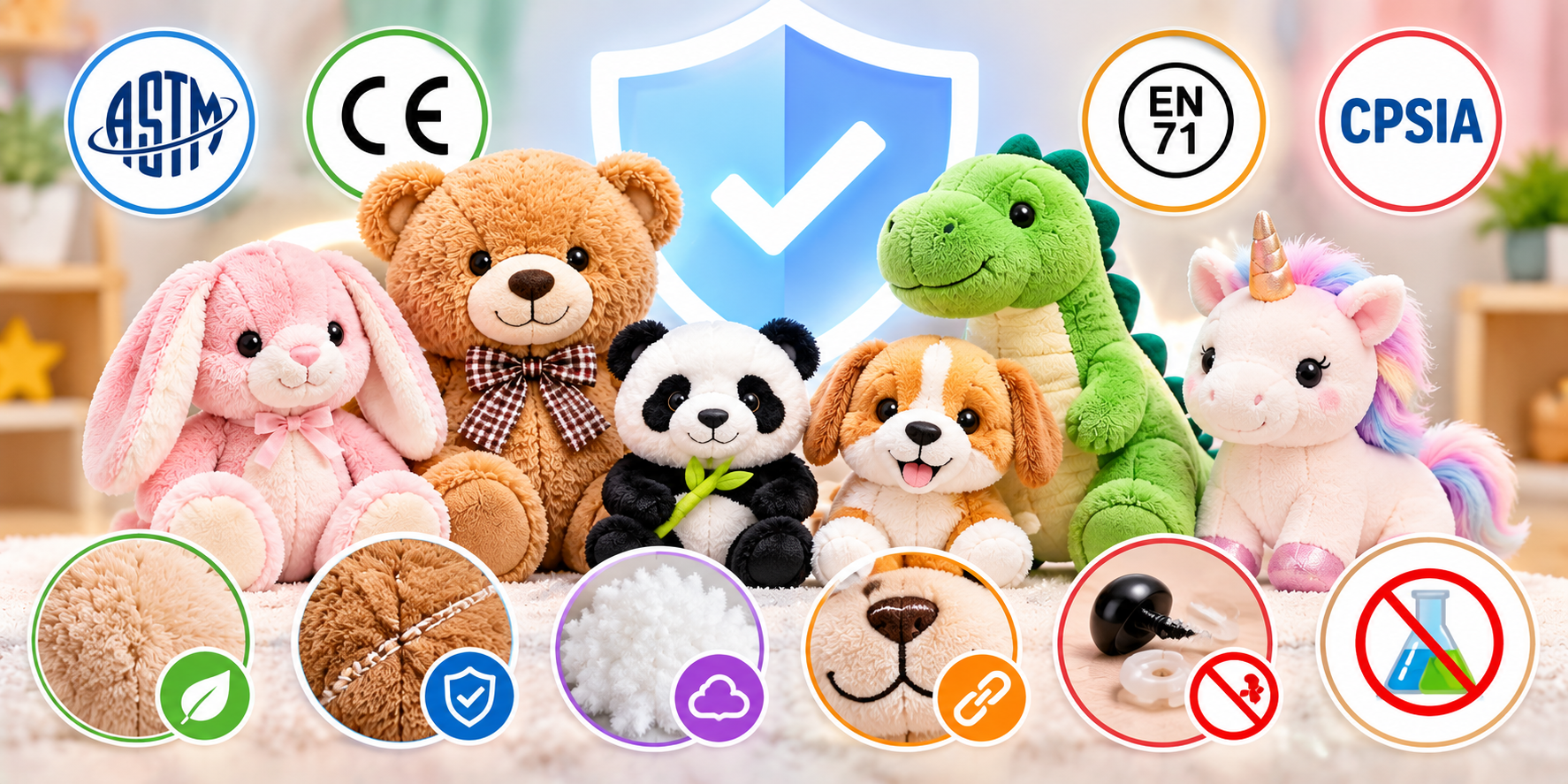
Product safety is essential when importing plush toys for commercial distribution.
Requirements differ by destination market, intended age group, product features, and applicable regulations.
United States: ASTM F963 and CPSIA
For plush toys sold in the United States, we should evaluate applicable requirements under the Consumer Product Safety Improvement Act (CPSIA) and the mandatory toy safety standard, ASTM F963, as incorporated into U.S. regulations.
Depending on the product, requirements may include mechanical safety, flammability, chemical restrictions, third-party testing, tracking labels, and a Children's Product Certificate.
We should verify the applicable requirements and testing scope with a qualified laboratory or compliance specialist.
European Union: EN 71 and CE Marking
For toys entering the European Union, manufacturers and importers must address the applicable EU toy safety requirements.
EN 71 standards cover important aspects of toy safety, including mechanical and physical properties, flammability, and migration of certain elements.
Where applicable, we must ensure appropriate conformity assessment, technical documentation, an EU Declaration of Conformity, and CE marking.
CE marking is a declaration of conformity under applicable EU legislation; it is not, by itself, proof that an independent organization has certified the product.
Quality Inspection Checklist
Before approving shipment, we recommend checking:
-
Seam strength and stitching consistency
-
Stuffing quality and distribution
-
Embroidery and facial feature accuracy
-
Product dimensions and weight
-
Color consistency and fabric condition
-
Loose threads and exposed sharp components
-
Small-part and attachment hazards
-
Packaging integrity
-
Labeling and traceability information
-
Compliance documentation and relevant test reports
For large orders, an independent pre-shipment inspection can provide additional assurance.
8. Eco-Friendly Plush Toys Wholesale
Sustainability is an increasingly relevant consideration for businesses developing long-term product ranges.
Some manufacturers offer plush toys containing recycled polyester fibers, recycled stuffing, or alternative packaging materials.
Recycled polyester plush toys can help reduce reliance on virgin polyester, depending on the materials and manufacturing processes involved.
However, environmental claims should be specific and supported by appropriate documentation.
For example, we should verify the recycled content percentage, applicable chain-of-custody documentation, and whether the claimed certification covers the actual materials or finished product.
We can also explore reduced packaging, recyclable cartons, and more efficient shipping configurations.
An environmentally responsible product strategy should consider material sourcing, manufacturing, durability, transportation, and end-of-life handling rather than relying on broad claims such as "100% eco-friendly."
9. Shipping Wholesale Plush Toys from China
Shipping arrangements can substantially influence the final cost of imported stuffed animals.
Because plush toys are often lightweight but bulky, freight charges may depend heavily on shipment volume.
Sea Freight
Sea freight is generally suitable for larger wholesale orders when delivery schedules allow.
We can consider less-than-container-load (LCL) shipping for smaller shipments or full-container-load (FCL) shipping when order volume justifies dedicated container space.
Air Freight
Air freight can be appropriate for urgent orders, product launches, or relatively small shipments.
However, its cost may be significantly higher than sea freight, particularly for bulky plush toys.
Express Courier
International courier services can be convenient for prototypes, samples, and small commercial shipments.
We should compare delivery speed, dimensional-weight charges, customs handling, and total transportation expenses.
Understanding Shipping Terms
Common Incoterms include EXW, FOB, CIF, and DDP.
These terms allocate specific responsibilities, costs, and risks between buyer and seller.
For example, under FOB, the seller generally delivers the goods on board the vessel at the named port of shipment, while the buyer assumes responsibility for subsequent carriage and associated risks under the agreed terms.
We should clearly specify the applicable Incoterms rule, named location, and version in our purchase contract.
10. How to Build a Profitable Wholesale Plush Toy Business
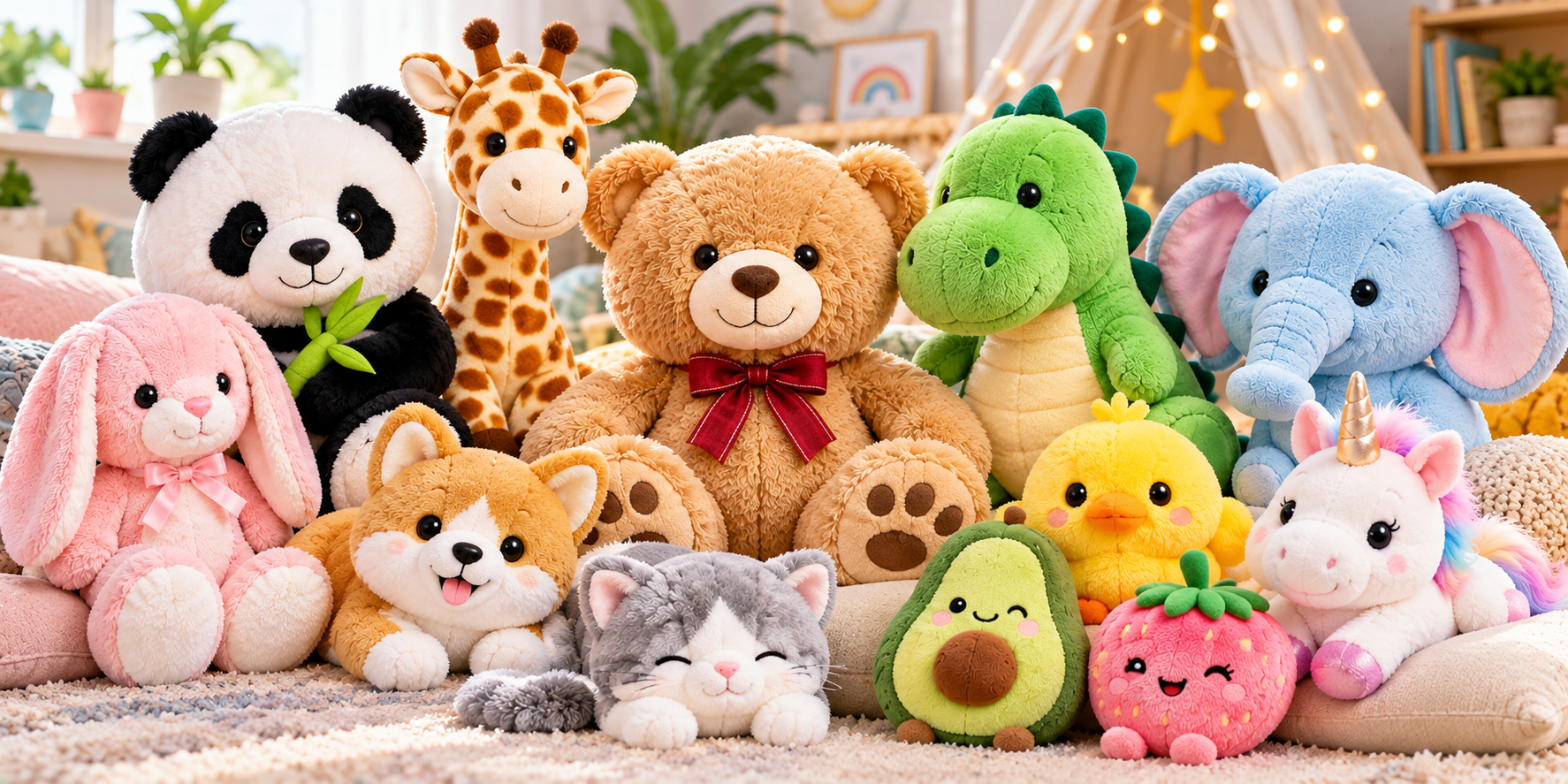
A successful plush toy business requires more than access to low manufacturing prices.
We must combine suitable product selection with careful inventory management, consistent quality, effective branding, and appropriate retail positioning.
Identify a Target Market
We can focus on a specific customer segment, such as children's gift retailers, lifestyle stores, corporate merchandise buyers, collectible plush enthusiasts, or e-commerce shoppers.
A clearly defined market helps us select suitable designs, sizes, price points, and packaging.
Start with a Focused Product Range
Rather than purchasing dozens of unrelated products, we can launch with a coordinated assortment.
For example, a small collection might include several medium-sized animal plush toys, matching mini keychains, and one premium oversized product.
This approach allows us to evaluate customer demand without spreading inventory investment across too many designs.
Calculate the True Product Margin
|
Cost Breakdown |
Cost per Unit (USD) |
|---|---|
|
Factory Purchase Price |
$3.20 |
|
Shipping & Freight |
$0.80 |
|
Import Duties & Taxes |
$0.30 |
|
Packaging & Labeling |
$0.25 |
|
Quality Inspection & Testing |
$0.20 |
|
Warehousing & Fulfillment |
$0.65 |
|
Marketplace & Payment Fees |
$1.00 |
|
Marketing & Advertising |
$0.70 |
|
Returns & Defect Allowance |
$0.20 |
|
Total Product Cost |
$7.30 |
|
Selling Price |
$14.99 |
|
Net Profit per Unit |
$7.69 |
|
Net Profit Margin |
51.3% |
Formula: Net Profit Margin = (Selling Price − Total Product Cost) ÷ Selling Price × 100
Note: This is an illustrative calculation. Actual net profit may be lower after fixed overhead, additional expenses, and unsold inventory are accounted for.
Build Long-Term Supplier Relationships
Consistent relationships with dependable manufacturers can improve communication, sampling efficiency, quality consistency, and production planning.
We should establish written specifications, realistic order forecasts, payment milestones, and documented procedures for resolving quality disputes.
11. Common Mistakes When Buying Plush Toys Wholesale from China
Several avoidable sourcing mistakes can lead to unnecessary expenses and delays.
Choosing suppliers based only on price: The lowest quotation may exclude essential testing, packaging, or quality requirements.
Skipping physical samples: Photographs cannot reliably demonstrate fabric quality, stitching, or stuffing consistency.
Ignoring compliance requirements: Products that fail destination-market requirements may face shipment delays, recalls, or other enforcement action.
Ordering excessive inventory: Large initial orders increase financial exposure before customer demand is validated.
Failing to protect intellectual property: We should confirm our rights to use character designs, logos, and licensed artwork before manufacturing.
Using unclear purchase agreements: Product specifications, inspection criteria, payment terms, shipping responsibilities, and defect remedies should be documented.
Avoiding these mistakes can help us build a more dependable and scalable wholesale operation.
12. Frequently Asked Questions About Plush Toys Wholesale
Where can we buy plush toys wholesale from China?
We can source wholesale plush toys through manufacturers, trading companies, industry exhibitions, and B2B sourcing platforms such as Alibaba and Made-in-China. Yangzhou, Dongguan, and Yiwu are useful locations to explore, depending on the type of product and purchasing model.
What is the minimum order quantity for custom plush toys?
Minimum order quantities vary by manufacturer, product size, design complexity, and materials. Some suppliers may accept several hundred pieces per design, while others require larger production runs. We should confirm whether the MOQ applies per design, color, size, or total order.
Can we manufacture plush toys using our own designs?
Yes. Many Chinese manufacturers provide OEM services for original stuffed animal designs. We typically need to supply illustrations, dimensions, color specifications, and branding requirements before prototype development begins.
How long does plush toy manufacturing take?
Lead times depend on sampling requirements, factory capacity, order quantity, and material availability. Custom prototypes may require several weeks, while bulk manufacturing may take additional weeks after sample approval. Exact schedules should be confirmed in writing.
Are plush toys manufactured in China safe?
Plush toys manufactured in China can meet stringent international safety requirements when they are properly designed, manufactured, tested, and documented. Safety cannot be established from country of origin alone. We should verify product-specific compliance before importation.
Which plush toys are best for wholesale resale?
Classic teddy bears, cute animal plush toys, kawaii characters, mini plush keychains, and custom mascots are useful categories to evaluate. The best commercial choice depends on customer demand, competition, retail pricing, shipping costs, and product differentiation.
Can we add our company logo to wholesale plush toys?
Yes. Depending on the design, manufacturers may offer embroidered logos, woven labels, printed fabric tags, branded hangtags, and custom packaging. We should approve logo placement and artwork during the sampling stage.
Conclusion: Choosing the Right Plush Toys Wholesale Supplier in China
Sourcing plush toys wholesale from China offers substantial opportunities for retailers, distributors, importers, and brands seeking diverse product designs and flexible manufacturing solutions.
From classic teddy bears and kawaii plush toys to custom mascots and promotional stuffed animals, the Chinese manufacturing market provides options for numerous commercial applications.
To build a reliable sourcing strategy, we should prioritize product quality, supplier verification, regulatory compliance, competitive landed costs, and consistent communication.
By carefully evaluating manufacturers, approving production samples, establishing clear quality standards, and selecting products that match customer demand, we can develop a distinctive wholesale plush toy collection and support sustainable business growth.
The foundation of a successful plush toy wholesale business is not simply finding the lowest-priced factory—it is establishing a dependable supply chain that consistently delivers safe, appealing, and commercially viable products.
Here are some related articles you may find interesting: