Back To Blog
 Wholesale Stationery from China: Best Guide to Sourcing Quality Stationery at Competitive Prices
China has become one of the world's leading manufacturing and export centers for stationery products, offering international buyers an extensive selection of wholesale stationery at competitive factory prices.
From everyday office supplies and school essentials to premium notebooks, creative writing instruments, and customized promotional stationery, Chinese manufacturers provide sourcing opportunities for businesses of virtually every size.
Whether we operate a stationery distribution company, an online retail store, a school supply business, or a corporate procurement department, wholesale stationery from China allows us to access diverse product ranges, flexible customization options, and scalable manufacturing capabilities.
However, successful stationery importing requires more than finding inexpensive products.
We must evaluate supplier reliability, product quality, minimum order quantities, international shipping costs, and applicable import regulations.
In this comprehensive guide, we explore how to source stationery from China efficiently, identify suitable manufacturers, negotiate competitive wholesale prices, and establish long-term supplier relationships.
Why Buy Wholesale Stationery from China?
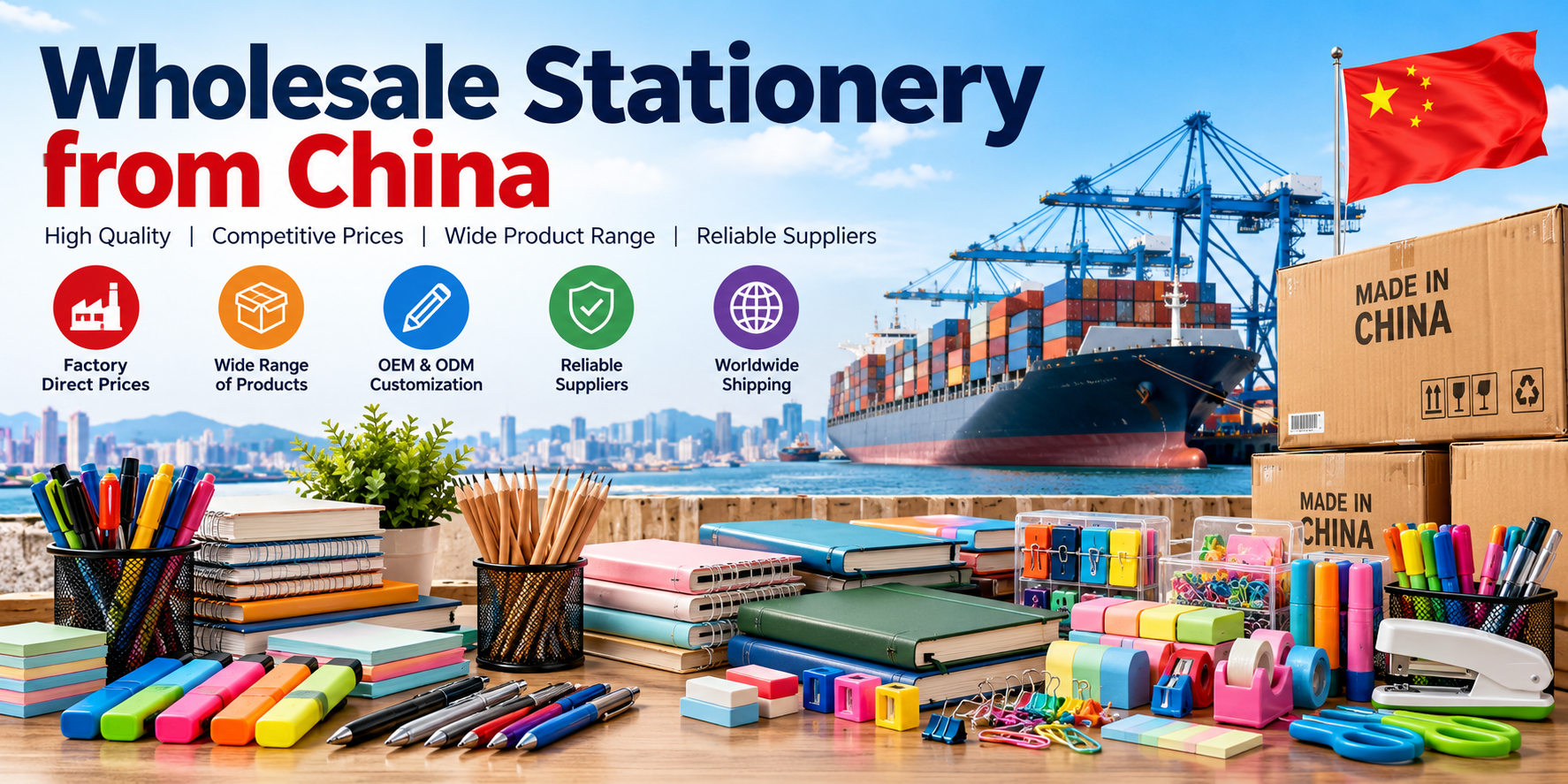
China's stationery manufacturing industry benefits from established production clusters, extensive raw material supply networks, specialized equipment, and experienced exporters.
These advantages make China an attractive sourcing destination for wholesalers, retailers, distributors, and private-label stationery brands.
1. Competitive Wholesale Stationery Prices
One of the primary reasons businesses purchase stationery from China is the potential for substantial cost savings.
Chinese manufacturers often benefit from large-scale production, specialized supply chains, and established manufacturing infrastructure.
When we purchase directly from factories, we may reduce intermediary markups and negotiate pricing based on order quantities, product specifications, and packaging requirements.
For example, ordering thousands of ballpoint pens or exercise books can produce a lower unit price than purchasing smaller quantities through domestic wholesalers.
Nevertheless, we should evaluate the total landed cost, including manufacturing, inspection, transportation, customs duties, taxes, and local delivery.
2. Extensive Selection of Stationery Products
Chinese stationery suppliers manufacture products across numerous categories, including educational stationery, office accessories, art materials, and corporate promotional products.
This diversity enables us to source complementary products from one supplier or consolidate purchases across multiple manufacturers.
3. OEM and ODM Stationery Manufacturing
Many Chinese stationery manufacturers provide OEM (Original Equipment Manufacturer) and ODM (Original Design Manufacturer) services.
Through OEM arrangements, we can commission products based on our specifications, branding, and packaging requirements.
ODM services may allow us to select existing manufacturer-developed designs and customize selected features.
These arrangements are particularly valuable for businesses developing private-label stationery collections.
4. Scalable Production Capacity
Established stationery factories may support both initial trial orders and larger recurring production volumes.
As our sales increase, we can negotiate production schedules, forecast inventory requirements, and develop supply agreements that support business growth.
Popular Wholesale Stationery Products from China
Pens, Pencils, and Writing Instruments
Writing instruments remain essential products for schools, offices, retailers, and promotional merchandise businesses.
Popular options include ballpoint pens, gel pens, fountain pens, mechanical pencils, wooden pencils, markers, and highlighters. We can compare ink performance, writing smoothness, refill compatibility, and barrel durability before purchasing.
Notebooks, Journals, and Paper Products
Chinese paper stationery manufacturers supply exercise books, spiral notebooks, planners, diaries, sticky notes, sketchbooks, and memo pads.
We should evaluate paper GSM, sheet count, binding strength, printing quality, and cover materials. Premium journals may also feature hardcover construction, elastic closures, ribbon bookmarks, and customized printing.
School Stationery Supplies
School stationery represents an important product category for educational distributors and seasonal retailers.
Common products include rulers, erasers, pencil sharpeners, geometry sets, pencil cases, correction tape, glue sticks, and student stationery kits. We can create bundled school supply packages to simplify purchasing for educational institutions.
Office Stationery and Desk Accessories
Office stationery products include staplers, staples, binder clips, paper clips, file folders, document organizers, adhesive tapes, desk trays, and labeling supplies.
These products can support recurring purchasing programs for corporate customers and office supply distributors.
Art and Craft Stationery
China also manufactures colored pencils, watercolor paints, acrylic paints, brushes, drawing markers, sketchpads, and craft accessories.
When importing products intended for children, we must pay particular attention to applicable chemical, labeling, and product safety requirements.
Best Places to Source Wholesale Stationery in China

Several Chinese cities and manufacturing regions are particularly relevant to stationery procurement.
Yiwu: Wholesale Stationery and Small Commodities
Yiwu, located in Zhejiang Province, is internationally recognized for its extensive wholesale trading markets.
The Yiwu International Trade Market provides access to a broad selection of stationery products, school supplies, office accessories, and promotional merchandise.
For importers seeking mixed-product orders, Yiwu can be particularly useful because traders and sourcing agents may help consolidate purchases from multiple manufacturers.
We can use Yiwu to compare product styles, inspect samples, and identify suppliers offering different price and quality levels.
Ningbo: Established Stationery Manufacturing
Ningbo is an important manufacturing and export center with suppliers specializing in writing instruments, office products, and other stationery categories.
The region also benefits from established port infrastructure, making it attractive for international shipments.
We can explore Ningbo-based suppliers when sourcing writing instruments, office supplies, and customized stationery products.
Wenzhou: Writing Instruments and Related Products
Wenzhou and surrounding manufacturing areas include producers of pens, markers, and related writing supplies.
For buyers focusing on specific writing instrument categories, manufacturers in this region may offer specialized production capabilities.
Guangdong: Customized and Premium Stationery
Guangdong Province offers manufacturing resources for packaging, printing, promotional products, and selected stationery categories.
Suppliers in Shenzhen, Guangzhou, and nearby industrial areas may be suitable for customized stationery sets, branded notebooks, and gift packaging.
When selecting a sourcing location, we should prioritize the manufacturer's actual capabilities rather than relying exclusively on its city or province.
How to Find Reliable Wholesale Stationery Suppliers in China
Selecting a trustworthy supplier is one of the most important stages of international stationery procurement.
We should evaluate manufacturing capabilities, business legitimacy, product consistency, communication, and export experience before placing a significant order.
1. Search Established B2B Sourcing Platforms
Several established B2B sourcing platforms and wholesale sourcing services connect international buyers with Chinese stationery suppliers. These platforms help us discover manufacturers, compare wholesale prices, explore product catalogs, and identify suitable sourcing partners.
|
Platform |
Primary Sourcing Advantage |
|---|---|
|
Yiwu-based sourcing platform offering creative stationery, school supplies, trendy products, flexible order quantities, and customization support. |
|
|
Extensive network of Chinese manufacturers and wholesalers offering bulk stationery and OEM products. |
|
|
Manufacturer discovery, product specifications, and direct supplier inquiries. |
|
|
Export-oriented suppliers and international B2B sourcing opportunities. |
|
|
Chinese domestic wholesale marketplace with factory listings and competitive bulk purchasing options. |
Why Consider EJET Spark for Wholesale Stationery from China?
EJET Spark is a China-based product sourcing and wholesale platform headquartered in Yiwu, Zhejiang Province. It helps international retailers, importers, distributors, and e-commerce businesses discover products through curated collections and an established supplier network.
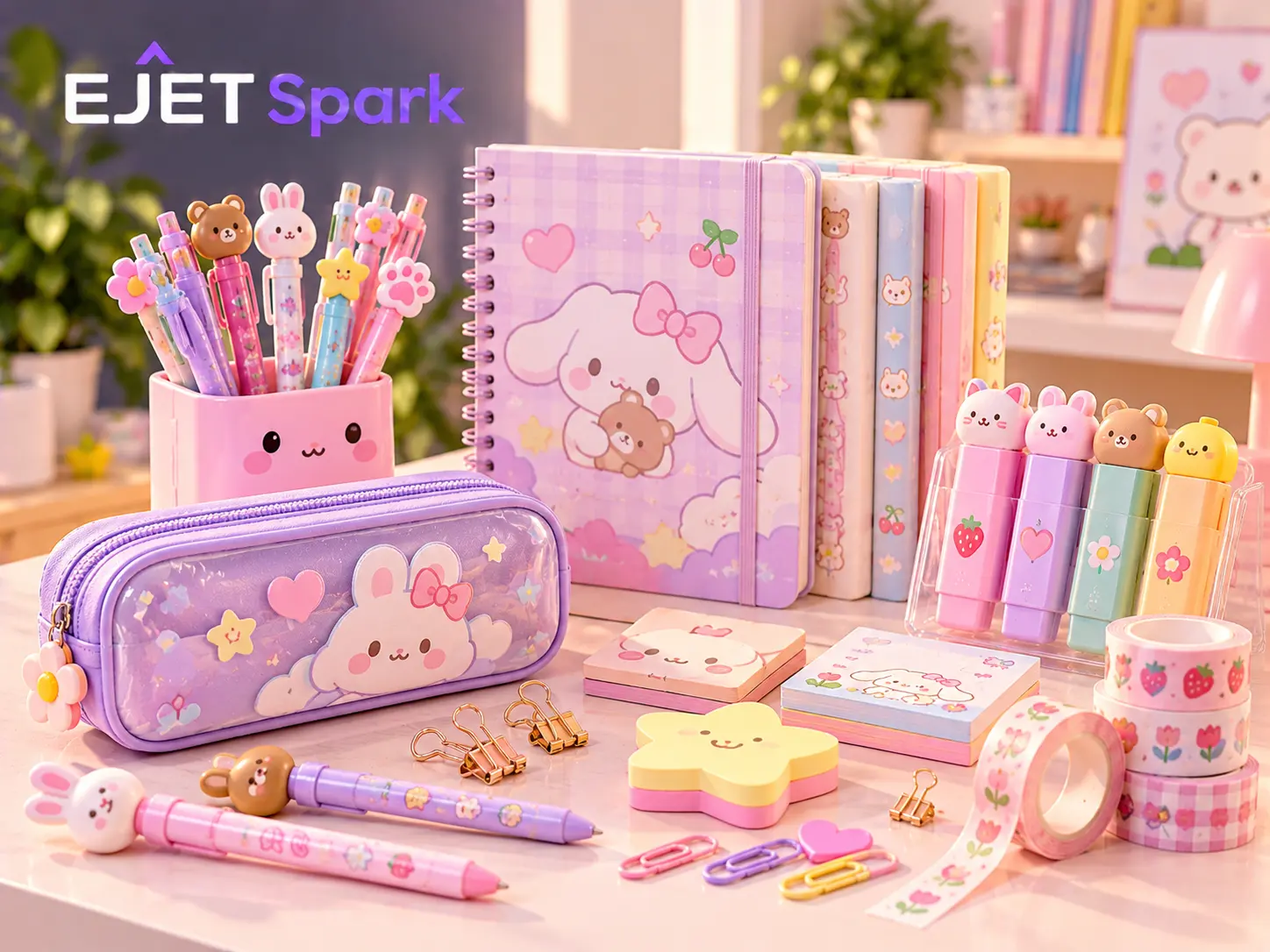
For businesses looking to buy wholesale stationery from China, EJET Spark offers access to creative stationery products, including notebooks, journals, pens, planners, stickers, school supplies, and desk accessories.
Its sourcing services include flexible minimum order quantities, mixed-category purchasing, private-label customization, product sampling, and international supply chain support. Buyers can also explore products through its online catalog or Yiwu showroom.
By comparing EJET Spark, Alibaba, Made-in-China, Global Sources, and 1688, we can identify sourcing options that best match our product requirements, order volumes, customization needs, and target markets.
Regardless of the platform selected, we should verify supplier credentials, request samples, compare quotations, and confirm product quality before placing large wholesale stationery orders.
2. Verify Supplier Credentials
Before proceeding with an order, we should request relevant company documentation and confirm that the supplier can legally conduct the proposed transaction.
Important checks include business registration information, factory or trading-company status, export capabilities, and product-specific compliance documentation.
For substantial orders, an independent factory audit may provide additional assurance.
3. Request Product Samples
Product samples allow us to examine the quality of stationery before committing to mass production.
For pens, we should test ink consistency, drying time, leakage resistance, and writing performance.
For notebooks, we should examine paper opacity, binding strength, page alignment, and cover durability.
For plastic stationery accessories, we should assess material quality, surface finishing, sharp edges, and functional performance.
An approved sample should serve as a reference for production and inspection.
4. Evaluate Communication and Responsiveness
Reliable communication is essential when sourcing internationally.
We should favor suppliers who respond clearly to technical questions, provide complete quotations, disclose production timelines, and communicate potential delays promptly.
Suppliers who consistently avoid documentation requests or provide contradictory information require additional scrutiny.
Understanding Wholesale Stationery Prices in China
Wholesale stationery prices vary according to product specifications, manufacturing processes, order quantities, packaging, customization, and market conditions.
The following figures are illustrative budgeting ranges, not verified current supplier quotations.
|
Stationery product |
Illustrative unit price (USD) |
|---|---|
|
Basic ballpoint pen |
$0.05–$0.30 |
|
Gel pen |
$0.10–$0.60 |
|
Wooden pencil |
$0.03–$0.20 |
|
Basic exercise notebook |
$0.20–$1.20 |
|
Plastic ruler |
$0.05–$0.30 |
|
Standard eraser |
$0.03–$0.20 |
|
Simple pencil case |
$0.30–$2.00 |
|
Basic highlighter |
$0.15–$0.70 |
Actual quotations may fall outside these ranges, especially for premium products, specialized materials, branded packaging, or small production runs.
Factors Affecting Wholesale Prices
Order quantity: Larger orders may reduce per-unit production costs by spreading setup expenses across more units.
Material quality: Higher-grade paper, durable plastics, premium inks, and specialized components can increase manufacturing expenses.
Customization: Custom molds, logo printing, unique colors, and specialized packaging may involve additional setup charges.
Packaging: Individual retail boxes, display cartons, and protective packaging affect total product costs.
Production schedule: Urgent orders may involve higher labor or logistics expenses.
We should compare suppliers using identical specifications and trade terms to obtain meaningful price comparisons.
Minimum Order Quantities for Wholesale Stationery
Minimum order quantity, commonly called MOQ, refers to the smallest quantity a supplier is willing to manufacture or sell under specified conditions.
MOQs vary significantly among manufacturers and product categories.
Some suppliers may offer ready-made products in relatively small quantities, while customized stationery may require thousands of units per design or color.
We can sometimes negotiate lower MOQs by selecting existing materials, standard colors, or established packaging formats.
For businesses entering a new market, smaller trial orders can reduce inventory risk and help validate consumer demand.
However, low-volume purchases may result in higher unit prices.
We should balance inventory exposure against manufacturing economics rather than automatically choosing the lowest possible MOQ.
How to Import Wholesale Stationery from China
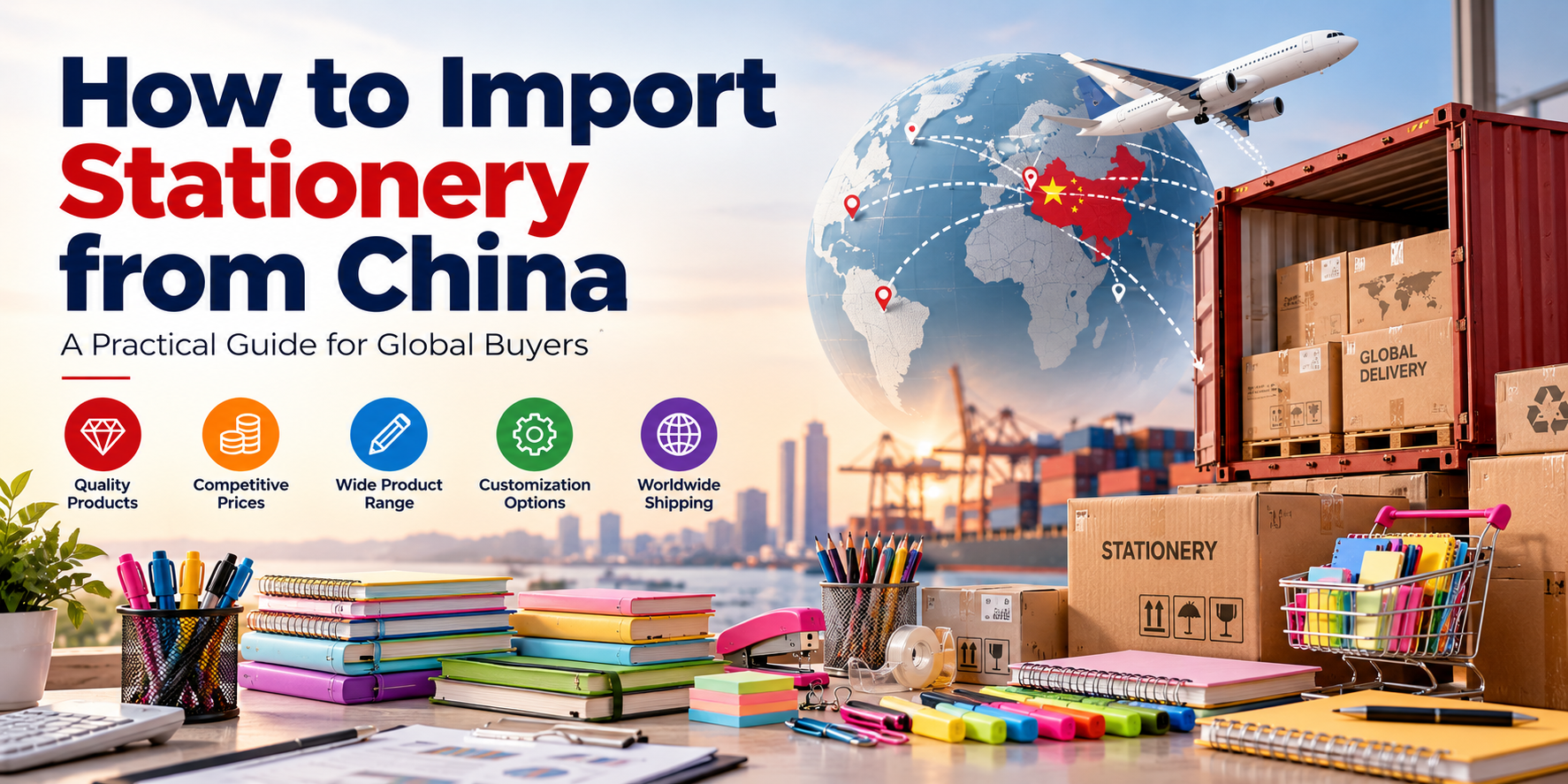
Importing stationery involves several coordinated stages, from product selection to final customs clearance.
Step 1: Define Product Specifications
We should create a detailed purchasing specification for each stationery item.
This document may include dimensions, materials, colors, functional requirements, packaging, labeling, acceptable tolerances, and relevant testing standards.
Clear specifications reduce misunderstandings and provide measurable criteria for quality inspection.
Step 2: Obtain Comparable Supplier Quotations
A comprehensive quotation should identify the product description, quantity, unit price, tooling charges, packaging expenses, production lead time, payment terms, and applicable Incoterms.
We should confirm whether quoted prices include export packaging, inland transportation, and export customs procedures.
Step 3: Negotiate Payment Terms
Common international payment arrangements include bank transfers and documentary letters of credit.
Some suppliers request a deposit before production and the remaining balance before shipment, although the precise arrangement depends on the supplier, order size, and commercial relationship.
We should avoid assuming that any particular payment schedule is standard or risk-free.
For new suppliers, secure payment mechanisms and independent verification can reduce exposure.
Step 4: Arrange Quality Inspection
Before shipment, we should inspect products against approved samples and written specifications.
A third-party inspection company can assess quantities, workmanship, packaging, labeling, and selected functional requirements.
Inspection sampling should be agreed upon in advance, including defect classifications and acceptance criteria.
Step 5: Select an International Shipping Method
The most appropriate shipping method depends on shipment volume, product value, delivery urgency, and destination.
|
Shipping method |
Best suited for |
Main consideration |
|---|---|---|
|
Express courier |
Samples and small urgent shipments |
Higher cost per kilogram |
|
Air freight |
Time-sensitive commercial shipments |
Faster transit, higher freight expense |
|
Sea freight (LCL) |
Smaller consolidated cargo |
Shared container space and handling charges |
|
Sea freight (FCL) |
Larger commercial shipments |
Full-container economics and capacity |
We should compare complete door-to-door logistics quotations rather than freight rates alone.
Step 6: Prepare Customs Documentation
Depending on the destination and transaction, import documentation may include a commercial invoice, packing list, bill of lading or air waybill, customs declaration, and applicable product compliance records.
Correct tariff classification is essential because stationery products can fall under different Harmonized System categories.
Pens, notebooks, paper products, and plastic office accessories may have different classifications and duty treatments.
We should confirm current requirements with the destination customs authority or a qualified customs broker.
OEM and Private Label Stationery from China
Private-label stationery offers opportunities to develop a recognizable brand rather than competing exclusively on price.
We can create branded collections featuring coordinated colors, distinctive packaging, and consistent product specifications.
Custom Logo Stationery
Common branding methods include pad printing, screen printing, heat transfer, embossing, debossing, and laser marking, depending on the material and product design.
For example, we can customize pen barrels, notebook covers, pencil cases, and stationery gift boxes.
Before approving production, we should review artwork placement, print durability, color matching, and packaging proofs.
Custom Stationery Sets
Coordinated stationery sets can be designed for students, professionals, corporate events, or retail gifting.
A typical set might combine a notebook, matching pen, sticky notes, and pencil case in branded packaging.
Bundling can simplify purchasing for customers and create opportunities for differentiated product positioning.
Sustainable Stationery Collections
Environmentally conscious stationery may include recycled paper, refillable writing instruments, reduced-plastic packaging, and materials sourced through documented responsible supply chains.
We should verify environmental claims through appropriate documentation rather than relying solely on supplier marketing descriptions.
Claims such as recycled content, biodegradability, or certified sourcing must be accurate and suitable for the destination market.
Quality Control Standards for Chinese Stationery Products
Quality control should begin before manufacturing rather than only when the finished goods are ready to ship.
We can establish a structured process that includes sample approval, production specifications, in-process checks, and final inspections.
Writing Instrument Quality
For pens and markers, we should evaluate ink flow, writing consistency, cap retention, leakage, refill performance, and shelf-life requirements where applicable.
Paper Product Quality
For notebooks and journals, important factors include paper weight, print alignment, binding durability, page count, and surface finish.
Safety and Regulatory Compliance
Products marketed to children may be subject to specific toy or children's product regulations, depending on their design, intended use, age grading, and destination market.
For example, relevant requirements may include applicable provisions of the US Consumer Product Safety Improvement Act, ASTM F963, EU toy safety legislation, or chemical restrictions under REACH.
Not every stationery product is legally classified as a toy, and compliance requirements must be determined product by product.
We should request appropriate test reports from qualified laboratories and confirm that reports correspond to the actual materials and finished products being purchased.
How to Calculate the Total Landed Cost of Stationery Imports
The factory price represents only one component of the final cost of imported stationery.
To determine commercial viability, we should calculate the complete landed cost.
A practical formula is:
Total landed cost = Product cost + Packaging + Inland transport + Export charges + International freight + Insurance + Import duties + Non-recoverable taxes + Customs clearance + Destination delivery
For illustration, consider an order of 20,000 pens.
|
Cost component |
Example amount |
|---|---|
|
Product cost: 20,000 × $0.12 |
$2,400 |
|
Packaging |
$180 |
|
Freight and insurance |
$520 |
|
Customs and clearance |
$240 |
|
Local delivery |
$160 |
|
Total landed cost |
$3,500 |
The estimated landed cost per pen would be:
$3,500 ÷ 20,000 = $0.175 per pen
This example is hypothetical and assumes all relevant costs have been captured. Recoverable import taxes should be treated appropriately in financial calculations.
By calculating landed costs, we can set sustainable wholesale prices and evaluate expected profit margins more accurately.
Common Mistakes to Avoid When Buying Wholesale Stationery from China
Choosing Suppliers Based Only on Price
The lowest quotation may not represent the best commercial value.
Poor-quality materials, inconsistent manufacturing, or inadequate packaging can lead to returns, damaged goods, and customer dissatisfaction.
We should assess quality, delivery reliability, compliance, and total costs alongside price.
Failing to Confirm Product Specifications
Vague descriptions such as "premium notebook" or "high-quality pen" are insufficient for manufacturing contracts.
We should specify measurable requirements, including dimensions, materials, tolerances, and performance expectations.
Skipping Pre-Shipment Inspections
Without an inspection, we may discover quality problems only after the goods arrive.
Correcting defects after international delivery can be considerably more expensive than identifying them before shipment.
Ignoring Intellectual Property Rights
We should avoid purchasing stationery featuring unauthorized logos, copyrighted characters, or protected designs.
When developing private-label products, we should also clarify ownership of artwork, molds, packaging designs, and other intellectual property.
Underestimating Seasonal Demand
School stationery demand often rises around academic purchasing periods, although school calendars vary by country.
We should plan procurement around the destination market's sales cycles and allow sufficient time for manufacturing, shipping, and customs clearance.
Strategies to Build a Profitable Wholesale Stationery Business
Successful stationery importing depends on disciplined purchasing and a clear understanding of customer demand.
We can improve business performance by focusing on products with repeat purchasing potential, maintaining consistent quality, and developing reliable distribution channels.
Build a Balanced Product Portfolio
A diversified stationery catalog can include high-volume essentials alongside higher-margin specialty products.
Basic pens, pencils, notebooks, and office supplies may generate recurring demand, while premium journals, gift sets, and customized stationery can provide differentiation.
Develop Long-Term Supplier Relationships
Consistent purchasing and transparent communication can strengthen supplier cooperation.
As our order volumes become more predictable, we may be able to negotiate improved pricing, production scheduling, packaging arrangements, and quality assurance processes.
Use Inventory Forecasting
We should monitor sales velocity, reorder points, supplier lead times, and seasonal demand.
Accurate forecasting helps reduce stockouts while limiting excess inventory.
Differentiate Through Packaging and Branding
Attractive packaging, clear product positioning, and consistent branding can increase perceived value.
For private-label stationery, a cohesive product collection may be more compelling than a disconnected assortment of generic items.
Diversify Supplier Risk
Depending entirely on one manufacturer can expose our business to production interruptions or unexpected capacity constraints.
Where commercially practical, we should qualify alternative suppliers for important product categories.
Frequently Asked Questions About Wholesale Stationery from China

Where can we buy wholesale stationery from China?
We can source wholesale stationery through Alibaba.com, Made-in-China.com, Global Sources, 1688.com, sourcing agents, trade fairs, and direct manufacturer relationships.
Yiwu and Ningbo are particularly relevant locations for exploring stationery sourcing opportunities.
Is stationery cheap in China?
China offers competitively priced stationery across many product categories, particularly for larger manufacturing orders.
However, actual savings depend on product specifications, order volume, shipping costs, duties, and quality requirements.
Can we buy stationery directly from Chinese factories?
Yes. Many manufacturers accept direct orders from international businesses.
We should confirm whether the supplier operates its own production facilities or functions as a trading company.
Both business models can be viable, but their capabilities and pricing structures may differ.
Can Chinese stationery manufacturers print our company logo?
Many suppliers offer custom logo printing, packaging design, and private-label manufacturing.
Customization options depend on the product, printing method, order quantity, and production capabilities.
What is the minimum order quantity for stationery from China?
There is no universal MOQ.
Ready-made stationery may be available in relatively small wholesale quantities, while customized products may require significantly larger orders.
We should request an MOQ for each product, color, design, and packaging variation.
How long does it take to import stationery from China?
Delivery time depends on manufacturing lead time, inspection, shipping method, customs processing, and destination.
Air freight is generally faster than ocean freight, while custom manufacturing may add several weeks or longer before dispatch.
We should request a complete production-to-delivery timeline from the supplier and logistics provider.
Is it profitable to import stationery from China?
Stationery importing can be profitable when we maintain competitive landed costs, control inventory, deliver consistent product quality, and establish reliable sales channels.
Profitability depends on actual selling prices, overhead expenses, distribution costs, returns, and market demand.
What documents are needed to import stationery from China?
Typical documents may include commercial invoices, packing lists, transport documents, customs declarations, and applicable product safety records.
Requirements vary according to the product and importing country.
How can we avoid unreliable stationery suppliers?
We should verify business credentials, request samples, confirm specifications, use appropriate payment protections, and conduct inspections before shipment.
For substantial purchasing commitments, independent factory audits and documented contracts can provide additional protection.
Conclusion: Building a Successful Stationery Supply Chain from China
Wholesale stationery from China offers substantial opportunities for businesses seeking diverse product selections, competitive manufacturing costs, customized branding, and scalable international sourcing.
From affordable school stationery and everyday office essentials to premium notebooks and personalized corporate gift sets, Chinese manufacturers support a wide range of commercial requirements.
To build a sustainable sourcing operation, we should prioritize verified stationery suppliers, detailed product specifications, consistent quality control, transparent pricing, and reliable international logistics.
By combining careful supplier selection with accurate landed-cost calculations and effective inventory management, we can develop a stationery product portfolio that supports customer satisfaction, repeat purchasing, and long-term business growth.
The strongest wholesale stationery sourcing strategy is not simply to purchase at the lowest factory price. It is to establish a dependable supply chain that consistently delivers the right products, at the right quality, with predictable costs and delivery performance.
Here are some related articles you may find interesting: