Back To Blog
Alibaba and AliExpress are related, but they are built for different buying situations. AliExpress is usually the simpler choice for individual shoppers, sample orders, and small quantities, while Alibaba.com is designed for business sourcing, wholesale buying, supplier negotiation, and custom manufacturing.
This comparison explains alibaba vs aliexpress by purchase size, pricing model, shipping, buyer protection, product quality checks, and the best use cases for each platform.
Are Alibaba and AliExpress the same?
No. If you are asking “is alibaba and aliexpress the same,” the practical answer is that both sit within the wider Alibaba ecosystem, but they are not the same shopping experience.
Alibaba Group describes Alibaba.com as a global business-to-business ecommerce platform, while AliExpress is a global retail ecommerce platform where consumers can buy directly from manufacturers around the world.
That difference matters because the platforms solve different problems. AliExpress feels more like a normal online marketplace: search, compare, read AliExpress reviews, pay, and wait for delivery.
Alibaba.com is closer to a sourcing platform: you contact Alibaba suppliers, discuss quantities, confirm specs, request samples, negotiate terms, and place larger orders through a more business-focused process.
Quick decision summary
Choose AliExpress if you want one item, a small test order, no supplier negotiation, and a familiar retail checkout. Choose Alibaba.com if you want wholesale pricing discussions, private-label possibilities, bulk inventory, business purchasing workflows, or direct conversations with manufacturers and distributors.
|
Decision factor |
AliExpress |
Alibaba.com |
|---|---|---|
|
Best for |
Individual shoppers, small orders, product testing |
Businesses, resellers, importers, bulk buyers |
|
Buying model |
Retail marketplace |
B2B sourcing and wholesale marketplace |
|
Typical order size |
Single items or small quantities |
Bulk orders, samples, negotiated quantities |
|
Pricing style |
Listed product price |
Often negotiated with supplier |
|
Customization |
Limited |
Often possible, depending on supplier |
|
Supplier contact |
Usually minimal |
Central to the buying process |
|
Shipping setup |
Shown at checkout by listing |
Often discussed by order, supplier, and freight option |
|
Learning curve |
Lower |
Higher |
|
Best risk control |
Product reviews, seller ratings, order protection |
Supplier verification, samples, written specs, Trade Assurance |
The core difference is retail buying versus wholesale sourcing
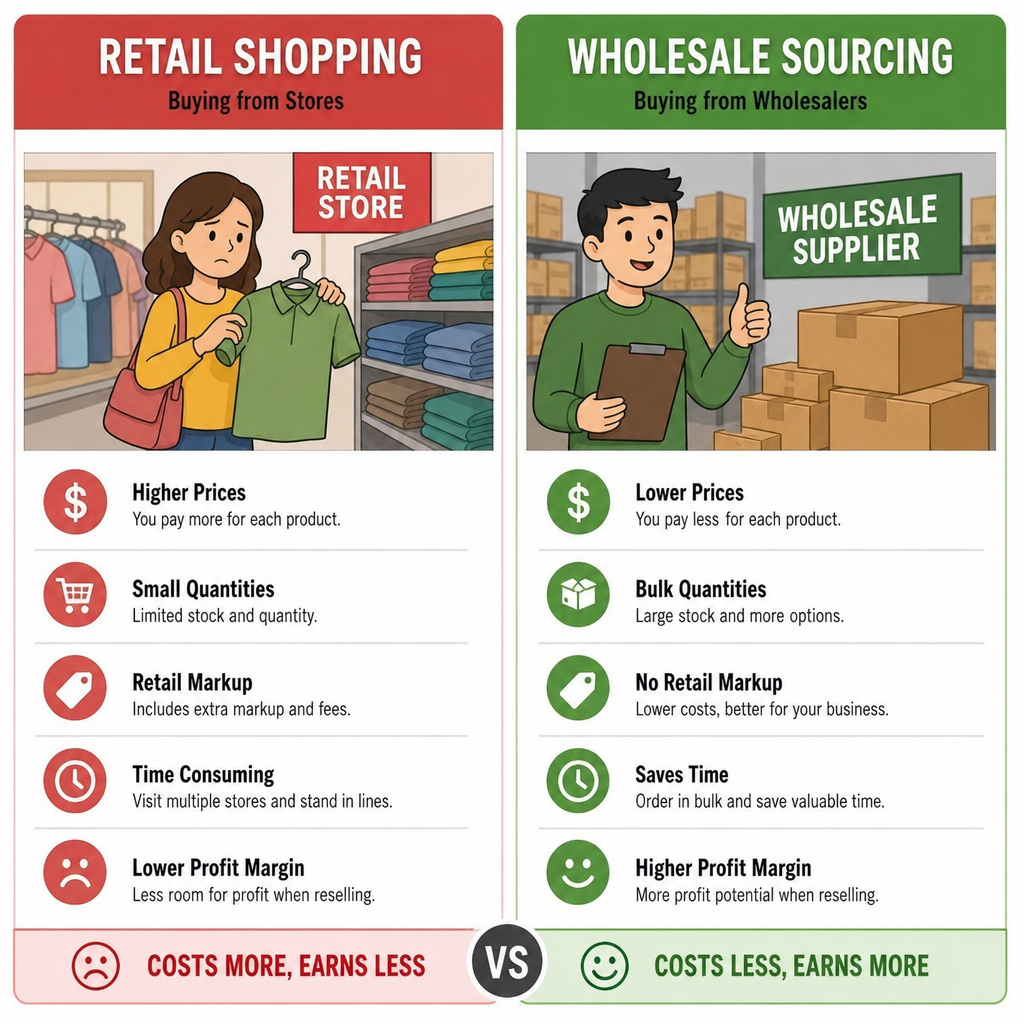
The simplest way to understand aliexpress vs alibaba is to look at intent. AliExpress is built for shoppers who want to buy finished products in low quantities. You browse listings, compare product photos, read buyer feedback, check delivery estimates, and complete checkout without having to build a relationship with the seller.
Alibaba.com is built for buyers who need supply, not just a single purchase. A small business might use Alibaba wholesale sourcing to find packaging, electronics accessories, home goods, apparel, beauty tools, or promotional products.
The process often includes comparing factories, checking supplier profiles, requesting quotes, asking about minimum order quantities, and confirming production details before payment.
This is why the same product category can feel completely different on each site. On AliExpress, you may see a phone case ready to ship as one unit. On Alibaba.com, you may see a similar phone case offered by a supplier that can discuss materials, logo printing, carton quantity, lead time, and shipping method.
Which platform is cheaper to use?
AliExpress can be cheaper for one-off purchases because you do not have to meet bulk requirements, pay for samples separately, or coordinate freight.
Alibaba.com can be cheaper per unit when you buy in volume, but the real cost depends on quantity, customization, shipping, import duties, packaging, inspection, and the supplier’s terms. There is no universal winner, so compare total landed cost rather than only the visible item price.
A fair cost comparison should include:
- Product price: AliExpress usually shows a checkout price; Alibaba.com pricing may be quote-based or quantity-based.
- Minimum order quantity: AliExpress is friendlier for one item; Alibaba.com may make sense when the order size is large enough.
- Samples: Alibaba buyers often order samples before committing to production.
- Shipping: AliExpress shipping is usually selected during checkout; Alibaba shipping may require more discussion, especially for heavier or bulk goods.
- Customs and duties: Bulk importing can create extra costs that do not appear in a simple product listing.
- Defect risk: A cheap unit price is not cheap if quality problems make the inventory hard to sell.
For personal shopping, AliExpress is usually easier to budget. For business buying, Alibaba.com can offer better long-term sourcing economics, but only if you manage the full purchasing process carefully.
Shipping and delivery expectations
AliExpress shipping is usually more straightforward for casual buyers because shipping options are attached to individual listings. The tradeoff is that delivery speed, tracking quality, carrier handoff, and return convenience can vary by seller, country, item, and shipping method. This is why shoppers should read recent listing-level feedback and not rely on the product photo alone.
Alibaba.com shipping is more flexible but also more complex. For small sample orders, a supplier may offer express courier options. For bulk orders, the discussion may involve cartons, weight, dimensions, sea freight, air freight, destination port, customs paperwork, and Incoterms. That complexity is not a flaw; it is part of international wholesale buying.
|
Shipping question |
AliExpress |
Alibaba.com |
|---|---|---|
|
Is shipping shown before checkout? |
Usually yes, by listing |
Often quoted or discussed by order |
|
Is it beginner-friendly? |
More beginner-friendly |
Requires more sourcing knowledge |
|
Is it good for heavy bulk goods? |
Usually less ideal |
Often more suitable |
|
Can delivery vary? |
Yes, by seller and method |
Yes, by supplier, freight method, and customs |
|
What should buyers check? |
Estimated delivery, tracking, reviews, return policy |
Freight quote, lead time, production time, documents, delivery terms |
Supplier vetting is more important on Alibaba.com
AliExpress buyers should still check seller ratings, product photos, buyer images, and recent reviews. However, Alibaba.com demands more due diligence because order sizes can be larger and products may be customized.
Alibaba.com encourages buyers to assess seller profiles, ask questions, look at supplier badges, and understand supplier types such as Gold Supplier, Verified Supplier, and Trade Assurance Supplier.
For business buyers, the goal is not simply to find the lowest price. The goal is to find a supplier that can consistently make the product you need, communicate clearly, meet the agreed specification, and handle problems professionally.
That means your first message should include enough detail for the supplier to respond accurately.
Use this supplier-checking checklist before placing a serious Alibaba order:
- Confirm the exact product specification. Include material, size, color, packaging, plug type, labeling, compliance needs, and acceptable tolerances.
- Ask for the MOQ and price breaks. A supplier may quote different unit prices at different quantities.
- Request samples. Do not judge production quality from listing photos alone.
- Check supplier profile details. Look for verification information, transaction history indicators, and relevant product specialization.
- Use written confirmations. Keep specifications, delivery dates, and quality expectations inside the order record.
- Consider inspection for larger orders. A third-party inspection may be worthwhile before final shipment.
Buyer protection and payment risk
Both platforms offer marketplace-level structures intended to make online buying safer, but buyers should still act carefully. On Alibaba.com, Trade Assurance is described as order protection connected to payments and delivery, and Alibaba.com says Trade Assurance protects orders for 30 days after receipt.
On AliExpress, risk control is more about choosing the right listing. Read AliExpress reviews with photos, compare multiple sellers, avoid unclear specifications, and be cautious when a price looks dramatically lower than similar listings. If the item is branded, technical, safety-related, or expensive, take extra care because marketplace listings can vary widely in accuracy.
The practical rule is simple: do not treat either platform as risk-free. AliExpress makes small purchases easier, so the downside is often smaller. Alibaba.com can unlock better sourcing opportunities, but larger orders deserve stronger checks before money changes hands.
Product quality and customization
AliExpress is best when you are buying a product as listed. Some sellers may offer variations, but the marketplace is not mainly built around custom production conversations. If you need a standard gadget, accessory, décor item, or hobby product, AliExpress can be efficient as long as you check reviews and delivery details.
Alibaba.com is the stronger option when product specifications matter. Businesses often use it to ask suppliers about logos, packaging, materials, colors, dimensions, certificates, and production timelines.
The advantage is control; the challenge is that you must communicate clearly enough to avoid misunderstandings.
If you are sourcing for resale, do not skip the sample stage. A product that looks profitable in a spreadsheet can fail if the material feels cheap, the packaging looks unprofessional, or the finished item differs from the listing. The more customized the product, the more important the written specification becomes.
Alternatives and similar websites
If you are comparing websites like AliExpress, the right choice depends on whether you want retail shopping, dropshipping-style testing, wholesale sourcing, or local delivery. Common websites similar to AliExpress include large marketplaces, niche retail platforms, and regional ecommerce sites.
For people searching “aliexpress alternative sites” or “concorrente aliexpress,” the important thing is to compare delivery times, return policies, seller quality, and product category strength rather than assuming every marketplace works the same way.
Possible alternatives to research include:
- Amazon Marketplace: often stronger for fast domestic delivery and easier returns, depending on seller and product.
- eBay: useful for new, used, refurbished, and collectible items from many seller types.
- Temu or Wish-style marketplaces: focused on low-cost consumer goods, though quality and shipping expectations should be checked carefully.
- Etsy: better for handmade, vintage, personalized, and small-maker products.
- DHgate or Global Sources: more relevant when you are comparing wholesale or supplier-sourcing platforms.
- 1688: often discussed as a China domestic wholesale marketplace; if you searched “1364 chinese market alibaba vs aliexpress vs 1 vs,” you may have meant 1688, which is different from both AliExpress and Alibaba.com and is generally less beginner-friendly for international buyers. Alibaba filings describe 1688.com as a China domestic wholesale marketplace.
Best choice by buyer type
|
Buyer type |
Better fit |
Why |
|---|---|---|
|
Casual shopper |
AliExpress |
Easier checkout, low quantities, retail browsing |
|
Hobbyist testing a gadget |
AliExpress |
Lower commitment and simpler ordering |
|
Dropshipping researcher |
AliExpress first, then Alibaba.com |
Useful for product testing; Alibaba may help if scaling inventory |
|
Small retailer |
Alibaba.com |
Better for wholesale sourcing and supplier relationships |
|
Private-label brand |
Alibaba.com |
More room for customization and production discussion |
|
Event buyer needing a few items |
AliExpress |
Simpler for small quantities |
|
Importer buying cartons or pallets |
Alibaba.com |
More suitable for freight, bulk pricing, and supplier negotiation |
Common mistakes to avoid
Do not compare only the product photo. Many listings across marketplaces can use similar images, but the actual seller, material, packaging, and shipping experience may differ. Read recent reviews, check whether buyers uploaded photos, and look for comments about sizing, durability, and delivery.
Do not assume Alibaba.com is automatically cheaper. A low unit quote can become expensive after shipping, duties, samples, inspection, and defects. Likewise, do not assume AliExpress is always the easiest option for every product; for bulk buying, it can be less efficient than working directly with Alibaba suppliers.
Do not place a large custom order without a sample. This is especially important for apparel, electronics accessories, beauty tools, branded packaging, and anything where color, measurements, safety, or finish quality affects resale value.
Final recommendation
For most individual shoppers, AliExpress is the better starting point because it is built around retail checkout, small quantities, visible listings, and simpler ordering. For businesses, Alibaba.com is usually the better long-term sourcing platform because it supports wholesale buying, supplier communication, custom requirements, and larger order planning.
The best answer to alibaba vs aliexpress is not “which site is better?” It is “which buying process matches your goal?” Use AliExpress when convenience and low commitment matter most. Use Alibaba.com when supplier selection, unit economics, customization, and scalable sourcing matter more than a quick checkout.
Frequently Asked Questions About AliExpress vs Alibaba
What is the main difference between Alibaba and AliExpress?
Alibaba is primarily a business-to-business platform designed for wholesale and bulk purchases, while AliExpress is a retail platform aimed at individual consumers looking to buy small quantities of products.
Can I purchase single items on Alibaba?
Generally, Alibaba focuses on larger orders and bulk purchases. However, some suppliers may allow single item purchases, but it's more common to buy in bulk.
How does shipping work on AliExpress compared to Alibaba?
On AliExpress, shipping options are typically displayed at checkout, making it easier for consumers. In contrast, shipping on Alibaba can vary based on negotiations with suppliers and the specifics of the bulk order.
Is buyer protection the same on both platforms?
Both platforms offer buyer protection, but the processes differ. AliExpress provides buyer protection through its listing reviews and ratings, while Alibaba uses Trade Assurance, which secures payments and ensures order delivery.
Are there alternatives to AliExpress and Alibaba?
Yes, there are several alternatives such as Amazon, eBay, DHgate, and regional ecommerce platforms. The choice depends on the type of products you're looking for and the purchasing model that suits you best.