Back To Blog
Choosing towel wholesale manufacturers and suppliers in China starts with a clear product specification, not a low price.
For retailers, hospitality operators, distributors, and private-label brands, the practical goal is to find a supplier that can reproduce an approved towel consistently.
This article explains how to compare suppliers, evaluate samples, clarify costs, and prepare a wholesale order without relying on unsupported promises.
How do you choose the right towel supplier in China?
Choose a towel supplier by matching its demonstrated capabilities to your product requirements, then verifying those capabilities through documentation, samples, and an agreed inspection process.
Ask every candidate to quote against the same specification. Treat missing information as a question to resolve before ordering, rather than assuming that similar photographs represent equivalent products.
Start by defining where the towel will be used. A hotel purchasing team might prioritize performance under its laundry process, while a gift brand might place more emphasis on presentation and embroidery. Turn those priorities into written acceptance criteria rather than broad descriptions such as “premium quality.”
Use this initial shortlist checklist:
Product fit: Request examples matching your intended towel category, construction, dimensions, and finishing.
Production responsibility: Ask which operations the supplier performs and which it subcontracts.
Order fit: Confirm minimum quantities for each size, color, and customization option.
Evidence: Request relevant sample reports and supporting documents for any certification claims.
Communication: Favor complete, consistent answers over quick replies that leave important details unresolved.
Do not assume that a business describing itself as a China towel manufacturer handles every production stage. Ask who weaves, dyes, cuts, hems, decorates, and packs your proposed order. Record the answers so that responsibility remains clear if a quality issue appears later.
Match the sourcing model to your business
When comparing China towel manufacturers, trading companies, and broader China-based textile suppliers, focus on the service you need rather than the supplier label alone. Ask each candidate to explain its role in your transaction. Establish who controls production, who issues the invoice, and who will resolve a defect claim.
For a factory relationship, make technical access part of your evaluation. Request a discussion about construction, finishing, tolerances, and production scheduling, rather than limiting the conversation to catalog prices. If an intermediary is involved, ask how it communicates specifications to the production site and verifies the finished goods.
For a mixed assortment, request a detailed consolidation plan. Specify whether towels from different production sites must share matching colors, packaging, or delivery dates. Ask who checks consistency across the complete shipment, not just within each individual product line.
Searches such as “towel factory China” can help build an initial candidate list, but use the next conversation to investigate capability. Request a live production walkthrough or an independent site assessment where appropriate. Keep your shortlist focused enough that you can examine each candidate properly.
Set clear boundaries before requesting extensive development work. Explain your target market, expected order size, and launch priorities, but avoid presenting unconfirmed forecasts as purchase commitments. Ask suppliers to separate what they can support now from what would require new equipment, subcontractors, or further development.
Build a specification that makes quotes comparable
For towel wholesale purchasing, define the product before negotiating the price. CottonWorks identifies fiber, fabric weight, and construction as important towel design considerations. GSM means grams per square meter: it describes fabric weight per unit area, not a complete quality rating. Use it alongside other requirements rather than treating a higher number as an automatic upgrade.
Build a specification sheet with the following fields:
|
Specification |
What to request |
|---|---|
|
Fiber composition |
Exact percentages and evidence supporting material claims |
|
Dimensions |
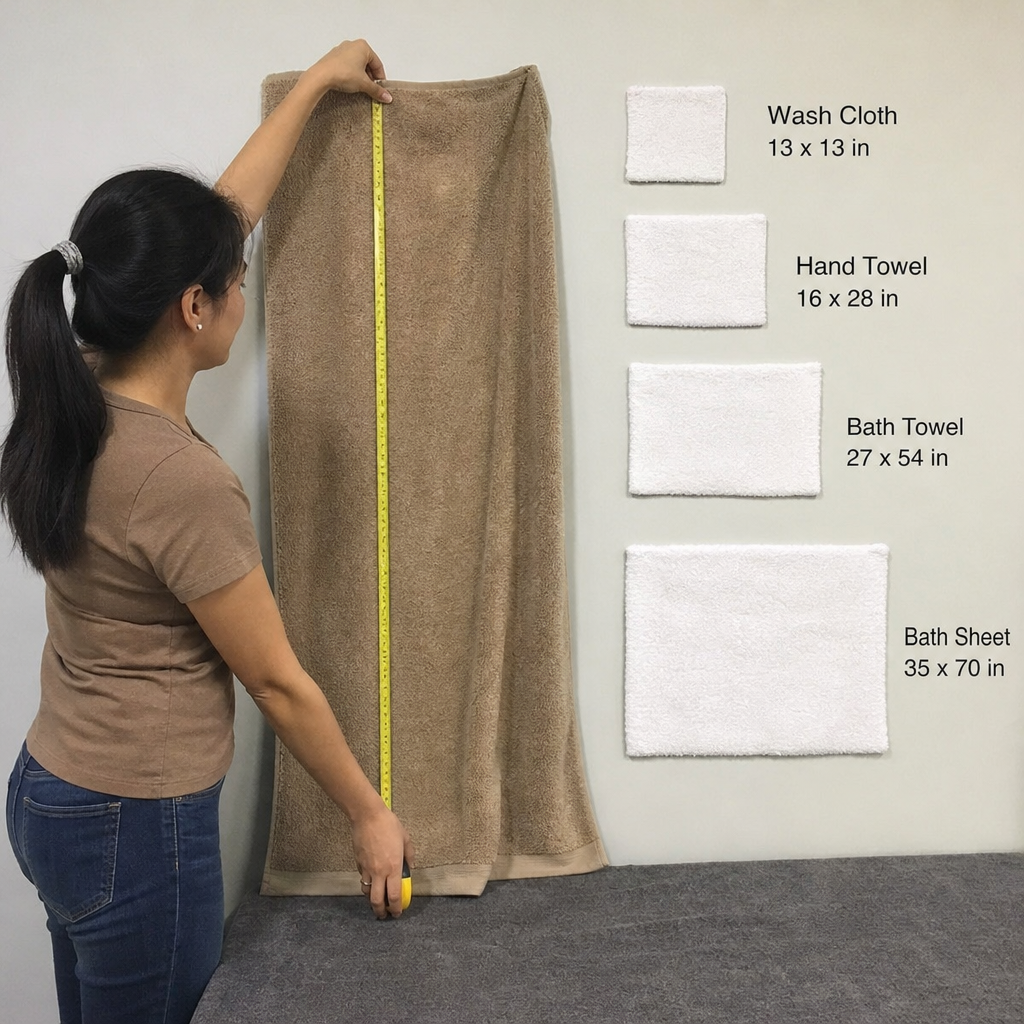
Finished length and width, plus agreed measurement tolerances |
|
Fabric weight |
Target GSM and an acceptable tolerance |
|
Construction |
Terry, waffle, or another agreed structure, with a reference sample |
|
Color |
Approved physical reference and a documented approval process |
|
Finishing |
Hem construction, border design, hanging loop, and decoration |
|
Performance |
Agreed testing, washing conditions, and acceptance limits |
|
Packaging |
Units per pack and carton, labels, barcodes, and carton markings |
Avoid asking only for a “soft cotton bath towel.” Instead, describe the intended use, measurable characteristics, and features that matter to your customer. Ask the supplier to identify any specification it cannot meet before providing its final quotation.
For example, a gym towel brief might prioritize compact dimensions and performance under the operator’s washing routine. A retail gift set brief might emphasize coordinated colors and presentation. Give each project its own specification instead of forcing different products into one generic request.
Evaluate samples beyond first impressions
Use samples to decide whether the proposed product meets your brief, not simply whether it feels pleasant out of the package. CottonWorks notes that towel fiber and construction affect product properties, including feel and absorbency. Its guidance also highlights trade-offs between soft, low-twist constructions and durability.
First, ask what the sample represents. Is it existing stock, a development sample, or a sample made to your proposed bulk specification? Request written confirmation of any differences, including yarn, dyeing, decoration, or packaging.
Then evaluate candidates under the same conditions:
Record the starting condition. Photograph the towel and document dimensions, weight, color, stitching, and visible defects.
Use a consistent wash routine. Follow the agreed evaluation conditions and record detergent, temperature, and drying method.
Compare the results. Note dimensional changes, appearance, loose threads, lint, border distortion, and performance during use.
Assess decoration separately. Examine embroidery, printing, labels, and packaging against approved artwork.
Resolve failures before approval. Request a revised sample when a proposed correction changes the product.
These checks are a practical screening exercise, not a substitute for laboratory testing. Where formal performance evidence is needed, ask a qualified laboratory to recommend suitable methods and document the acceptance criteria before testing.
Keep an approved reference sample and arrange for the supplier to retain a matching one. Identify both with the specification version, approval date, and product code. Require written approval before any proposed substitution reaches production.
How can you verify supplier and certification claims?
Verify supplier claims by requesting evidence specific to the business, production site, and product you intend to buy. For certification claims, check the issuing organization’s verification system and confirm that the documented scope matches the proposed towel. OEKO-TEX provides a Label Check tool for checking certificate or label numbers.
Request the supplier’s registered business details, production address, and explanation of its relationship to any separate exporter or payment beneficiary. Compare the information across quotations, invoices, and supporting documents. Ask for discrepancies to be explained in writing before proceeding.
Read certification claims narrowly. OEKO-TEX STANDARD 100 concerns textiles tested for harmful substances; it is not a general quality label or proof of performance after cleaning. Do not use it as evidence that a towel will meet your absorbency, shrinkage, or durability requirements.
For U.S.-bound cotton products, include supply-chain traceability in your review. CBP emphasizes traceability as part of importer due diligence and explains the UFLPA restrictions concerning goods connected to Xinjiang or listed entities. Request supporting supply-chain records and obtain qualified guidance on your specific transaction rather than relying on a general “compliant” statement.
Keep an evidence file for each shortlisted supplier. Include specifications, sample approvals, relevant reports, certification checks, and correspondence resolving discrepancies. Review that file again when the product, production site, or sourcing arrangement changes.
Compare minimum orders, customization, and total cost
When comparing wholesale towels from China, request an itemized quotation rather than a single unit price. Ask suppliers to distinguish the base towel from decoration, packaging, development, testing, and other quoted charges. Use identical quantities and specifications when comparing offers.
Clarify how minimum order quantities apply. Ask whether the minimum is calculated per order, design, size, color, or packaging format. If your proposed assortment falls below a minimum, request clearly priced alternatives rather than accepting an unspecified change to the product.
For private-label development, confirm these details before approval:
Logo dimensions, placement, colors, and artwork format.
Decoration method and the sample approval required.
Label wording, placement, and attachment method.
Packaging dimensions, inserts, barcodes, and carton quantities.
Ownership and permitted reuse of artwork or production files.
Charges and approval steps for later revisions or repeat orders.
Build your comparison around the cost of acceptable goods delivered to your destination. Request freight, inspection, testing, clearance, insurance, and applicable import-charge estimates from the relevant providers. Keep estimates separate from confirmed charges, and refresh them before committing.
Avoid reducing your first order’s unit price by adding untested colors or sizes. Instead, ask for pricing at several realistic quantities while keeping the specification unchanged. This gives you a clearer basis for deciding how much inventory to commit to initially.
Put production, inspection, and shipping in writing
Before placing the order, assemble a purchase document that identifies the exact specification and approved sample. Include quantities by product variant, packaging instructions, production milestones, inspection arrangements, and the process for handling nonconforming goods. Ask the supplier to acknowledge the complete document, not just the price and quantity.
Request a schedule showing material preparation, sample approvals, production, inspection, and dispatch. Identify which dates depend on your artwork or approval. Build your receiving plan around the full sequence rather than treating a proposed factory completion date as the delivery date.
Use a precisely stated trade term with a named place and version. ICC explains that Incoterms rules allocate obligations, costs, and the point of risk transfer; they do not replace the sales contract. Its guidance recommends considering FCA for containerized or multimodal transport when the relevant responsibilities fit the transaction, rather than automatically selecting FOB.
Agree what an inspection will examine and how results will be reported. Include product identity, quantity, measurements, workmanship, color references, decoration, and packaging in the proposed scope. Establish the response to a failed inspection before production starts, including corrective work and any required reinspection.
For U.S. sales, review label content before printing. FTC guidance states that covered textile labels must identify fiber content, country of origin, and the responsible company name or qualifying RN. Confirm the requirements for your product and have the final artwork reviewed before authorizing production.
After delivery, record receiving discrepancies and compare the shipment with the approved reference. Share specific findings with the supplier and document agreed corrections. Use those records when deciding whether to repeat, revise, or discontinue the product.
Start with a controlled first order
The strongest sourcing decision is one you can explain with a complete specification, verified evidence, an approved sample, and clear commercial terms. Resist choosing towel suppliers on catalog appearance or headline price alone. Give more weight to how thoroughly each candidate resolves your questions before receiving the order.
Begin with a manageable assortment and use the first shipment to evaluate execution against the written agreement. Before expanding, review product consistency, documentation, packaging, and issue resolution. A disciplined first order gives your next towel wholesale purchase a firmer foundation.
Frequently Asked Questions About Towel Wholesale Manufacturers and Suppliers in China
What are the key factors to consider when choosing a towel supplier in China?
It's important to evaluate their capabilities, production processes, documentation, sample quality, and communication effectiveness. Clear specifications for the towels you need and consistent answers from the supplier are crucial.
How can I verify the claims made by a towel manufacturer?
Request specific evidence related to the manufacturer's business and production site. Check for certification claims through the issuing organization's verification system and compare information across quotes and documents.
What should I include in my towel specification sheet?
Your specification sheet should detail fiber composition, dimensions, fabric weight, construction type, color, finishing requirements, performance criteria, and packaging needs. This clarity helps in obtaining accurate quotes.
What is the importance of evaluating samples before placing a wholesale order?
Evaluating samples allows you to determine if the product meets your specifications and quality standards, focusing on factors like absorbency, feel, and durability, rather than just initial impressions.
How can I ensure clear communication and documentation with my towel supplier?
Establish a detailed purchase document that outlines specifications, quantities, inspection arrangements, and production milestones. Regular communication about expectations and clear documentation of agreements can prevent misunderstandings.