Back To Blog
Alloy jewelry is jewelry made from a metallic mixture rather than a single pure metal. Combining metals lets makers adjust qualities such as strength, color, and workability, creating options from detailed zinc-based pendants to warm-toned brass bracelets.
Understanding the mixture—and any surface coating—helps you choose pieces that suit your style, wearing habits, and care expectations.
What is alloy jewelry?
Alloy jewelry includes pieces made from mixtures containing a principal metal and other added elements. In jewelry, familiar examples include brass, sterling silver, and karat gold: each combines metals to achieve useful properties that differ from those of the pure starting material.
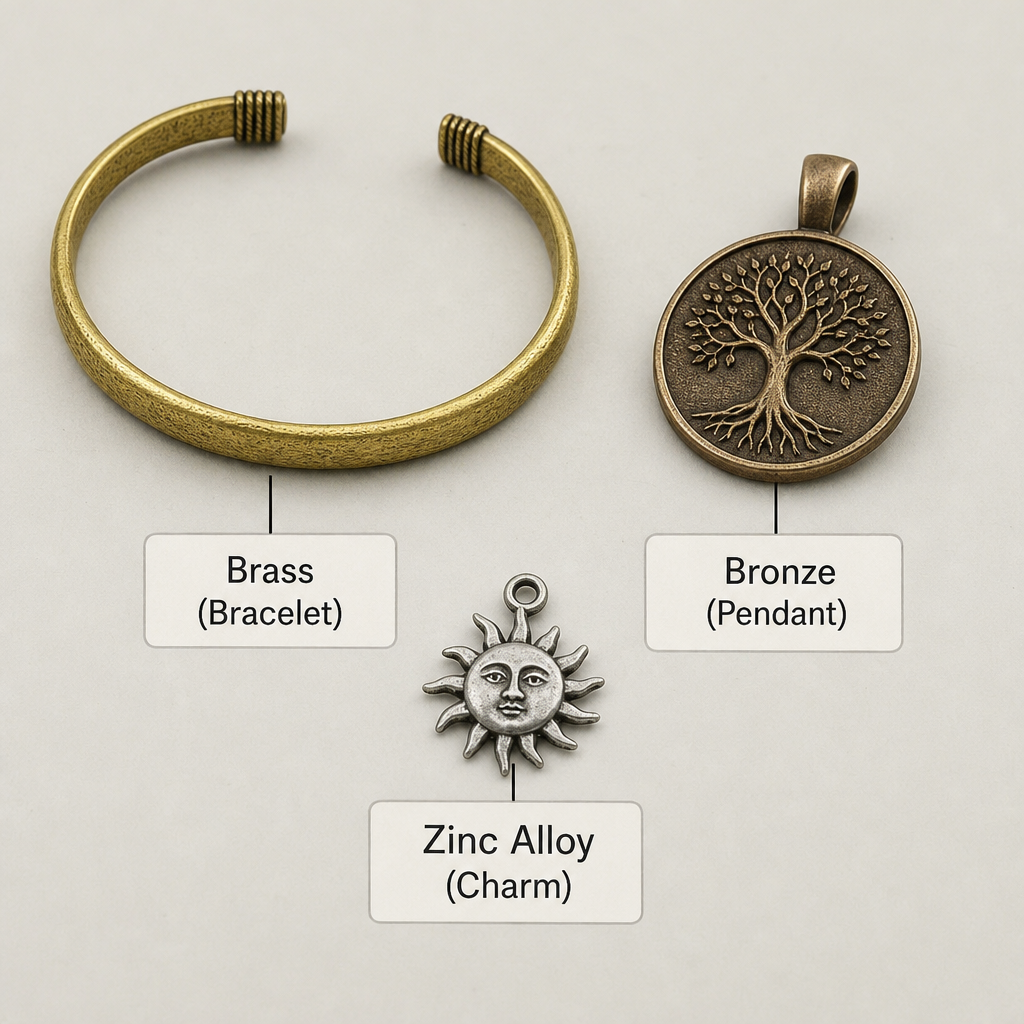
The word “alloy” therefore describes a material category, not a particular price point or quality grade.
That distinction matters when browsing product descriptions. A listing that says only “alloy” leaves important questions unanswered: which metals are present, what touches your skin, and whether the visible color comes from the underlying material or a coating.
Treat the term as a starting point for questions, not a complete specification.
The defining components are:
Principal metal: The main ingredient, such as zinc or copper, establishes the alloy family.
Alloying additions: Other elements modify properties such as hardness, strength, color, or casting behavior.
Surface finish: Polishing, plating, or another treatment changes the exterior without necessarily changing the underlying alloy.
Finished construction: The body, clasp, chain, and earring posts should be considered separately when evaluating a piece.
“Alloy” also does not mean “plated.” An alloy is a mixture within the material; plating is a layer applied over a surface. A piece can be both—for example, a copper-alloy base covered with gold plating.
The main benefits of alloy jewelry
The appeal of alloy jewelry lies in choice. Manufacturers can select materials for a design rather than rely on the properties of one pure metal. For wearers, that can mean more varied colors, shapes, and price options, although the benefits depend on the specific alloy and construction.
Detailed designs and versatile finishes
Zinc casting alloys can reproduce complex shapes and accept decorative finishes. Their casting characteristics make them useful where a designer wants texture, relief, or a sculptural form. The International Zinc Association identifies casting flexibility and finishing capability as major advantages of these materials.
For a shopper, the practical attraction is design freedom: consider a pendant with raised botanical details or a geometric charm with recessed surfaces. Those are examples of designs worth exploring, not guarantees that every inexpensive casting will have crisp edges or a smooth finish. Inspect close-up photographs and, where possible, the piece itself.
Strength suited to the application
Alloying can make a soft metal more practical for jewelry. Silver, for example, is commonly mixed with other metals to improve strength and durability; sterling silver is a familiar result. However, the fact that alloying improves one material does not establish that every alloy is stronger than every alternative.
Think of strength as a design requirement rather than a universal ranking. Ask whether the maker recommends the piece for daily wear, whether a delicate component can be repaired, and whether the clasp feels secure. A material name should support those checks, not replace them.
Color choice and accessible styling
Copper alloys offer attractive colors in their own right. Changing the proportions of copper and zinc produces different brass tones, while plating provides another route to a desired surface appearance. Base metals also give designers alternatives to constructing an entire piece from precious metal.
This makes alloy pieces worth considering when your priority is experimenting with a silhouette or coordinating jewelry with occasional outfits. Compare the actual price, finish information, and return terms rather than assuming “alloy” automatically means a bargain. Value is personal: an appealing piece still needs to meet your expectations for upkeep and wear.
Is zinc alloy good for jewelry?
Zinc alloy can be a good choice for decorative jewelry when its composition, construction, and finish match the intended use. Zinc casting alloys offer useful strength, economical production, and the ability to create detailed shapes. Those manufacturing benefits do not, by themselves, prove that a finished piece is suitable for sensitive skin or constant wear.
The phrase zinc alloy metal jewelry describes a broad category rather than one standardized recipe. Conventional zinc casting alloys include the ZAMAK family, while other zinc alloys contain higher proportions of aluminum. Different grades have different characteristics, so a generic material label cannot tell you everything about performance.
When evaluating zinc alloy for jewelry, separate three questions:
- Does the design suit the material? Examine fine projections, connecting loops, and other vulnerable details rather than judging only the decorative face.
- What is the surface treatment? Ask whether the piece is plated and whether the seller provides finish-specific care instructions.
- What is known about skin-contact components? Request information about the body, posts, backs, and clasp, especially if you have a known metal allergy.
The sensible conclusion is conditional: zinc alloy in jewelry deserves consideration for its design possibilities, but an unidentified mixture should not be treated as a promise of durability or skin compatibility. Favor clear product information over broad claims such as “premium alloy.”
Copper alloys and other jewelry metals
Copper alloy jewelry includes familiar materials such as brass and bronze. Brass is a family of copper-zinc alloys; traditional tin bronze combines copper and tin. Their composition affects appearance and mechanical properties, so “copper alloy” is useful information but still not a complete description.
|
Material category |
What it describes |
What to clarify before buying |
|---|---|---|
|
Zinc-based alloy |
A material whose principal metal is zinc |
Alloy grade, finish, and skin-contact components |
|
Brass |
A copper-zinc alloy |
Whether it is bare, coated, or plated |
|
Tin bronze |
A copper-tin alloy |
Exact composition and recommended care |
|
Sterling silver |
An alloy containing 92.5% silver |
Other alloying metals and any surface coating |
|
Karat gold |
Gold mixed with other metals in a stated proportion |
Karat, color alloy, and any plating |
These categories describe composition, not interchangeable levels of quality. Sterling silver and karat gold are alloys too, while brass and zinc-based alloys belong to different material families despite both potentially containing zinc.
If a listing uses an awkward description such as “jewelry copper alloy,” translate it into a practical question: which copper alloy, and with what finish? Do not infer gold content from a gold-colored photograph. Likewise, do not assume a silver-colored piece contains silver; some copper-nickel-zinc alloys have a silvery appearance.
How does alloy jewelry differ from plated jewelry?
Alloy jewelry is defined by the composition of its metal, while plated jewelry is defined by an applied surface layer. These descriptions overlap rather than compete: a brass pendant can be gold plated, and a gold-alloy piece can also receive plating. The underlying material and the coating each need their own description.
This distinction changes what you should expect as the piece ages. Gold plating eventually wears away, with wear depending partly on coating thickness and how the item is used. Ask what material will become visible beneath it and whether replating is available rather than expecting the original surface to last indefinitely.
Keep these common misconceptions in mind:
- “Alloy means costume jewelry.” Sterling silver and karat gold are also alloys.
- “Gold plated means gold throughout.” Plating describes a surface layer, not the composition of the entire piece.
- “A gold tone identifies the metal.” Brass can have a gold-like color without being gold.
- “A precious-metal coating proves skin compatibility.” Check the underlying material and other components rather than relying on the visible finish alone.
Skin sensitivity, tarnish, and realistic expectations
Skin compatibility depends on more than whether the main metal is zinc, copper, silver, or gold. Nickel released from jewelry can trigger allergic contact dermatitis in sensitized people, and exposure may come from components such as earring posts or clasps. A clear composition statement is therefore more helpful than an unspecified “alloy” label.
Surface discoloration and allergy are not the same issue. Copper-containing jewelry can leave green marks through chemical reactions involving the metal and substances on the skin. An itchy or inflamed rash, however, calls for a different response than simply cleaning a mark away.
If you have a known allergy, ask for relevant material and testing information before purchasing. Stop wearing a piece that causes irritation, and seek a dermatologist’s advice if symptoms persist or recur. Patch testing may help identify an allergen when the cause is unclear.
Practical uses that match different priorities
Start with the job you want the jewelry to do, then evaluate individual pieces against that brief. These examples are shopping scenarios, not guarantees about an entire metal category:
- An occasional statement pendant: Prioritize its shape and finish, then confirm that the chain and clasp are adequately described.
- A warm-toned bracelet: Explore brass or bronze, but ask whether its appearance is intended to remain polished or develop surface changes.
- A plated accessory for coordinated outfits: Decide whether eventual finish wear and possible replating fit your expectations.
- An everyday sentimental piece: Put repair options, component quality, and clear material disclosure ahead of an attractive generic label.
For each scenario, define your deal-breakers before comparing products. Someone comfortable with maintenance may assess a piece differently from someone who wants minimal upkeep. Neither preference makes an alloy universally good or bad; it changes what information matters most.
Care and a final buying checklist
Follow the maker’s instructions, especially when a piece combines metal with stones, enamel, adhesives, or coatings. As general precautions, protect jewelry from household chemicals, avoid careless exposure to cosmetics, and store pieces separately to reduce scratching. Do not assume an ultrasonic cleaner or a metal polish is suitable for every component.
Before buying, check:
- Material disclosure: Is the alloy identified beyond “mixed metal”?
- Finish details: Is the piece bare, plated, or otherwise coated?
- Component information: Are posts, backs, chains, and clasps described?
- Maintenance expectations: Are cleaning instructions and any refinishing options clear?
- Purchase protection: Can you inspect the piece and return it if it does not meet the description?
The strongest reason to choose alloy jewelry is not a blanket claim that it lasts longer or costs less. It is the opportunity to find a combination of design, material, finish, and upkeep that works for you. Choose the individual piece with clear expectations, and the word “alloy” becomes useful information rather than a mystery.
Frequently Asked Questions Related to Alloy Jewelry
What is alloy jewelry, and how is it different from pure metal jewelry?
Alloy jewelry is made from a mixture of metals, allowing for enhanced properties such as strength, color, and durability. Unlike pure metal jewelry, which consists of a single metal, alloy jewelry combines different metals to create unique aesthetics and characteristics.
Is zinc alloy good for making jewelry?
Yes, zinc alloy can be a good option for decorative jewelry when it is made with quality composition and construction. It offers advantages like strength, design flexibility, and economical production, but it’s essential to ensure that it’s suitable for skin contact and daily wear.
How do I determine if a piece of alloy jewelry is good quality?
To evaluate the quality of alloy jewelry, check the material disclosure, finish details, and component information, especially for parts that touch the skin. Look for clear product descriptions, ask about care instructions, and ensure there are options for returns if the piece doesn't meet your expectations.
Can I be allergic to alloy jewelry?
Yes, some people may experience allergic reactions to specific metals in alloy jewelry, especially nickel. It is crucial to inquire about the metal composition, particularly if you have known allergies, and to monitor for any irritation when wearing the jewelry.
How do I care for my alloy jewelry?
Care for alloy jewelry generally involves avoiding exposure to harsh chemicals, cleaning with a soft cloth, and storing pieces separately to prevent scratches. Always follow the manufacturer's care instructions, especially for items that combine metal with stones or other materials.