Back To Blog
Sourcing wholesale hair extensions from China starts with defining the product you need, verifying suppliers, and testing samples before committing to inventory.
This guide gives salon owners, distributors, and emerging hair brands a practical framework for comparing offers, checking quality, and planning an initial order.
Treat it as a buying process—not a search for the lowest advertised bundle price.
How do you source wholesale hair extensions from China?
To source wholesale hair extensions from China, prepare a written specification, shortlist suitable suppliers, verify their capabilities, and compare samples against consistent acceptance criteria.
Then agree on pricing, inspection, payment, shipping, and defect remedies before placing a controlled first order. Canada's Trade Commissioner Service recommends supplier due diligence, detailed specifications, samples, and production quality control rather than relying on price alone.
Start with the customer you intend to serve. A stylist buying extensions for repeat salon appointments may prioritize dependable color matching and installation performance. An online brand might instead begin with a tightly edited collection and retail-ready packaging.
Write down your nonnegotiables before contacting vendors. Separate essential performance requirements from optional presentation features so negotiations do not quietly trade product quality for a more attractive box.
Use the same brief for every quotation. Otherwise, you may compare products with different weights, processing histories, or packaging and mistake those differences for savings.
Define the product before comparing suppliers
Build your sourcing brief around measurable details rather than phrases such as “best quality.” Ask each supplier to explain its terminology in writing and attach the agreed description to your order. For quality hair extensions, your acceptance criteria should describe what the delivered product must actually do.
Include these details in your request:
Composition: State whether you require human hair, synthetic fiber, or a disclosed blend, and request supporting evidence for composition claims.
Format: Specify wefts, tape-ins, clip-ins, tips, or another attachment system, including relevant construction details.
Length and weight: Define how length will be measured and whether quoted weight excludes packaging and attachments.
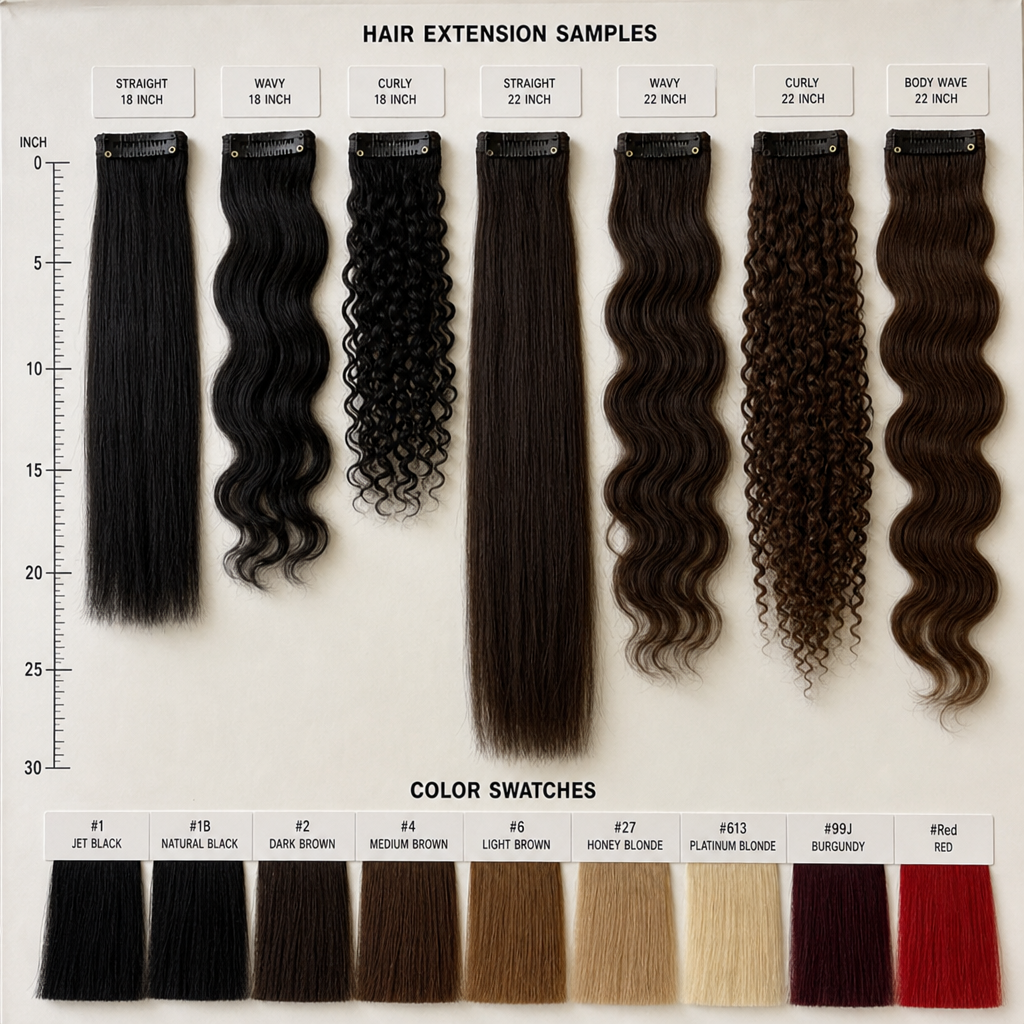
Color and texture: Provide approved references and explain how differences will be assessed.
Processing: Request disclosure of coloring, bleaching, texturing, and finishing treatments relevant to your intended use.
Packaging: Identify labeling, barcode, care-card, and private-label requirements separately from the hair specification.
For human hair weft extensions wholesale orders, request additional details about seam construction, weft dimensions, and permitted cutting or installation methods. Ask your stylist or product tester to assess those features against the installation service you plan to offer.
Keep the initial assortment manageable. Rather than ordering every available texture, choose the products you can evaluate thoroughly and support confidently after sale.
Verify the business behind the catalog
Ask whether you are dealing with a manufacturer, trading company, or sourcing agent. Then establish who will produce the goods, who will invoice you, and who is responsible if production falls short. The China-Britain Business Council advises buyers to investigate supplier arrangements and clarify responsibilities when using intermediaries.
Request the supplier's registered business name, production address, export experience, and relevant customer references. Where practical, arrange a factory visit or independent assessment. These checks align with the Trade Commissioner Service's guidance on evaluating Chinese suppliers before making commitments.
When reviewing hair extensions suppliers, make the conversation product-specific. Ask how they separate orders, retain approved samples, handle color variation, and document changes to materials or production. Request evidence connected to the actual product you intend to buy, not just a polished factory video.
If you use Alibaba.com, review the underlying verification information rather than stopping at a badge. Alibaba says its Verified Supplier program includes third-party assessment of company profiles, production capabilities, products, and process controls; use that information as one input in your own selection process.
Set a clear stopping rule: do not proceed while the contracting business, production site, or proposed payment recipient remains unexplained. Ask for written clarification before sending funds.
What separates quality hair extensions from an attractive sample?
For purchasing purposes, define quality as repeatable performance against your agreed specification—not simply softness or appearance when a sample arrives.
Evaluate the characteristics your customers will notice during installation, washing, styling, and wear. An approved sample should become a reference for production inspection, not permission to skip it; official sourcing guidance specifically warns that a good sample does not eliminate the need for mass-production quality control.
Test samples under consistent conditions
Create a written evaluation routine and use it for every shortlisted vendor. Record the products used, handling steps, observations, and photographs so your comparison remains useful after several samples arrive.
Check the delivery. Compare the sample with its stated length, net weight, shade, texture, and attachment format.
Inspect construction. Examine seams, clips, tabs, or tips for the requirements relevant to your installation method.
Wash consistently. Use the same care routine and note tangling, shedding, color transfer, and changes in feel.
Assess styling claims. Test only the heat, coloring, or other services the supplier expressly supports, preferably through a qualified stylist.
Document the result. Photograph the sample before and after testing, and record why it passes or fails.
Do not treat a home test as laboratory proof of composition, chemical safety, or origin. If a purchasing decision depends on a specific claim, request appropriate independent evidence rather than drawing conclusions from appearance alone.
Turn premium language into acceptance criteria
If you plan to sell premium hair extensions, identify what justifies that positioning in your own collection. You might require a particular finish, a narrowly controlled shade match, or an installation format approved by your stylist testers. Make each requirement concrete enough to inspect.
Ask suppliers to define terms such as “virgin,” “Remy,” and any numbered quality grade they use. Do not assume two quotations use those labels identically. Where a claim matters to your retail description, require a written explanation and evidence you can review before repeating it to customers.
Compare landed cost rather than cheap hair extensions
Use cheap hair extensions as a search starting point, not a purchasing standard. Request an itemized quotation and compare the complete cost of receiving saleable stock. Official sourcing guidance recommends considering pricing alongside service, lead times, logistics, and contractual terms.
Build a costing sheet that includes:
Product cost for the exact approved specification.
Sampling, testing, and inspection expenses.
Custom packaging, labels, and artwork charges.
Freight, insurance, and destination handling.
Applicable duties, taxes, and customs brokerage.
Payment charges and an internal allowance for unusable stock.
Calculate your planning figure as total order-related cost divided by expected saleable units. Keep assumptions visible, especially estimated freight and the allowance for rejected items. Update the sheet after your first shipment instead of treating the initial estimate as permanent.
For U.S. imports, confirm classification and applicable duty treatment for the actual merchandise with a customs professional. CBP advises importers to provide detailed product information and offers binding rulings on classification and duty rates; avoid relying on a generic rate copied from another seller's listing.
Before negotiating price, decide which changes you would accept. Simplifying packaging or reducing the assortment may suit your business better than relaxing the product requirements you intend to promise customers.
What should your first wholesale order include?
Your first wholesale order should include a limited, testable assortment, approved reference samples, written specifications, an inspection plan, and clear commercial terms. Choose a quantity you can evaluate and support without depending on an immediate reorder. The purpose is to validate the working relationship as well as the product.
Ask suppliers to quote minimum order quantities separately for stocked products, custom shades, and branded packaging. Request production and dispatch milestones rather than an unexplained delivery estimate. Keep your launch date provisional until you have a realistic plan for inspection and transport.
Put these points in the purchase agreement:
Product definition: Include SKU-level specifications, quantities, and approved sample references.
Change control: Require approval before substitutions or changes to agreed materials, processing, or production arrangements.
Inspection: State when inspection occurs, who arranges it, and how failures are handled.
Payment: Connect payment stages to agreed milestones and specify the authorized recipient.
Defect remedies: Define evidence requirements, reporting periods, and the process for replacement, credit, or refund.
Shipping responsibilities: Identify who arranges transport, insurance, clearance, and delivery.
If ordering through Alibaba Trade Assurance, put the specifications and shipping commitments into the platform order and follow its payment instructions. Alibaba describes protection in relation to the contract's shipping and quality requirements, so review the applicable terms instead of assuming every disagreement will qualify for reimbursement.
For a significant commitment, have qualified advisers review the agreement. Keep quotations, approvals, sample records, inspection results, and payment documents together so decisions remain traceable.
Plan import compliance and responsible sourcing early
For U.S.-bound goods, import compliance belongs in the sourcing stage. CBP states that importers must exercise reasonable care over classification, valuation, and entry information. Work with a licensed customs broker to identify the information needed for your particular extensions before the shipment leaves.
Ask the supplier for accurate product descriptions, composition information, invoices, packing details, and manufacturing records needed for review. Make sure the broker understands the product format rather than receiving only a broad description such as “beauty accessories.” Resolve discrepancies before approving shipping documents.
Check origin, traceability, and marketing claims
Do not equate a supplier's locati0n with a complete answer about customs origin. U.S. origin determinations can depend on manufacturing facts, including whether processing creates a substantial transformation. Have the proposed origin marking reviewed for your specific product and supply chain before printing retail packaging.
Responsible sourcing requires more than a general assurance. U.S. law prohibits imports produced wholly or partly with forced labor, and CBP encourages importers to understand where and how their products are made. Ask suppliers to document upstream sourcing and processing, and review current enforcement guidance with a qualified adviser.
Keep retail claims aligned with the evidence you actually hold. If you cannot substantiate a statement about origin, processing, or traceability, revise the statement rather than filling the gap with persuasive language.
Build repeat orders around documented results
After the first shipment, compare received inventory with the approved sample and inspection criteria before releasing it for sale. Record discrepancies by SKU and batch, photograph issues, and follow the agreed reporting process. Retain representative samples so later discussions refer to the same physical benchmark.
Create a simple supplier scorecard covering specification compliance, communication, dispatch performance, documentation, and defect resolution. Add customer feedback carefully: record the product, installation method, and care history before attributing an issue to manufacturing.
Use those records to decide whether to reorder, adjust specifications, or pause the relationship.
The takeaway is straightforward: buy against an agreed standard, verify before scaling, and calculate costs beyond the quotation. Start with a clear brief and a controlled order. Expand only when the delivered product and the supplier's response justify the next commitment.
Frequently Asked Questions About Sourcing Wholesale Hair Extensions from China
What are the key factors to consider when sourcing wholesale hair extensions from China?
Key factors include defining product specifications, verifying suppliers, comparing samples, understanding pricing structures, and ensuring quality control through inspections.
How can I ensure the quality of hair extensions before placing a large order?
Request samples, conduct thorough evaluations under consistent conditions, and establish clear acceptance criteria that outline the expected quality and performance of the extensions.
What type of documentation should I request from suppliers?
You should request documents that include business registration, export experience, composition evidence, detailed specifications, and any certifications related to production quality and safety.
Are there additional costs associated with sourcing hair extensions wholesale?
Yes, additional costs may include sampling and testing expenses, custom packaging fees, freight and handling charges, applicable duties and taxes, and potential costs related to quality inspection.
What steps should I take if the hair extensions received do not meet my specifications?
Follow the agreed-upon defect remedies outlined in your purchase agreement, document the discrepancies, communicate promptly with the supplier, and request replacements, credits, or refunds as stipulated in the contract.