Back To Blog
The best wholesale bag charms and plush keychains are the ones that fit your customers, meet your quality expectations, and leave room for a workable retail margin.
For boutiques, online shops, and merchandise brands, that means comparing more than cute designs or low unit prices.
This guide explains how to build an assortment, evaluate samples, compare suppliers, and approach customization without committing too much inventory too soon.
What makes wholesale bag charms and plush keychains worth stocking?
Wholesale bag charms and plush keychains are worth stocking when their appearance, construction, price, and ordering terms support a clear selling opportunity.
Choose products you can explain and merchandise easily, with attachment hardware suited to their intended use.
A distinctive character may attract attention, but the buying decision should also account for sample quality, delivery expectations, and the cost of getting saleable stock onto your shelves.
Start with the customer rather than the catalog. Picture the bag they carry, the styles they already buy, and whether they want a playful statement or a subtle finishing touch. That gives you a more useful purchasing brief than simply asking a supplier for its bestsellers.
Use these starting points to narrow your search:
|
Your selling situation |
Product direction to consider |
What to verify |
|---|---|---|
|
Fashion boutique |
Coordinated decorative bag charms |
Scale, finish, and compatibility with stocked bags |
|
Gift shop |
Plush animals, initials, or themed motifs |
Presentation, recipient appeal, and packaging |
|
Artist merchandise |
Original illustrated or character charms |
Artwork reproduction and sample accuracy |
|
Brand promotion |
Logo charms or mascot keychains |
Branding visibility and delivery schedule |
|
Online accessory store |
A focused collection with clear variations |
Consistent photography, dimensions, and fulfillment cost |
Treat these as buying directions, not guaranteed winners. Your own sales history, customer requests, and small test orders should determine which products earn deeper inventory.
Build a focused assortment instead of chasing every trend
Trendy bag charms deserve attention, but a trend should be a reason to investigate—not an instruction to overbuy. JOOR’s July 2025 analysis documented substantial growth in bag charm sales on its wholesale platform during the first half of 2025. That historical signal supports exploring the category, but it does not establish which designs will sell to your customers today.
A practical starting assortment can combine three roles: an accessible everyday style, a visually distinctive statement piece, and a giftable option. Keep the collection connected through color, subject matter, or hardware finish. This gives shoppers choices without making the display feel unrelated.
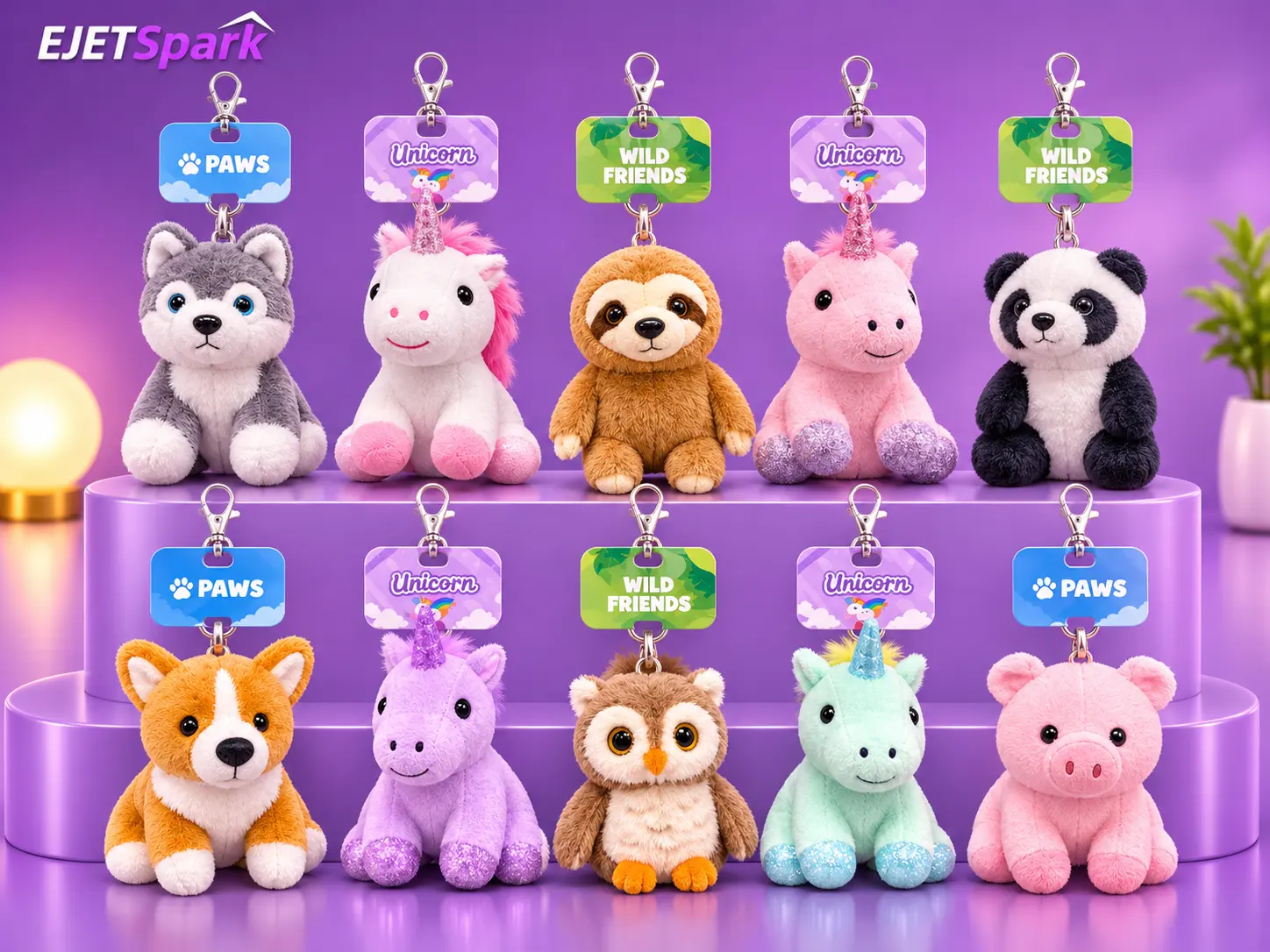
For example, an animal-themed capsule might pair a plush character with an illustrated charm and a coordinating initial accessory. The connection gives you a styling story to photograph and explain. You do not need to purchase every available animal or color to make the collection feel complete.
Separate inspiration from evidence. Save customer inquiries, review which existing accessories sell together, and note whether shoppers respond to a particular motif or price point. Use those observations to decide what to sample next.
Reserve experimental designs for quantities you can comfortably test. Avoid assigning a large share of your purchasing budget to an unfamiliar style simply because its product photos look compelling.
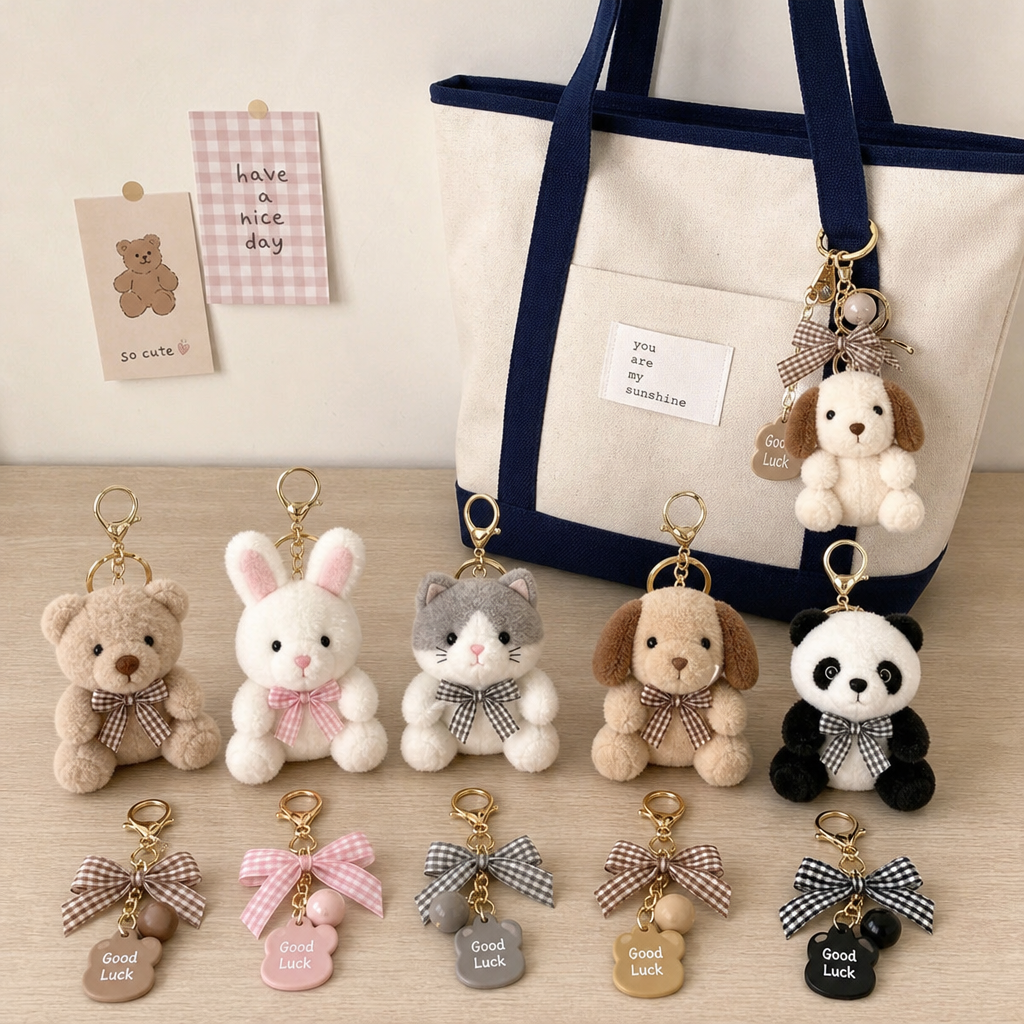
Materials and construction deserve a closer look
Materials should be part of your product specification, not a vague catalog description. Custom keychain catalogs can include acrylic, metal, and plush options, but those category names alone do not tell you how a particular item will look or perform. Request the composition, construction details, dimensions, and attachment information for each shortlisted product.
Compare finished samples rather than assuming one material is always better. The right choice depends on the intended appearance, selling price, and use. A flat illustrated charm and a three-dimensional plush character solve different merchandising needs.
Plush fabrics, filling, and finishing
For plush keychains, ask the supplier to identify the outer fabric and filling. Request close-up photographs of seams, facial details, and the point where the hanging loop joins the body. Then inspect a physical sample to see whether those details match the images.
Check the silhouette from several angles. Does the face remain recognizable when the charm hangs naturally? Are matching limbs or ears positioned consistently? Decide which variations are acceptable before production rather than debating them after delivery.
If the supplier provides care instructions, review them before writing your listing. Do not promise machine washability or stain resistance unless the specific product supports that claim.
Acrylic, metal, and flexible components
For acrylic charms, inspect print alignment, edge finishing, and how the artwork looks from both sides. Ask whether the quoted version includes protective film, and confirm what customers should remove before use. Assess the sample in ordinary lighting rather than relying only on studio photographs.
For metal components, examine surfaces, edges, and the finish around attachment points. For flexible charms, inspect fine details and consistency of shape. Ask suppliers to describe the actual material rather than accepting broad terms such as “rubber” without clarification.
Record the specification you approve. If a later quotation substitutes a material or finish, you will have a clear basis for comparison.
Rings, clips, and connecting loops
Evaluate the entire attachment system, not just the main charm. Open and close clips, inspect connecting rings, and attach the sample to bags similar to those your customers use. Check whether the opening accommodates the intended handle, loop, or hardware.
Consider the overall hanging length as well. A charm that looks balanced on a large tote may be awkward on a compact purse. Photograph the sample in context so you can judge proportion before ordering.
Plush keychains need a product-specific sample review
Give plush samples their own review process instead of treating them like flat accessories. Ask to see the front, back, sides, and attachment area, then compare the physical item with the approved artwork. Focus on the features that make the character recognizable.
A useful sample review includes:
Facial placement: Check eye spacing, mouth position, and expression against the approved design.
Body shape: Compare the sample’s proportions with the intended silhouette, including ears, limbs, and accessories.
Seams and filling: Look for openings, exposed filling, and uneven areas that fall outside your acceptance criteria.
Attachment placement: Confirm that the character hangs in the intended orientation rather than tipping backward or obscuring its face.
Packaging recovery: Examine the sample after unpacking and ask how production units will be packed for transit.
Write specific feedback. “Move the mouth closer to the center” is more actionable than “make it cuter.” Include marked photographs so both parties can identify the requested adjustment.
Keep an approved reference sample and record its version. Informal handling checks can help you assess presentation and usability, but they are not substitutes for applicable safety testing or a documented inspection process.
How should you approach supplier selection?
Approach supplier selection by comparing product capability, sample accuracy, communication, order terms, and total cost against the same written brief. Give shortlisted suppliers identical requirements so their quotations are meaningfully comparable. Alibaba’s buyer guidance recommends requesting samples and creating detailed purchase orders before committing to full orders.
Start by clarifying what each business actually provides. Ask whether it manufactures the product, coordinates production through another factory, or distributes finished stock. Use the answer to understand who handles design changes, inspections, and production problems—not as an automatic reason to accept or reject the supplier.
Your first inquiry should cover the decisions that could change the order:
Minimum quantities: Ask about minimums per design, color, and total purchase, including whether mixed assortments are permitted.
Sample process: Confirm sample charges, shipping, revision arrangements, and whether the sample represents bulk production.
Specifications: Request material, dimensions, hardware, finishing, and packaging details in writing.
Schedule: Separate sampling, approval, production, dispatch, and estimated transit stages.
Problem resolution: Ask how shortages, damaged goods, and specification mismatches must be documented and reported.
Reordering: Confirm how repeat orders are identified and whether materials or components can change between runs.
Compare the answers for clarity as well as price. If one supplier leaves essential details unanswered, request clarification before placing it alongside a complete quotation. Do not fill gaps with assumptions favorable to the deal.
If using a purchasing platform, read its current protection terms. Alibaba describes Trade Assurance protection in relation to shipping and quality obligations recorded in the supplier contract; do not treat the service name as an unconditional guarantee. Document the agreed specifications and follow the platform’s payment and dispute procedures.
Custom bag charms work best with a precise brief
Custom bag charms give you an opportunity to build around original artwork, a brand mascot, or a coordinated collection. Start by deciding what actually needs customization. An existing shape with your artwork may meet the brief; a new three-dimensional character requires a different conversation.
Ask suppliers to distinguish artwork changes from changes to shape, construction, material, and hardware. Request a quotation for each relevant option rather than assuming they share the same development process. Compare the additional commitment with the customer benefit you expect.
For custom orders, provide a brief containing:
Artwork and references: Supply usable files and explain which features must remain unchanged.
Dimensions: Specify body size and total hanging length, stating whether measurements include hardware.
Colors: Identify reference colors and ask how the supplier handles color matching.
Construction: Describe the desired material, facial details, printing or embroidery, and attachment type.
Packaging: State whether the order needs individual bags, backing cards, hangtags, or another presentation.
Approval stages: Identify what must be approved before bulk production and how revisions are recorded.
Leave room for manufacturing feedback, but require approval for changes. If a tiny illustrated detail cannot be reproduced clearly, ask for alternatives that preserve the design’s identity. Review the revised sample rather than approving from a verbal description alone.
Check supplier-specific conditions before developing unusual materials. For example, Budsies’ bulk-order agreement states that custom fabrics outside its stock palette may require additional safety testing and have order restrictions.
The broader buying lesson is to ask about feasibility, cost, and testing before finalizing your specification.
For unique bag charms, prioritize original design direction and document who supplies the artwork. If a product uses someone else’s recognizable character or logo, seek appropriate authorization and advice before committing to production.
Affordable bag charms start with the full cost
Affordable bag charms should fit your budget after the order arrives—not merely look inexpensive in a quotation. Build a cost sheet before comparing suppliers, and use the same assumptions for every option. Separate confirmed charges from estimates so you can see where uncertainty remains.
Include the product purchase, sampling, customization, packaging, freight, and any applicable import-related charges. Add receiving, inspection, and preparation expenses if those are part of your operation. Obtain current quotes or professional guidance where needed rather than assuming an old rate still applies.
Use this planning formula:
Landed cost per saleable unit = total acquisition cost ÷ units available for sale
Then assess selling expenses separately. Marketplace fees, payment processing, customer fulfillment, discounts, and returns belong in the wider profitability calculation. Avoid calling the difference between retail price and supplier price your profit.
Compare quotes on the same basis. Confirm currency, included packaging, shipping scope, and who is responsible for the next stage of delivery. If one offer excludes a cost another includes, adjust the comparison before choosing.
Be cautious about purchasing extra inventory solely to reach a lower unit price. Compare the total cash commitment, the quantities you expect to sell, and what happens if demand is slower than planned. A smaller test may be the more manageable choice even when its quoted unit cost is higher.
Keep a note of which expenses repeat with each order and which belong only to initial development. That distinction helps you evaluate both a first purchase and a potential reorder.
Safety and product positioning must agree
Decide who the product is intended for before approving packaging or advertising. In the United States, the CPSC evaluates children’s-product status using factors including intended use, marketing, consumer recognition, and age guidelines. A label alone does not determine whether a product is a children’s product.
Small-parts restrictions and warning requirements depend on the product and intended age group, with exemptions and product-specific distinctions. CPSC guidance also explains certification obligations for children’s products subject to applicable rules. Do not assume a plush keychain has the same requirements as every other accessory.
Ask what documentation applies to your exact product, materials, and intended market. Check that reports and certificates identify the relevant item rather than accepting an unrelated document. For uncertain classifications or requirements, consult a qualified testing laboratory or compliance adviser before selling.
Keep your positioning consistent across listings, packaging, photographs, and displays. Do not describe a product as an adult collectible while presenting it primarily for young children without first resolving the compliance implications.
Merchandise decorative bag charms with useful context
Show shoppers how the product looks in use, then give them the details needed to judge fit. Photograph decorative bag charms against bags that make their scale easy to understand. Include a separate close-up of the attachment hardware and an uncluttered view of the product itself.
Build displays around a clear connection. You could group products by color, motif, or compatible bag style, then show one restrained combination and one more expressive arrangement. Treat styling as a suggestion rather than implying every item must be purchased together.
For online listings, prepare a consistent information checklist:
Main charm dimensions and total hanging length.
Material details supported by the supplier’s specification.
Attachment type and relevant opening measurements.
Exactly what the customer receives, including whether pictured bags are excluded.
Product-specific care information and applicable warnings.
Available variations and what differs between them.
Use product names that describe the item plainly. A shopper should be able to distinguish a plush animal keychain from an acrylic illustrated charm without decoding an elaborate collection name. Keep unsupported claims such as “indestructible,” “hypoallergenic,” or “eco-friendly” out of the copy.
How much should you order for a first launch?
Order enough to test a focused assortment, but not so much that an unproven collection restricts your next buying decision. Base the quantity on your budget, existing customer demand, supplier minimums, and opportunities to sell through stock. Without those inputs, a universal opening quantity would be misleading.
Work backward from a manageable cash commitment. Compare a mixed-design order with separate minimums for every style, and ask whether fewer variations would let you test the same overall concept. Protect enough budget to respond if one design attracts stronger demand than the others.
Before launch, set up a simple tracking sheet with units received, units sold, discounts, returns, and customer comments. Record the selling period and any promotion so you can interpret the results in context. Review individual designs rather than judging the entire category from a single combined total.
Use clear reorder decisions:
Reorder: The design meets your sales and margin expectations, with no unresolved quality issue.
Adjust: Customers show interest, but feedback points to a change in size, color, hardware, or presentation.
Pause: Sales require unsustainable discounting or the product creates repeated quality concerns.
Keep quality feedback alongside sales results. A fast-selling item with recurring attachment complaints needs investigation before a larger reorder. Confirm the specification again rather than assuming the next batch will resolve the problem.
A disciplined buying decision beats a crowded catalog
The strongest wholesale charms assortment does not need the most designs or the lowest advertised price. It needs a clear customer, an approved product specification, understandable order terms, and costs that support your business.
Shortlist deliberately, compare physical samples, and test a focused collection. Let quality checks and actual customer response guide your reorders. That approach gives both playful plush keychains and distinctive bag charms a fair chance to become dependable additions to your range.
Frequently Asked Questions About Wholesale Bag Charms and Plush Keychains
What factors should I consider when selecting bag charms for my store?
When choosing bag charms, consider your target customer’s preferences, the compatibility with bags you already carry, the quality of materials, and the price points that align with your market. It's also vital to verify attachment hardware and overall construction.
How can I differentiate my bag charm selection from competitors?
Focus on unique designs, custom options, and themed assortments that cater to specific customer interests. Using high-quality materials and presenting the charms in a visually appealing way can also help set your selection apart.
What are the best materials for bag charms and keychains?
Common materials include acrylic, metal, and plush fabrics. Each material has its own advantages; for example, plush is soft and appealing to younger customers, while acrylic offers vibrant colors and durability.
How do I determine the right quantity to order for a new product launch?
Base your initial order on your budget, supplier minimums, and expected demand. It's advisable to start with a manageable quantity to test customer interest without overcommitting your resources.
What should I include in the product description for bag charms?
Ensure your product descriptions are clear and detailed, including dimensions, materials, attachment types, care instructions, and any variations available. Also, specify if any display items, like bags, are not included with the purchase.