Back To Blog
Interactive cat toys give pet stores a range of products for shared play, chasing, batting, and food-based challenges.
This shortlist covers eight products worth evaluating for your assortment, with practical guidance on customer fit, demonstrations, and purchasing checks.
The selections reflect manufacturer-described features rather than hands-on testing; treat them as buying candidates, not a universal ranking.
Which interactive cat toys should pet stores stock?
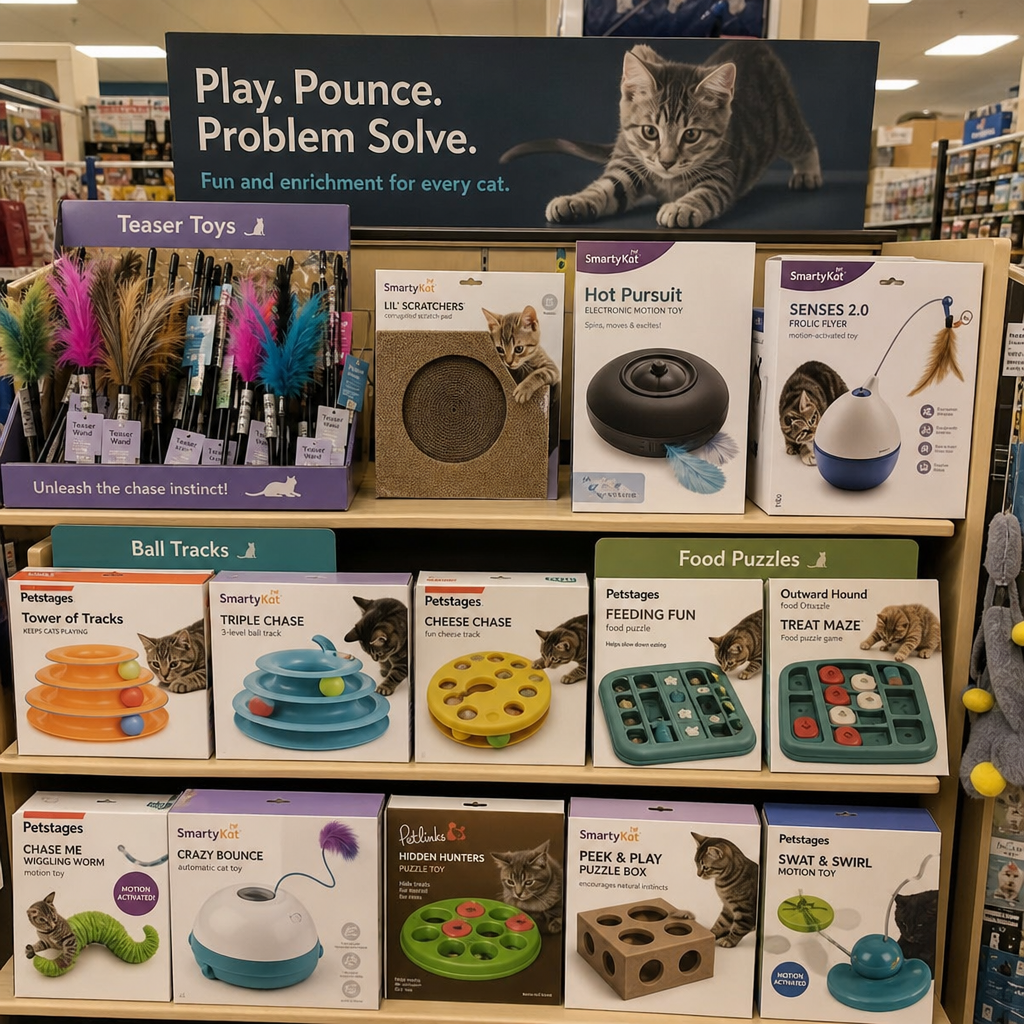
Pet stores should consider a balanced selection of handheld teasers, ball tracks, food puzzles, and electronic interactive cat toys. These formats offer different ways to encourage stalking, pouncing, and problem-solving, while individual cats may prefer different kinds of play. A varied assortment gives staff more options when matching a product to a customer's cat.
For your initial buying plan, organize the category around the interaction rather than the packaging:
|
Play format |
Customer need to explore |
Buying priority |
|---|---|---|
|
Handheld teaser |
Playing together with the cat |
Comfortable handling and clear supervision guidance |
|
Ball track |
A batting and chasing activity |
Stable construction and accessible tracks |
|
Food puzzle |
Adding a challenge to feeding |
Approachable difficulty and easy cleaning |
|
Electronic motion toy |
Introducing powered movement |
Understandable controls and clear power requirements |
Use these as merchandising categories, not promises that every cat will enjoy every toy. Before ordering, verify the exact model, wholesale availability, packaging, and instructions with your supplier.
1. Cat Dancer Original for owner-led play
The Cat Dancer Original combines spring steel wire with rolled cardboard, creating a handheld toy without batteries or electronic controls. Its simple construction makes the play mechanism easy to explain: the owner moves the wire while the cat follows the cardboard lure.
Consider it for the part of your assortment devoted to customers who want to participate in play, rather than switch on a device. In a staff demonstration, focus on handling and movement instead of making broad claims about how enthusiastically every cat will respond.
Suggested shelf message: “A simple starting point for playing together.” Position it alongside other owner-operated toys, with enough space for customers to understand its shape outside the package.
Include inspection advice in the sales conversation. Cornell recommends avoiding detachable pieces that could be swallowed, so customers should check toys for damage and remove unsafe components from use.
2. Catit Senses Play Circuit for configurable chasing
The Catit Senses Play Circuit uses an orange ball inside a track with peekaboo covers and paw openings. Its easy-click components can form different layouts, and the manufacturer describes compatibility with other Senses products. These features give staff something concrete to show beyond a product photograph.
Consider this option when your assortment needs a non-electronic track toy. Build a sample layout so customers can see how the pieces connect, where the ball travels, and how much space the assembled toy requires.
Make configuration the centerpiece of the demonstration. Ask whether the customer wants a compact arrangement or has room to experiment, then show the relevant layout rather than implying that a larger setup is always better.
Before planning accessory bundles, verify compatibility for the exact items you intend to stock. Keep the assembled example close to its packaging so shoppers can identify the correct product without assistance.
3. Petstages Tower of Tracks for multilevel batting
The Petstages Tower of Tracks has three track levels, rolling balls, and a non-slip base. The manufacturer's listed version includes six balls and carries guidance recommending it for cats aged 12 weeks and older. Because versions and packaging can differ, confirm the specifications of the stock your distributor supplies.
This is a candidate for customers comparing track toys by shape and play layout. Place an assembled sample beside a flatter circuit so shoppers can compare the formats directly without relying on package illustrations.
A useful demonstration is straightforward: move a ball around each level and show the available paw access. Avoid presenting the multilevel design as proof that several cats will happily share one toy.
Carry the supervision message onto the shelf. The manufacturer instructs owners to supervise play, inspect the toy regularly, and remove it if broken or if parts separate.
4. Catit Senses Digger for stationary food puzzles
The Catit Senses Digger is a stationary feeder with five cups in different sizes. Cats use their paws to retrieve dry food or treats, while the broad base includes a sloped surface that directs loose pieces toward a front basin. The cups and base separate for cleaning.
Evaluate it for customers interested in cat enrichment toys that incorporate food without a rolling dispenser. Display the cups outside the packaging so shoppers can see the retrieval challenge and understand how the parts come apart.
For the sales conversation, ask whether the cat has used a food puzzle before. Recommend an approachable introduction rather than filling every compartment and expecting immediate success; Cats Protection advises starting with easy food puzzles to avoid frustration.
Merchandise it near feeding products as well as toys. A small instruction card can explain the activity while leaving dietary decisions to the owner and their veterinary team.
5. TRIXIE Fun Board for varied puzzle activities
The TRIXIE Fun Board Strategy Game combines five activities on one board: globe, peg, alley, tongue, and tunnel. It includes non-slip rubber feet and a booklet with training guidance. This gives your team several distinct features to demonstrate within a single product.
Consider the board when you want a puzzle option that customers can inspect and compare with simpler feeders. Show the different sections individually rather than describing the whole product only as a “brain game.” That explanation helps shoppers understand what their cat would actually do.
For merchandising, leave enough display space to reveal the full board. A partially hidden sample makes its range of activities harder to appreciate.
Use the included training booklet when preparing staff, and encourage buyers to read it at home. Keep the recommendation grounded in the activities available; avoid promising improvements in intelligence, behavior, or health that your store cannot substantiate.
6. PetSafe SlimCat Interactive Feeder for rolling food play
The PetSafe SlimCat Interactive Feeder dispenses dry food or treats as the ball moves. Adjustable openings let owners change the challenge, and the manufacturer lists the product as top-rack dishwasher safe. These are practical details to cover when customers compare food-dispensing toys.
Consider it as a contrasting option to stationary cup feeders and puzzle boards. Your demonstration should show both the rolling action and the adjustment mechanism, with a clear explanation of how the owner fills and closes the toy.
Ask customers where they intend to use it and whether they prefer a moving or stationary feeding activity. That keeps the recommendation focused on the household rather than treating every food puzzle as interchangeable.
For supplier evaluation, test the adjustment process with a sample before ordering deeply. Staff should be able to explain it confidently and point customers toward the product's cleaning instructions without guessing about settings or food compatibility.
7. SmartyKat Hot Pursuit for concealed electronic movement
SmartyKat Hot Pursuit moves a feathered wand beneath rustling fabric, with changing direction, moving lights, and two speed controls. Its distinguishing feature is concealed motion: the moving target travels under a cover rather than remaining fully visible throughout play.
Consider this product for customers specifically exploring electronic interactive cat toys. A powered demonstration can show the movement and controls more clearly than a static display, so keep a working sample available when practical.
Let shoppers observe the operating sound as well as the action. Ask what kinds of movement their cat already investigates, rather than presenting the electronic mechanism as an automatic upgrade over a handheld toy.
Before ordering, review the current package for power requirements, care instructions, and warnings. Prepare staff to explain those details, and distinguish any included components from optional replacements. Keep promotional language focused on the mechanism rather than guaranteed engagement.
8. PetSafe Cheese Automatic Cat Toy for peekaboo play
The PetSafe Cheese Automatic Cat Toy features two toy mice that emerge from a cheese-shaped housing. It is battery-operated, includes automatic shutoff, and offers a mode with separate play sessions throughout the day. The manufacturer specifies three AA batteries, sold separately.
Evaluate it as another electronic format rather than a substitute for every other toy on the shelf. Its pop-out action offers a clear point of comparison with the concealed movement of Hot Pursuit.
Demonstrate the mice emerging from the housing, then explain the controls and battery requirements. If you merchandise batteries nearby, make their separate purchase clear before checkout.
Avoid translating automatic operation into a blanket promise that the product is suitable for every cat without oversight. Review the supplied instructions with staff and encourage buyers to observe their cat's response during introduction. The best recommendation leaves room for individual preference, not just convenience.
How can pet stores choose the right assortment?
Choose the assortment by covering distinct play formats first, then evaluate individual products against your customers, shelf space, and supplier terms. Start with a manageable selection that staff can explain well. Expand after reviewing sales, customer feedback, and the questions your team repeatedly hears.
Use this purchasing checklist before committing to a larger order:
Define each product's role. Identify the interaction it adds, not merely its color or packaging style.
Check the exact version. Match model details, included parts, warnings, and instructions to the inventory being supplied.
Request commercial terms. Confirm minimum orders, lead times, defect handling, and any applicable selling restrictions.
Inspect a sample. Practice assembly, filling, cleaning, or control adjustments before writing shelf copy.
Plan customer support. Record where staff can find manuals and whom to contact about missing or faulty components.
Set a review point. Assess performance before expanding into several products with nearly identical functions.
When choosing between similar items, favor differences your team can explain clearly. “This one rolls to release food; this one stays in place” is more useful than calling both the best cat toys.
Merchandise the activity and make safety visible
Group interactive pet toys by the experience you want shoppers to compare: play together, bat and chase, work for food, or investigate powered movement. Use plain-language shelf cards and a small number of accessible samples. Keep any display demonstration consistent with the manufacturer's instructions.
Train staff to begin with three questions: What does the cat already enjoy? Will the owner participate in play? Has the cat tried a food puzzle or moving toy before? Use the answers to narrow the choices rather than immediately recommending the most elaborate product.
Add a brief care reminder to the conversation. Cornell recommends checking for potentially detachable or ingestible components and rotating toys to maintain interest; Cats Protection also warns against leaving cats unattended with fishing-rod toys because of entanglement risk.
Build your shortlist around complementary activities, verify the supplied versions, and give staff time to learn each product. A focused selection with clear demonstrations is a practical starting point for helping customers choose cat interactive toys with realistic expectations.
Frequently Asked Questions About Interactive Cat Toys
What are interactive cat toys?
Interactive cat toys are designed to engage cats in physical and mental play. They encourage natural behaviors such as stalking, pouncing, and problem-solving, providing both enrichment and exercise for indoor cats.
How do I choose the right interactive toy for my cat?
Consider your cat's preferences and play style. Observe how your cat interacts with different types of toys (e.g., chasers, puzzle feeders, and electronic toys) and select options that match their interests. Additionally, consider the level of supervision required and the toy's safety features.
Are electronic interactive cat toys safe for cats?
Yes, most electronic interactive cat toys are designed with safety in mind. However, it's essential to choose reputable brands, check for any small or detachable parts, and supervise play to avoid any potential hazards.
How often should I rotate my cat's toys?
It's recommended to rotate your cat's toys every few days to keep their interest high. This prevents boredom and stimulates mental engagement. Regularly switching toys can help maintain your cat's curiosity and playfulness.
Can interactive cat toys help with weight management?
Yes, interactive cat toys encourage active play, which can help cats maintain a healthy weight. They stimulate physical activity, promote exercise, and provide mental challenges, contributing to overall well-being.