Back To Blog
The best wholesale Christmas gifts for retail stores are products that suit your customers, feel worth their price, and leave enough margin after freight, packaging, and promotions.
Consider giftable home accessories, winter essentials, stationery, food gifts, and carefully selected family activities rather than buying solely on seasonal appearance.
This article explains how to choose an assortment, evaluate suppliers, build a buying timeline, and turn holiday stock into displays shoppers can navigate easily.
What are the best wholesale Christmas gifts for your store?
The best wholesale Christmas gifts for your store are items your existing customers would confidently buy for a recognizable recipient or occasion. Start with familiar categories, then add seasonal details through color, packaging, or complementary accessories. Treat the categories below as candidates to test, not a universal bestseller list.
There is a useful distinction between broad gift appeal and store-specific demand. In its October 2025 holiday survey, the National Retail Federation identified clothing and accessories, books and other media, and personal care and beauty among the gifts consumers wanted to receive.
That offers category context, but it does not establish what will sell in an individual shop.
Before selecting seasonal products, give each item a clear job:
An accessible add-on: A compact gift shoppers can add without reconsidering their whole budget, such as a bookmark or small notebook.
A complete present: A standalone item with clear usefulness and presentable packaging, such as a journal or throw.
A bundle component: A product that complements something already stocked, such as a tea towel alongside kitchen accessories.
A distinctive discovery: A smaller test purchase that gives customers something unexpected without dominating your inventory commitment.
Use last season’s transactions, customer requests, and remaining stock to decide which roles need more depth. For a new store, begin with smaller commitments and record what shoppers actually choose.
Gift categories worth considering
Home fragrance and small home accessories
Consider candles, decorative trays, small vases, and compact home accessories when they fit your store’s identity. Select a coherent assortment rather than unrelated objects that happen to feature festive packaging. A restrained color palette can support several display arrangements without requiring a different fixture for every item.
Evaluate fragrance samples in person where possible. Check packaging condition, label readability, and whether the product looks presentable without additional wrapping. For candles, request the supplier’s relevant safety and warning information before ordering.
Keep explicitly Christmas-themed designs separate from pieces you could reasonably merchandise after December. That distinction should influence order depth and your eventual clearance plan.
Winter accessories and cozy essentials
Scarves, knit hats, socks, and throws deserve consideration where they match your customers and climate. For a simple assortment, favor products with limited sizing complexity and colors that coordinate with your existing merchandise. Avoid committing deeply to multiple nearly identical variations before establishing demand.
Ask for fabric composition, care instructions, dimensions, and packaging details. Examine samples for loose stitching, inconsistent finishes, and how the material feels against the skin. If a throw is intended as a complete present, check whether its wrap or sleeve survives normal shelf handling.
Build the selection around specific uses: a commuting accessory, a relaxed evening at home, or a practical stocking addition. Those distinctions give staff something more helpful to say than “it’s festive.”
Mugs, kitchen textiles, and hosting gifts
Mugs, tea towels, serving accessories, and small kitchen gifts can form a focused hosting collection. Choose pieces that connect visually and functionally, such as a mug paired with sealed tea or a tea towel alongside a suitable kitchen accessory. Keep every component’s original product information accessible.
Inspect samples for uneven finishes, rough edges, and packaging weaknesses. Request support for claims such as dishwasher suitability rather than assuming every product can carry the same care message. For breakable items, include protective packaging and potential damage handling in your cost review.
A neutral design may deserve a different buying decision from a dated Christmas slogan. Assess each on its own likely selling window.
Stationery and small desk gifts
Notebooks, journals, pens, bookmarks, and desk accessories are worth testing for customers seeking modest, useful presents. Give the assortment a purpose: travel notes, everyday organization, reading, or creative writing. That creates a clearer selection than a table of disconnected small items.
Check paper quality, binding, pen performance, and whether covers scuff during handling. Request actual dimensions; a photograph alone can make a pocket notebook look like a substantial journal. Confirm whether products arrive individually labeled and ready for sale.
Offer a standalone option as well as a suggested pairing. A journal and pen might make a complete gift, while a bookmark gives shoppers a smaller choice without forcing them into a set.
Packaged food and drink gifts
Consider sealed tea, coffee, cocoa, confectionery, or other shelf-stable gifts when your store can manage the category appropriately. Before buying, review remaining shelf life, storage instructions, ingredient information, and the condition of the retail packaging. Ask how much shelf life the supplier guarantees on delivery rather than relying only on a sample’s date.
Allergen information deserves particular attention. FDA guidance explains that foods covered by federal allergen-labeling requirements must identify major food allergens using their food-source names. Preserve required labels and avoid covering them with decorative sleeves or bundle packaging.
Build food bundles around compatible uses and storage needs. Do not describe an item as suitable for a dietary requirement unless you have reliable product-specific support.
Puzzles, games, and creative activities
Puzzles, card games, and craft activities are options for a family-oriented assortment. Choose products whose instructions, contents, and intended audience are clear from the packaging. Ask staff to review a sample so they can explain what the customer is buying.
For children’s products, make safety documentation part of supplier approval. The CPSC advises sellers to examine products for safety and recalls, and its guidance states that selling recalled products is illegal. Check relevant products against recall information rather than treating an attractive wholesale listing as sufficient assurance.
Keep age guidance visible in displays and online descriptions. Avoid presenting an adult novelty or decorative item as a child’s toy simply because it looks playful.
Match affordable holiday gifts to real shopping budgets
Build your price architecture around your store’s transaction history rather than arbitrary price points. Identify an entry level, a comfortable main-gift level, and a more substantial option. Then check that each tier contains merchandise you would be pleased to recommend.
Affordable holiday gifts should still feel deliberately chosen. Look for a useful function, consistent finish, clear product information, and packaging that does not immediately need replacing. Remove weak products from consideration instead of assuming a low ticket price excuses them.
For shoppers seeking discount Christmas presents, make the value understandable. Show the item, its price, and what is included. Avoid surrounding a modest gift with costly packaging that either erodes your margin or pushes the finished price beyond the intended budget.
Plan promotions before placing orders. Decide which products could support Christmas gift deals and which should remain full-price standalone gifts. The FTC’s advertising guidance says truthfulness standards apply to price comparisons and sale-price claims, so any advertised savings need a sound basis.
Calculate costs before comparing wholesale offers
Compare the cost of bringing sellable inventory into your store, not just the quoted unit price. For each proposed order, record merchandise cost, inbound freight, applicable duties or fees, and any preparation needed before sale. Keep uncertain costs visible until the supplier confirms them.
Separate inventory cost from the other expenses a sale must support. Gift packaging, payment processing, promotional discounts, and handling can all affect the amount left from a transaction. Use a worksheet consistently so that one supplier’s offer is not evaluated more generously than another’s.
A practical comparison should include:
|
Decision factor |
What to establish before ordering |
|---|---|
|
Sellable unit cost |
Total relevant acquisition costs divided by expected sellable units |
|
Case commitment |
Units per case, required variations, and minimum order value |
|
Selling price |
A price your customers can understand and your store can support |
|
Promotion room |
The effect of a planned discount on the amount retained |
|
Exit plan |
How remaining inventory could be sold, repurposed, or cleared |
Pay attention to mixed cases. An attractive average cost is less persuasive if the assortment includes colors or slogans you would not choose individually. Ask whether substitutions are permitted and whether you can approve them before dispatch.
How do you choose a wholesale Christmas gift supplier?
Choose a supplier by verifying product quality, commercial terms, documentation, and delivery expectations before committing to a substantial order. A low wholesale quote is only one part of that decision. Prefer clear written answers over assumptions based on photographs or a sales conversation.
Request samples from unfamiliar suppliers and inspect them using the same standards you apply to established lines. Compare the sample with the final order specification, including size, material, color, packaging, and included accessories. Retain photographs and written approvals for reference.
Use this supplier checklist:
Order requirements: Confirm minimum quantities, case packs, mixed-case options, and opening versus reorder requirements.
Availability: Establish whether stock is ready to ship, awaiting production, or dependent on another delivery.
Delivery terms: Request dispatch expectations, shipping arrangements, and the process for delayed or incomplete orders.
Damage procedures: Ask about inspection deadlines, evidence requirements, credits, and replacements.
Product information: Obtain dimensions, materials, care instructions, warnings, and relevant compliance documentation.
Retail preparation: Confirm barcodes, price-label space, individual packaging, and whether assembly is required.
Reordering: Check whether specific products or variations can be replenished separately.
When comparing wholesale gifts for Christmas, distinguish an established repeat order from an untested seasonal opportunity. Give the latter a smaller initial commitment unless you have a strong reason to do otherwise. A supplier’s willingness to answer detailed questions should inform your decision, but it is not a substitute for checking the product itself.
When should retailers buy Christmas gifts in bulk?
Retailers should buy Christmas gifts in bulk by working backward from their intended shelf-ready date and the supplier’s confirmed lead time. Include time for sampling, approvals, transport, receiving, labeling, and display preparation. There is no single ordering month that suits domestic stock, custom production, and imported merchandise equally.
Do not plan exclusively around December shoppers. In its October 2025 survey, NRF reported that 42% of holiday shoppers planned to begin before November, while most expected to finish in December. Those findings support preparing for both early browsing and later purchases, rather than concentrating the entire assortment into one launch.
Use the following buying timeline as a planning sequence, adjusting it to actual supplier terms:
Review and budget: Examine previous sales, markdowns, customer requests, and existing inventory. Set a total commitment and preserve room for replenishment.
Sample and approve: Compare products, confirm documentation, and establish realistic selling prices before issuing purchase orders.
Confirm delivery: Record promised dispatch dates, expected arrival windows, and the latest useful receipt date for each line.
Receive and prepare: Count stock, inspect condition, resolve discrepancies, and complete labels before scheduling displays.
Replenish selectively: Reorder products supported by actual sales only when their expected arrival leaves a useful selling window.
If your buying window is already short, prioritize confirmed availability and manageable preparation over an elaborate assortment. Do not accept a late shipment merely because it was part of the original plan. Decide in advance what delays would justify cancellation or a revised order, subject to agreed terms.
Display concepts that make gift selection easier
Plan display concepts around the decisions shoppers need to make: who the gift is for, what it costs, and whether it feels complete. Start with a clear organizing idea such as cozy evenings, gifts for readers, or thoughtful host presents. Use products that genuinely support that idea rather than filling space with unrelated stock.
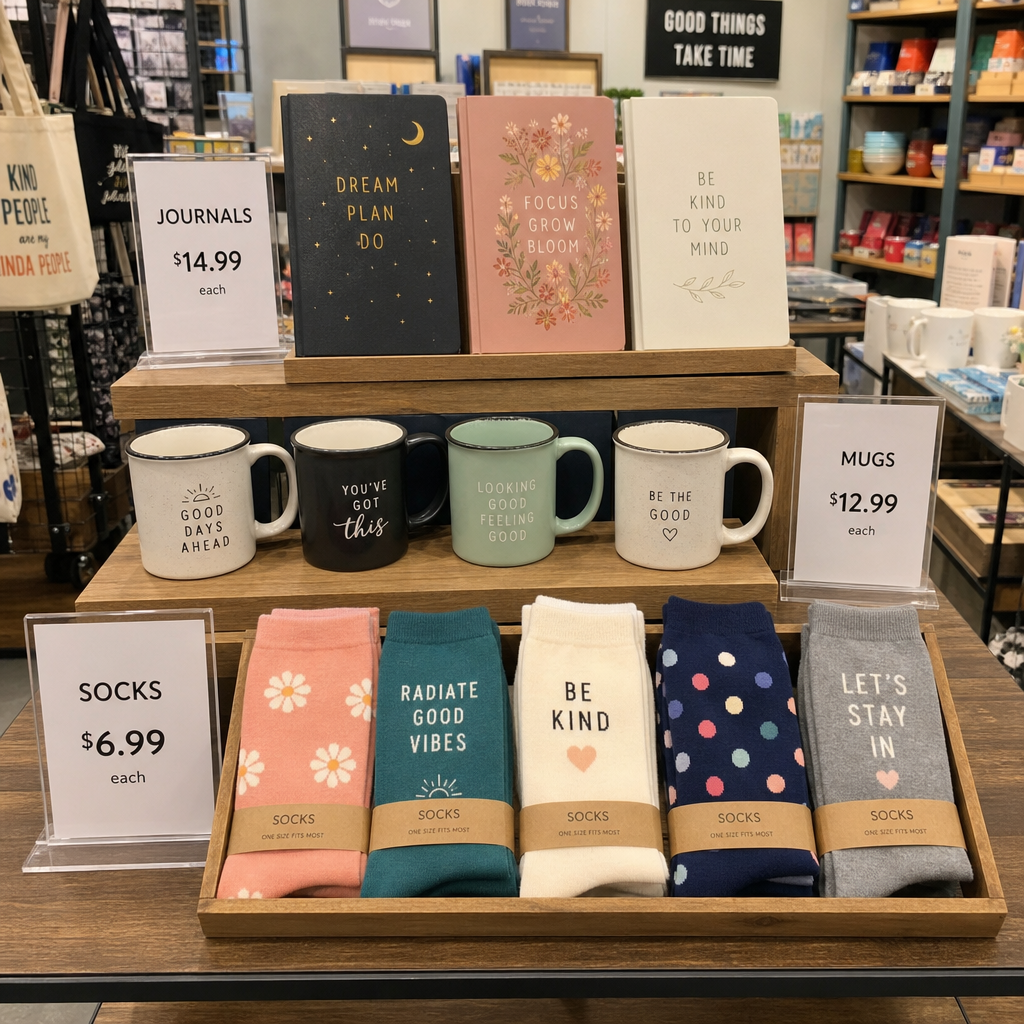
Create a main display with enough space to see individual products. Put complete presents together, then identify optional extras nearby. Keep labels readable and avoid decorations that obscure prices, care information, or packaging details.
Try these arrangements as controlled merchandising tests:
Recipient-led grouping: Bring suitable products together under a specific sign, while avoiding assumptions about age or gender that unnecessarily narrow their appeal.
Price-led shelf: Present a clearly defined budget range with an accurate price on every item. Check the sign whenever stock changes.
Ready-to-give selection: Show finished gifts exactly as sold, including the packaging and any optional wrapping charge.
Small-gift checkout area: Choose compact products with an obvious purpose, keeping the payment area uncluttered.
Give staff a short explanation of each display’s purpose and encourage them to note recurring questions. If customers repeatedly ask what is included, revise the presentation. Good merchandising should make the offer clearer, not require a longer sales explanation.
Build bulk holiday gifts without hiding the value
Consider bulk holiday gifts for customers buying several comparable presents, such as workplace teams, community groups, or event hosts. Start with a repeatable combination rather than a highly customized package that your staff cannot assemble consistently. Confirm stock before accepting an order and record the agreed contents in writing.
Potential combinations to test include:
Reading break: A notebook or bookmark with a suitable sealed drink product.
Cozy evening: Socks paired with a mug, with sizes and care information retained.
Host thank-you: A coordinated kitchen textile and small serving accessory.
Creative pause: A journal and pen, presented with their actual specifications.
Price every proposed set from its components upward, including packaging and assembly requirements. Compare the finished price with what the customer receives, not with an invented combined value. Offer individual products alongside bundles where practical so shoppers can choose without feeling pushed into extras.
For larger requests, establish payment terms, substitution approval, collection or delivery arrangements, and an order deadline. Avoid promising identical replacements unless the supplier has confirmed availability.
Monitor sales and protect your remaining budget
Treat the initial holiday assortment as a plan to manage, not a decision to defend. Review product-level sales alongside stock on hand, replenishment lead time, and customer feedback. The SBA’s holiday preparation guidance recommends reviewing previous inventory to understand which products sold well and which did not.
Track units sold, selling price, discounts, and remaining quantities consistently. Note whether an item sold alone or mainly inside bundles. That distinction matters when deciding what deserves a deeper order next season.
Before reordering, ask:
Can the stock arrive early enough to sell at the intended price?
Is demand broad, or did one large purchase create the appearance of momentum?
Would another order crowd out better-supported merchandise?
What would happen to unsold units after Christmas?
Set a review point for Christmas-specific stock before the season ends. Consider a different display, a relevant bundle, or a planned markdown rather than automatically discounting every slow item. Record what you changed so next year’s buying decisions have useful context.
Choose a focused assortment over a larger gamble
A strong Christmas gifts assortment does not need every popular category. It needs products your customers understand, suppliers whose terms you have checked, and prices that work after the full costs are considered. Choose depth where you have evidence and keep unfamiliar lines proportionate to the risk.
Start with a shortlist, request samples, and build your cost and delivery worksheet before placing orders. Then give each product a clear role on the shelf. Thoughtful buying and straightforward presentation offer a more useful foundation than chasing the largest wholesale discount.
Frequently Asked Questions About Best Wholesale Christmas Gifts for Retail Stores
What types of gifts are best for wholesale purchasing during the Christmas season?
The best types of wholesale gifts include items that appeal to your existing customer base, such as home accessories, winter essentials, food gifts, and family activities. Focus on products that can be categorized as add-ons, complete presents, or bundles.
How can I ensure that the wholesale Christmas gifts I choose will sell?
Analyze past sales data, customer requests, and market trends to determine what types of products are likely to be successful in your store. Always test a variety of categories and pay attention to items with high demand among your customer base.
What factors should I consider when selecting a wholesale supplier?
Verify product quality, pricing structure, commercial terms, and delivery expectations before committing to a supplier. Request samples, assess their documentation, and check for any relevant compliance or safety certifications.
When is the best time to order Christmas gifts in bulk?
It's advisable to work backward from your planned shelf-ready date and consider the supplier's lead time. Typically, begin your orders well in advance of the holiday season to allow for sampling, approvals, transport, and display preparations.
How do I create effective displays for wholesale Christmas gifts in my store?
Organize displays based on the decisions shoppers must make, such as who the gift is for or the price range. Use clear signage and arrange products in a way that makes it easy for customers to see individual items and understand their value.