Back To Blog
Buying drawstring backpack bags wholesale from China starts with matching the bag to its purpose, then checking samples, supplier capabilities, and the full delivered cost.
This article explains how to compare wholesale drawstring bags, plan customization, and build a purchasing process around clear specifications rather than attractive listing prices.
Whether you are preparing event giveaways, stocking a retail range, or ordering team bags, the goal is the same: receive a product that meets your brief without avoidable surprises.
What should you consider before buying drawstring backpacks wholesale from China?
Before choosing a supplier, define who will use the bags, what they will carry, your required quantity, your delivery deadline, and your maximum delivered budget. Treat these details as the foundation of your sourcing brief. They give suppliers something specific to quote and help you compare proposals on equal terms.
Start with the actual contents. For a conference, test the proposed size against your brochures, merchandise, and welcome materials. For a sports program, check the fit of clothing and accessories rather than selecting a bag from its photographed proportions.
Separate essential features from preferences. A readable logo and secure cord attachments might be essential, while an extra pocket or special fabric color could be optional. This distinction gives you sensible ways to adjust the design when quotations exceed your budget.
Also decide how you will distribute the order. Ask for packing that suits individual giveaways, retail presentation, or delivery to several locations. Include these requirements in the initial inquiry, not after approving the bag price.
Match the material and construction to the intended use
Chinese supplier listings include drawstring backpack options in polyester, nylon, and cotton, with different customization choices and minimum order quantities. Use those listings to identify candidates, but request the specification of the exact version being quoted. A product family can contain several configurations.
Instead of choosing by material name alone, ask how the finished bag should perform. Consider these points when reviewing samples:
Fabric feel and appearance: Compare the surface, opacity, texture, and overall presentation with your intended positioning.
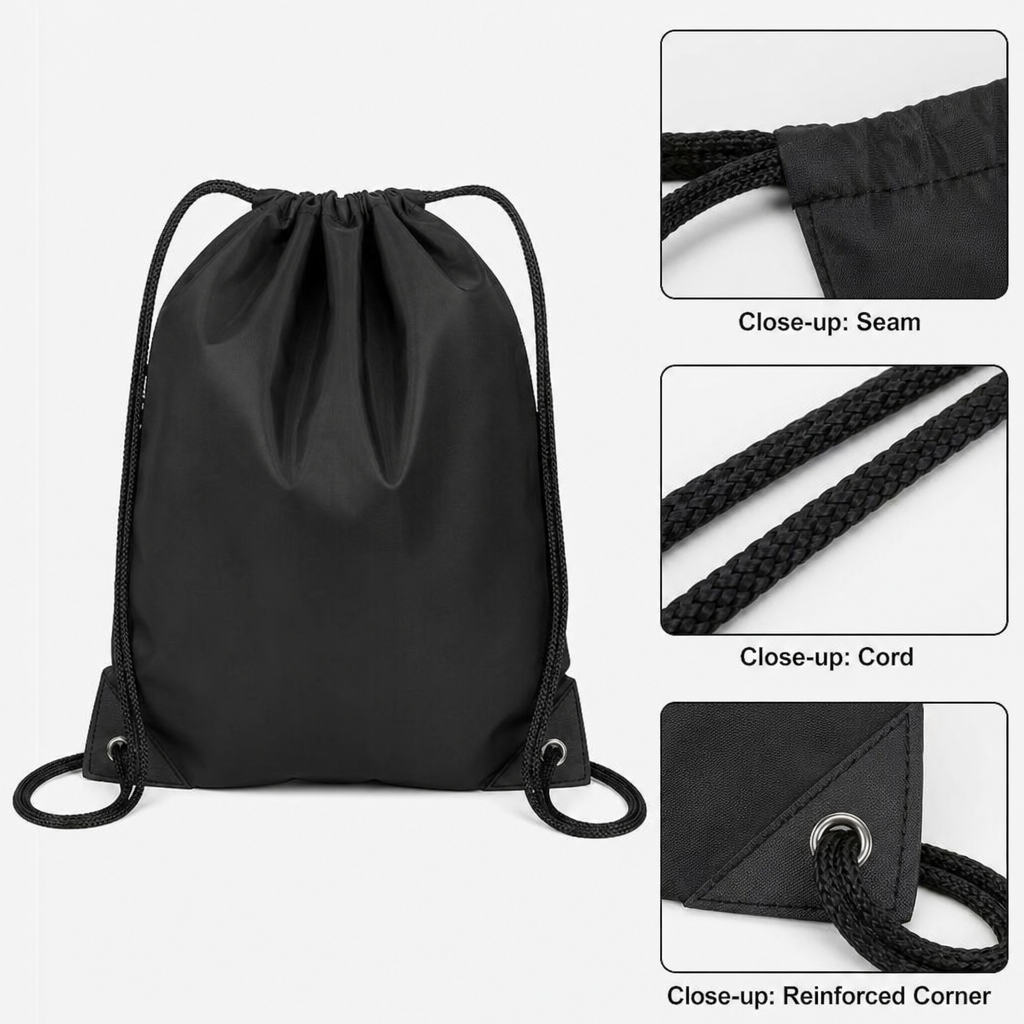
Seams and corner attachments: Examine the stitching and reinforcement, particularly where the cords connect to the bag.
Cord comfort: Try the bag with its intended contents and check whether the cords feel comfortable for the expected carrying time.
Opening and usable space: Fill the sample, close it, and confirm that the opening and internal space suit the contents.
Additional components: Test any zipper, pocket, lining, or attachment included in your specification.
For example, if you are planning a welcome pack, assemble the complete pack inside the sample. Look beyond whether everything fits: check how the filled bag hangs and whether recipients can open and close it easily.
Record your observations in the same format for every sample. A simple comparison sheet is more useful than trying to remember which bag felt better several days later.
Plan custom drawstring bags around a clear artwork brief
Approach custom drawstring bags as a product specification and a design project together. Before requesting a decorated sample, provide the logo file, intended print dimensions, placement, bag color, and any required color references. Ask the supplier to identify its proposed decoration method and confirm its suitability for the quoted fabric.
Do not approve the artwork solely because it looks attractive on a screen. Request a proof that shows the decoration at its actual dimensions, then review the physical sample before authorizing production. Include spelling, small lettering, logo proportions, and placement in your approval notes.
A useful artwork brief should state:
Whether decoration appears on one side or both sides.
The approved artwork version and its dimensions.
The placement reference and acceptable positioning variation.
Required color references and how color will be approved.
Whether labels, tags, or individual packaging need separate artwork.
For promotional drawstring bags, prioritize a design recipients can recognize without crowding the surface. Try a simple logo layout before adding several messages, contact details, and campaign graphics. Judge the result on a filled bag as well as a flat sample.
Keep the approved files and written decisions together. If you change the artwork after sampling, ask whether another sample or revised production schedule is necessary before proceeding.
How do you evaluate a wholesale drawstring bag supplier?
Evaluate a supplier against your specific order: its ability to explain the quoted construction, reproduce your approved sample, document requirements, and communicate clearly. Use the same inquiry brief for each candidate, then compare the completeness of the answers rather than choosing solely by price.
Ask who will manage sampling, production updates, quality questions, and shipping coordination. Establish which business will issue the quotation and receive payment. If several parties are involved, request a clear explanation of their roles before moving forward.
Your initial conversation should cover:
Relevant production capability: Request examples that resemble your material, construction, and decoration requirements.
Minimum order quantity: Confirm whether it applies to the whole order, each color, or each artwork version.
Sample arrangements: Ask what the sample includes, what it costs, and whether it represents the proposed production specification.
Written change control: Require approval before substituting fabric, cords, printing, or packaging.
Problem resolution: Agree how shortages, defects, or departures from the specification will be handled.
Give particular attention to vague replies. If you ask for fabric details and receive only a photograph, repeat the question before comparing the quotation. Treat unresolved specification gaps as open issues, not assumptions in your favor.
Keep a short supplier comparison sheet. Include unanswered questions beside the price so that a seemingly attractive offer does not hide missing information.
Compare total cost, not just cheap drawstring backpacks
When comparing cheap drawstring backpacks, calculate the cost of receiving usable bags at your destination. The U.S. International Trade Administration defines landed cost as the product price plus freight, insurance, tariffs, taxes, and other fees. A factory quotation is therefore only one part of the purchasing budget.
Build your comparison around the same specification, quantity, destination, and delivery scope. Ask suppliers to separate product cost, decoration, setup charges, sample charges, packaging, and any quoted logistics charges. Mark excluded or unconfirmed items clearly rather than treating them as zero.
For internal planning, use this calculation:
Estimated cost per usable bag = total purchasing and delivery costs ÷ expected usable quantity.
Treat that figure as a planning estimate until the relevant charges and quantities are confirmed. If your organization needs spare stock for distribution, budget for it explicitly instead of assuming every ordered bag is available for the main allocation.
Request price breaks only for quantities you could realistically use. Compare the total cash commitment and storage requirement alongside the per-bag figure. Do not increase the order simply to reach a lower unit price without a distribution plan.
If the budget is too high, ask for alternatives such as a standard fabric color, simpler decoration, or different packaging. Review each change against your essential requirements. Preserve the features that make the bag suitable for its intended purpose.
Use samples and inspection to define acceptable quality
Turn “good quality” into observable requirements before placing a drawstring backpack bulk order. Professional bag testing can cover material and seam strength, strap strength, static and dynamic loads, and durability. Discuss which checks suit your product and intended use rather than assuming a visual review covers everything.
Begin with a documented sample review. Measure the bag, examine the construction, check decoration, and try the intended contents. Photograph any issue and describe what must change. Ask for a revised sample when the correction affects an essential requirement.
Once approved, retain a reference sample and give the supplier the matching specification. QIMA explains that a reference sample helps its inspection teams understand the expected appearance and performance of a product. Use the sample and written brief together, rather than relying on either alone.
For bulk drawstring backpacks, consider an inspection plan that addresses:
Finished dimensions and agreed tolerances.
Fabric, colors, cords, seams, and construction details.
Logo spelling, dimensions, positioning, and appearance.
Function of closures, pockets, or other components.
Quantity, packing method, and carton markings.
Pre-shipment inspections can check finished goods against specifications, packaging instructions, and workmanship criteria before dispatch. If you arrange one, agree on the checks and the response to unacceptable findings in advance. An inspection report should support a clear shipment decision, not start a debate about previously undefined expectations.
What should your shipping and delivery plan include?
Your delivery plan should identify the destination, required arrival date, production milestones, shipping scope, and responsibility for each stage. Work backward from when the bags must be ready to distribute, leaving room for sample approval, corrections, inspection, transportation, and receiving. Ask suppliers and logistics providers to confirm their own portions of that schedule.
Distinguish the date production finishes from the date the bags are expected at your premises. Request a schedule with separate milestones for artwork approval, sample approval, production completion, inspection, dispatch, and estimated arrival. Keep estimates visibly separate from contractual commitments.
Confirm the quoted Incoterms rule and named place with the supplier and your logistics provider. ICC explains that these rules allocate obligations, costs, and the point at which risk transfers between buyer and seller. Do not assume a general phrase such as “shipping included” settles those responsibilities.
For a U.S.-bound order, ask your customs broker or logistics provider to confirm the applicable import requirements and charges before committing. Provide the actual product description, materials, intended use, value, and shipping details needed for that review. Avoid building your budget around an unverified tariff assumption.
Build a purchase brief that supports repeat orders
Before paying for production, consolidate the approved decisions into one purchase brief. Attach the specification, artwork, sample approval, packaging instructions, quantity breakdown, and delivery terms. Ask the supplier to confirm the complete package rather than relying on scattered messages.
Use this final checklist:
Product: Bag dimensions, material specification, color, cord details, construction, and required features are documented.
Decoration: Artwork version, placement, dimensions, colors, and approval method are agreed.
Quantity: Totals and allocations by color or design match your distribution plan.
Commercial terms: Prices, included charges, payment milestones, and quotation validity are clear.
Quality: Reference samples, inspection criteria, and procedures for handling defects are recorded.
Delivery: Packing, destination, shipping responsibilities, and schedule are confirmed.
When the order arrives, compare it with the same brief before distribution. Record counts, photograph issues, and keep the findings with the supplier’s responses. Use that record to decide what to retain or improve on a repeat order.
For reorders, reconfirm the specification rather than sending only “same as last time.” Identify the approved version and ask the supplier to disclose any proposed changes before quoting.
Make the specification your buying advantage
The strongest wholesale purchase starts with a clear use case and ends with a documented receiving check. Choose the bag around its contents, approve the actual construction and decoration, and compare complete delivery costs before committing. Your next step is practical: write one consistent brief and use it to request comparable quotations and samples. That gives you a firmer basis for choosing a supplier than price alone.
Frequently Asked Questions About Drawstring Backpack Bags Wholesale from China
What are the benefits of buying drawstring backpacks wholesale from China?
Buying wholesale from China often allows for significant cost savings, a wide variety of materials and styles, and the opportunity for customization. This can be especially beneficial for businesses looking to order large quantities for promotional use or resale.
How can I ensure the quality of wholesale drawstring backpacks?
To ensure quality, it's essential to request samples from suppliers, evaluate the materials and construction, and possibly conduct quality inspections. Create a clear purchasing brief and comparison sheet to document your findings and expectations.
What is the typical minimum order quantity (MOQ) for wholesale drawstring backpacks?
MOQs can vary widely depending on the supplier and the customization options chosen. It's important to confirm these details with each supplier before placing an order to ensure they align with your purchasing plan.
How long does it typically take for wholesale drawstring backpacks to be delivered?
Delivery timelines can vary based on the order size, production schedules, and shipping methods. Generally, it may take anywhere from a few weeks to several months, so planning ahead and discussing timelines with suppliers is crucial.
What should I consider when customizing drawstring backpacks?
When customizing, consider the material, design, logo placement, and color schemes. Providing clear and comprehensive artwork briefs to your supplier can help ensure that the final product meets your expectations and serves its intended purpose effectively.