Back To Blog
Global sourcing means selecting suppliers across international markets to meet business needs, rather than limiting procurement to domestic options. It can widen access to materials, skills, and production capabilities, but it also requires careful attention to cost, supplier reliability, and supply chain risk.
Understanding global sourcing benefits and challenges helps businesses evaluate opportunities without treating a low quoted price as the whole story.
What is global sourcing, and how does it work?
Global sourcing is a procurement approach that evaluates suppliers internationally to find the right combination of capability, quality, cost, and availability. It can involve raw materials, components, finished products, or services. The objective is not necessarily to replace domestic suppliers, but to consider a broader range of resources and production options.
For planning purposes, distinguish supplier selection from ongoing procurement management. Selection should establish whether a supplier can meet the requirement; management should track whether that promise holds throughout the relationship. Independent checks of identity, financial soundness, capacity, and capability provide a foundation for that decision.
A useful starting point is to define the business problem before searching for suppliers. Are you trying to reduce delivered cost, obtain a specialized process, or create an alternative source for a critical component? Use that answer to shape the shortlist, qualification process, and performance measures.
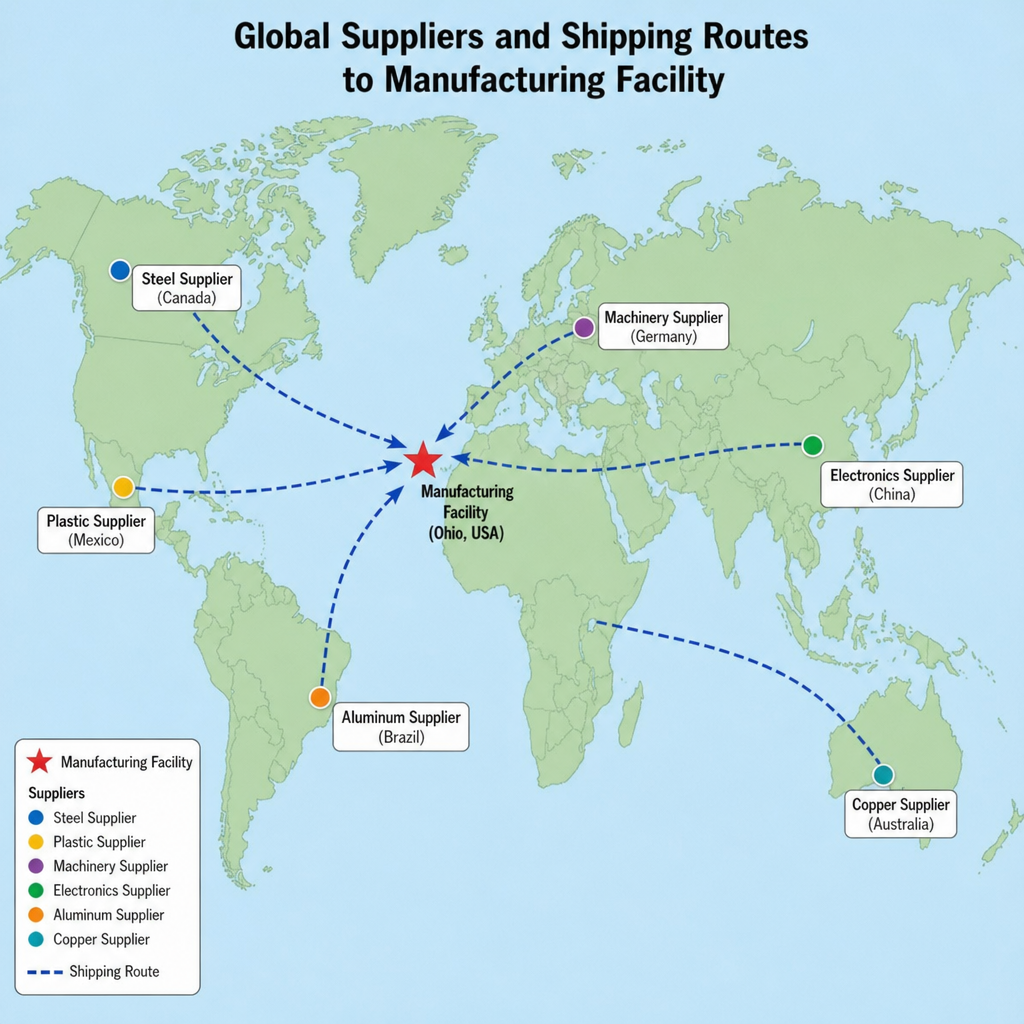
5 benefits of global sourcing
The benefits of global sourcing extend beyond purchase price. Access to different inputs and capabilities can support productivity, product development, and more diversified supply networks. These are opportunities rather than guaranteed results: their value depends on supplier fit and effective execution.
1. Opportunities for sourcing cost savings
A wider supplier market can provide access to lower-cost inputs or production methods. WTO research identifies broader access to intermediate inputs as one channel through which international trade can reduce input costs and improve productivity. However, sourcing cost savings should be assessed after transportation, insurance, duties, taxes, and other relevant charges—not from the factory quotation alone.
Ask shortlisted suppliers to quote against the same specifications, order quantities, packaging requirements, and delivery assumptions. This creates a more useful comparison than negotiating isolated unit prices.
2. Access to specialized capabilities
Some sourcing benefits come from obtaining inputs or expertise that are difficult to secure within an existing supplier network. Research on global value chains highlights access to a greater variety and quality of foreign inputs as a potential source of productivity improvement.
Translate that opportunity into a specific qualification test. If a component requires a particular finish or tolerance, request evidence that the supplier can reproduce it consistently. Evaluate the capability needed for your product, not simply the supplier’s equipment list.
3. More options for supply diversification
International markets can provide alternatives to concentrated sources of supply. The OECD identifies diversification through international trade as an opportunity to reduce dependencies, while cautioning that concentrated trade relationships can create vulnerabilities.
When assessing alternatives, look beyond the number of supplier names. Ask whether candidates depend on the same upstream producer, transport route, or geographic area. Use those answers to decide whether a second supplier creates a genuinely different recovery option.
4. Greater scope for product improvement
Global sourcing advantages can include access to different materials, component designs, and production knowledge. WTO research links a broader range of imported intermediate inputs with opportunities to improve product quality and expand product variety.
Invite suppliers to propose improvements against a defined brief. For example, ask them to suggest a material substitution while preserving required performance. Review proposals through engineering and quality teams before approving changes.
5. A broader pool of potential capacity
Looking internationally expands the pool of businesses available for evaluation. Whether that produces usable capacity depends on verification: procurement due diligence should establish that a supplier has the resources and capability to deliver over the contract’s life.
Ask about available production time, competing commitments, staffing, and subcontracting. Then test the proposed arrangement with a controlled order. Treat an attractive capacity claim as something to validate, not as a reason to bypass qualification.
The challenges behind international purchasing
International supply chains face risks from geopolitical tensions, natural disasters, regulatory uncertainty, and economic volatility. The practical challenge is to identify which exposures matter to the specific product and supplier network, rather than assuming that every overseas source presents the same risk.
Delivery uncertainty and operational disruption
Supply chain resilience requires more than identifying an alternative on paper. IMF research emphasizes that businesses cannot immediately reconfigure supply chains after a shock because adjustments encounter practical constraints. Diversification can improve resilience, but it can also involve efficiency costs.
Build delivery planning around the full sequence from order release to usable inventory. Ask suppliers and logistics providers to explain production milestones, handoffs, documentation, and likely bottlenecks. For critical items, define when to escalate a delay and who can authorize an alternative shipment or source.
Supplier verification and quality alignment
A supplier’s presentation should not substitute for independent verification. Government procurement guidance recommends checking legal identity, financial soundness, delivery capability, past performance, and relevant employment practices before awarding a contract.
Create a shared specification package with drawings, revision numbers, approved materials, inspection criteria, and packaging instructions. Establish how defects will be reported and corrected. Require written approval before changing materials, processes, or subcontractors, and use pilot results to decide whether larger orders are justified.
Trade requirements and responsible sourcing
Cross-border purchasing requires attention to applicable tariffs, taxes, and allocation of shipping responsibilities. The International Trade Administration also cautions that landed-cost estimates can change as charges and tariff conditions change. (trade.gov)
Responsible sourcing deserves a separate review. The U.S. Department of Labor’s SourcingStrong tool supports companies assessing labor-related supply chain safeguards, while European Commission guidance encourages businesses to examine suppliers’ own due diligence and mitigation procedures.
Before committing, assign responsibility for checking product-specific requirements with appropriate specialists. Ask suppliers for supporting records and a process for correcting identified problems. Avoid treating a completed questionnaire as the end of due diligence.
Limited visibility beyond the direct supplier
For information and communications technology suppliers, NIST’s due diligence framework explicitly considers provenance, resilience, foundational cybersecurity practices, and supply chain tiers. Its scope illustrates why evaluating the immediate seller alone may leave important questions unanswered.
Tailor your questions to the purchase. For a critical physical component, ask where essential inputs originate and which activities are subcontracted. For a digital service, examine access permissions and handling of sensitive information. Document unresolved dependencies before approving the relationship.
How do you calculate the true cost of global sourcing?
Start with landed cost: the product price plus transportation, insurance, tariffs, taxes, and other applicable fees needed to deliver it to the buyer. Then extend the business case to include your organization’s additional costs of qualifying, financing, inspecting, and managing the purchase. Keep those categories separate so assumptions remain visible.
Use the following checklist when requesting comparable proposals:
- Purchase terms: Confirm quantities, tooling charges, packaging, payment timing, and exactly what the quoted price includes.
- Delivery costs: Request estimates for freight, insurance, handling, customs support, and final delivery where relevant.
- Border charges: Verify applicable duties and taxes rather than carrying forward assumptions from a previous purchase.
- Internal workload: Budget for supplier qualification, sample reviews, inspections, and ongoing coordination.
- Inventory exposure: Model the cash committed before goods become available and the consequences of holding additional stock.
- Exceptions: Test scenarios involving rejected goods, replacement shipments, delayed deliveries, or changed transport costs.
The first three categories establish the landed-cost comparison; the remaining categories broaden the decision into a business case. The International Trade Administration recommends treating landed costs as estimates, including because shipping providers may impose additional charges.
Run a base case and a less favorable case. If the proposal only works when every assumption goes right, reconsider the supplier, order structure, or sourcing decision.
Global sourcing strategies that balance value and risk
A useful strategy should specify what to source internationally, why the opportunity matters, and what would make the arrangement unacceptable. Avoid applying one purchasing model to every category. Instead, use the steps below to turn broad global procurement benefits into testable business decisions.
Segment purchases before selecting suppliers
Assess each category by business impact, substitutability, specification complexity, and tolerance for interruption. OECD analysis identifies disruption risk, economic importance, and constrained substitution as useful dimensions for understanding trade dependencies. Use those dimensions as prompts for your own category review, not as a ready-made supplier score.
For an easily replaced item, prioritize a straightforward comparison and efficient ordering. For a critical custom component, require deeper qualification and a documented recovery plan. Write the reasoning down so stakeholders understand why different categories receive different controls.
Qualify progressively and define decision gates
Make each stage answer a specific question before releasing more spend:
- Initial screening: Does the supplier appear capable of meeting the requirement and providing the necessary evidence?
- Independent verification: Can identity, financial standing, references, and delivery capability be substantiated?
- Sample evaluation: Does the proposed output meet the agreed specification and inspection criteria?
- Pilot order: Can the supplier execute the order, documentation, communication, and delivery process as planned?
- Scale-up approval: Do results justify greater volume, and are unresolved issues acceptable to the responsible teams?
Set acceptance criteria before each stage begins. Record exceptions and assign owners rather than allowing unresolved concerns to disappear during commercial negotiations.
Design backup arrangements that can be used
Consider targeted diversification where interruption would be costly and substitution difficult. IMF research finds that the resilience case for diversification depends on exposure to shocks and the trade-off against efficiency; it does not suggest that every purchase needs multiple sources.
For selected critical items, document backup qualification, production readiness, tooling access, and activation responsibilities. Discuss whether the alternative needs periodic orders to remain usable. Review the arrangement when the product, supplier, or route changes.
Measure results beyond the negotiated price
Build a scorecard around the original sourcing objective. If the goal was cost reduction, compare realized delivered cost with the approved baseline. If it was continuity, examine whether the business now has a workable alternative. Keep measures simple enough that teams can maintain them consistently.
Useful measures to consider include:
Cost performance: Delivered cost against the approved business case, with changes explained.
Delivery reliability: Performance against agreed arrival dates and quantities.
Quality performance: Accepted output, recurring defects, and closure of corrective actions.
Responsiveness: Speed and completeness of replies to operational issues.
Dependency readiness: Status of critical upstream information and approved alternatives.
Agree on definitions before comparing suppliers. Review results with purchasing, operations, finance, and quality stakeholders so that an apparent purchasing win is tested against the wider business outcome.
Turn sourcing opportunities into dependable value
Evaluate global sourcing as a business decision, not a contest for the lowest quotation. Begin with one clearly defined category, compare costs transparently, and qualify suppliers against measurable requirements. Scale only when evidence supports the decision. That approach keeps attention on the sourcing benefits the business actually needs—and on the controls required to preserve them.
Frequently Asked Questions Related to Global Sourcing Benefits and Challenges

What are the main benefits of global sourcing?
Global sourcing provides access to lower-cost inputs, specialized capabilities, alternative supply sources, opportunities for product improvement, and a broader pool of potential suppliers, which can enhance a company's competitiveness and reduce costs.
What challenges do businesses face with global sourcing?
Challenges include delivery uncertainties, supplier verification issues, trade compliance complexities, potential geopolitical risks, and limited visibility beyond direct suppliers, which can complicate procurement decisions.
How can companies calculate the true cost of global sourcing?
The true cost includes the product price plus transportation, insurance, tariffs, taxes, and any additional costs associated with qualifying, managing, and inspecting the suppliers. This approach helps businesses make informed sourcing decisions.
What strategies can businesses use to mitigate risks in global sourcing?
Companies can segment their purchases based on impact, define progressive qualification criteria for suppliers, design backup arrangements for critical items, and continuously evaluate sourcing outcomes against established objectives.
How do businesses choose the right suppliers in global sourcing?
Businesses should conduct thorough due diligence, verify supplier capabilities, assess financial health, and define acceptance criteria. It's essential to align sourcing strategies with business needs and performance measures for effective supplier selection.