Back To Blog
Global Sources connects business buyers with suppliers through online sourcing and trade shows. Start online if you need to compare products remotely; consider meeting shortlisted suppliers in person when product evaluation or customization warrants the trip.
This comparison explains how to choose a sourcing route, assess manufacturers versus trading companies, and move from inquiry to an order with clear specifications and agreed terms.
Should you buy through online sourcing or trade shows?
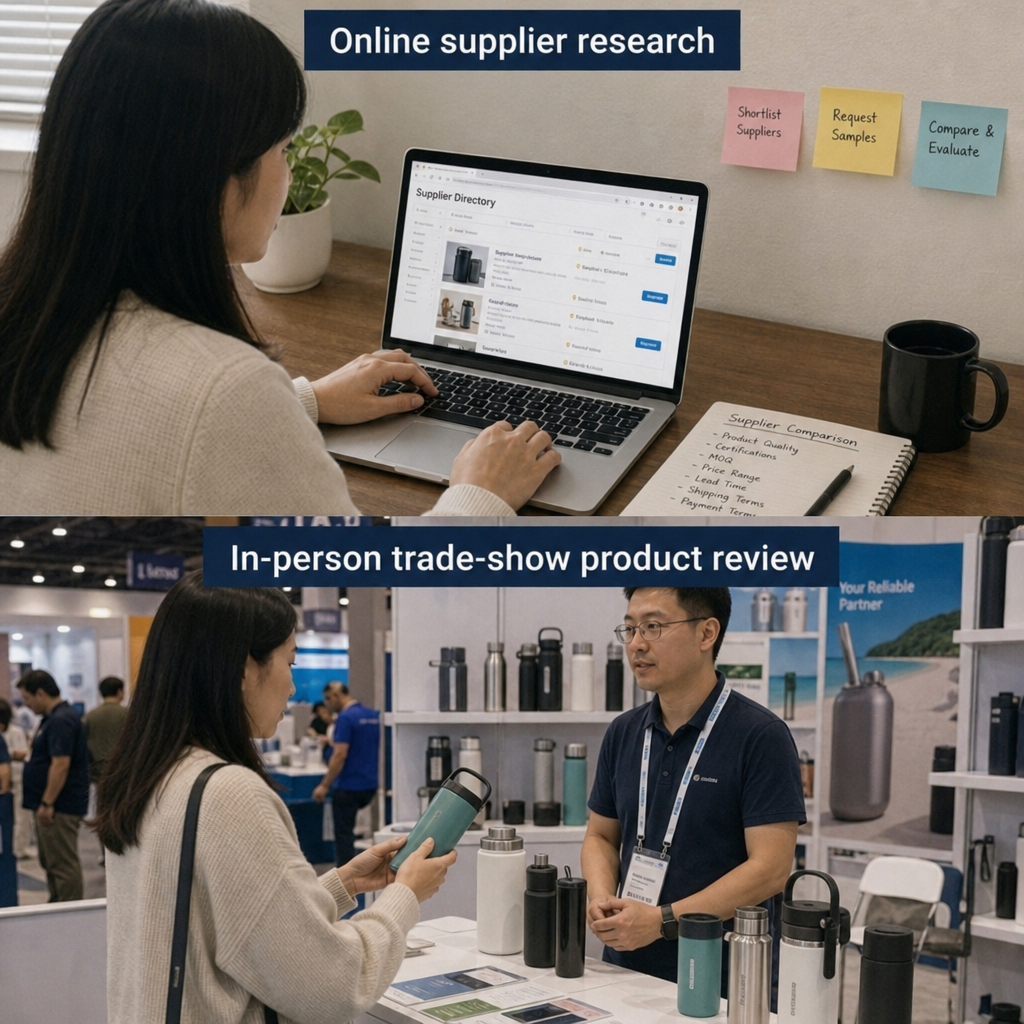
Use online sourcing for initial research and remote supplier discussions. Choose trade shows when handling samples and discussing requirements face to face would help resolve important purchasing questions. Global Sources supports both approaches, so you can research suppliers online before arranging meetings at an exhibition.
The following decision guide compares how to use each route rather than promising that one produces better suppliers.
|
Decision criterion |
Online sourcing |
Trade-show sourcing |
|---|---|---|
|
Best starting point |
Researching a defined product remotely |
Evaluating a prepared supplier shortlist in person |
|
Product review |
Request specifications, videos, and shipped samples |
Examine display samples, then request production-representative samples |
|
Supplier discussions |
Keep written questions and quotations organized |
Resolve detailed questions during scheduled meetings |
|
Budget planning |
Allow for samples, testing, and remote assessments |
Add travel, accommodation, and staff time |
|
Comparison method |
Send the same brief to every candidate |
Use the same evaluation sheet at every booth |
|
Essential follow-up |
Verify capability before committing |
Document discussions and verify capability afterward |
Recommended starting route: research online, request comparable quotations, and order samples before deciding whether travel adds enough value. Avoid booking a trip simply because a supplier has an attractive display. Instead, identify the unanswered questions that justify meeting them.
If you attend a show, arrange priority meetings beforehand and bring your specification sheet. Ask each supplier to send a written quotation after the conversation. Global Sources’ own sourcing guidance recommends obtaining a full specification quotation so both parties retain the same understanding.
Which supplier type fits your order: manufacturer or trading company?
Choose a manufacturer when direct discussion of production and customization is central to your project. Consider a trading company when coordination across products or factories matters more. Neither label should decide the purchase alone: ask what the business actually controls, what it outsources, and who will resolve quality problems. Global Sources’ sourcing guidance recognizes both models as potentially useful.
Use these questions to compare candidates on the same terms:
|
Criterion |
Ask a manufacturer |
Ask a trading company |
|---|---|---|
|
Production control |
Which processes happen at your facility? |
Which factory makes this exact item? |
|
Product expertise |
What is your main production specialty? |
How do you qualify factories in this category? |
|
Customization |
Who approves drawings and process changes? |
How are my requirements communicated and checked? |
|
Quality management |
Who inspects production and authorizes release? |
Who inspects the factory’s output before shipment? |
|
Order coordination |
Can you supply every required component? |
Can you consolidate products without losing traceability? |
|
Accountability |
Which legal entity signs the order? |
Which legal entity accepts responsibility for defects? |
For a narrowly specified product, prioritize evidence of relevant production capability. For a mixed assortment, ask how the supplier manages consistency across different production sites. Require the quotation to identify the seller and explain any separate manufacturing arrangements.
Do not assume that buying directly always produces the lowest overall cost. Compare actual offers, inspection arrangements, shipping responsibilities, and the work your own team must perform. Choose the business model that fits your order, then verify the individual supplier behind it.
Prepare a buying brief before searching
Start with a specification that another person could use to evaluate the product without guessing. Describe the intended use, destination market, dimensions, materials, finish, packaging, and acceptable variations. Separate nonnegotiable requirements from preferences so suppliers know where alternatives are welcome.
Your brief should cover:
- Product identity: category, reference images, model requirements, and intended customer.
- Technical requirements: materials, dimensions, performance expectations, and measurable tolerances.
- Order scope: initial quantity, variants, packaging, and a realistic replenishment scenario.
- Customization: logo placement, artwork, tooling, and ownership questions.
- Delivery needs: destination, required arrival window, and quotation basis.
- Evidence needed: samples, relevant test reports, inspection access, and production information.
Decide whether to compare an existing design or a customized product. Request separate quotations when evaluating both. Otherwise, a stock-item offer and a custom-development offer may look comparable even though they involve different deliverables.
Before requesting production, investigate the requirements for your destination market. For United States imports, CBP advises importers to ensure their merchandise satisfies applicable agency requirements and to obtain specialist guidance where necessary. A supplier’s willingness to ship is not a substitute for that review.
Give the brief a version number and date. Use that version in inquiries, sample requests, and purchase documents so later changes remain traceable.
Search Global Sources and request comparable quotations
Search with a specific product name and the features that matter most. Review product information alongside the supplier’s company profile, then use the available inquiry or contact tools to ask for missing details. Global Sources provides supplier profiles and contact options, while its help center offers sourcing support.
Treat the first search as discovery, not selection. Build a shortlist, record why each candidate appears relevant, and send everyone the same brief. Your aim is to compare responses to one requirement rather than collect unrelated offers.
A practical first inquiry
Adapt this message to your product instead of sending an unspecified request for the “best price”:
We are sourcing [product] for sale in [destination market]. Please quote against the attached specification, version [number], for [quantity] units. Identify your legal company name and whether you manufacture this item.
Please confirm the minimum order quantity, sample cost, production lead time, packaging, customization charges, payment proposal, and quotation validity. State the delivery term and named location, list exclusions, and identify any requirements you cannot meet.
Ask suppliers to distinguish sample availability from bulk production timing. Request separate lines for tooling, artwork, packaging changes, testing, and other charges. Also ask what starts the production clock: deposit receipt, artwork approval, sample approval, or another agreed event.
Organize responses in a comparison sheet. Mark unanswered questions rather than filling gaps with assumptions. If one supplier proposes a different material or design, keep that offer separate until you decide whether the substitution is acceptable.
Before choosing a finalist, request a revised quotation that resolves every open point. Global Sources’ supplier guidance recommends confirming quantity, price, delivery time, payment method, and other order details in writing. (help.globalsources.com)
Verify the supplier beyond its profile badge
Global Sources distinguishes several verification signals. Its Verified Supplier designation concerns third-party verification of business registration details. Verified Manufacturer concerns a government-licensed manufacturing business scope checked by third parties.
An optional Supplier Capability Assessment provides more detailed information from an onsite visit. These checks address different questions; none should be read as approval of your particular order. (globalsources.com)
Build your own verification file around the transaction:
Match the legal identity. Compare the company name on the profile, quotation, proposed contract, and payment instructions. Ask for an explanation of differences.
Confirm relevant capability. Request evidence related to your product and process, not simply photographs of a large facility.
Review available assessments. Check the assessed locati0n, scope, date, and whether the findings relate to the proposed production site.
Discuss subcontracting. Ask which processes may move elsewhere and how changes will be disclosed.
Establish escalation contacts. Identify who can authorize corrective action when the sales contact cannot resolve a problem.
For a substantial or technically demanding order, consider an independent assessment with a scope tailored to your risks. Define what the assessor should examine before commissioning the work. A generic factory tour may not answer questions about your materials, tooling, or production controls.
Keep verification and product acceptance separate. One establishes whom you are dealing with; the other establishes whether the goods meet your requirements. Require evidence for both before increasing your commitment.
Which quotation is cheaper after delivery costs?
The cheaper quotation is the one with the lower comparable total cost, not necessarily the lowest unit price. Landed cost includes the product price, freight, insurance, tariffs, taxes, and other applicable charges. Compare suppliers on the same destination and delivery basis before deciding.
Use this worksheet to expose differences without inventing a universal shipping rate or import charge:
|
Cost category |
Supplier A |
Supplier B |
|---|---|---|
|
Goods at the same quantity and specification |
Record confirmed amount |
Record confirmed amount |
|
Tooling and setup |
Identify included and separate charges |
Identify included and separate charges |
|
Packaging and labeling |
Confirm exact scope |
Confirm exact scope |
|
Samples, testing, and inspection |
Obtain relevant quotations |
Obtain relevant quotations |
|
Freight and insurance |
Quote the same route and service |
Quote the same route and service |
|
Duties, taxes, and clearance |
Verify for the actual shipment |
Verify for the actual shipment |
|
Destination handling and delivery |
Identify exclusions |
Identify exclusions |
Ask a freight provider to review the shipment dimensions, weight, route, and service assumptions. Ask your customs broker to review classification and applicable import charges. Recalculate before committing if the product, origin, quantity, or shipping arrangement changes.
Record the agreed Incoterms rule, named place or port, and version. These rules allocate specified delivery tasks, costs, and risks, but they do not replace payment terms, product specifications, or dispute provisions. Do not treat “shipping included” as a complete allocation of responsibilities.
For an internal decision, also consider inventory exposure. Reject a larger order if the apparent unit-price saving does not justify the cash commitment and storage burden for your business.
Compare payment proposals and document the order
Payment terms deserve the same scrutiny as price. Cash in advance places substantial risk on the importer, while other arrangements allocate risk differently.
The International Trade Administration’s Trade Finance Guide explains options including advance payment, letters of credit, and documentary collections; discuss suitability with your bank rather than assuming one method fits every purchase.
When comparing proposals, ask:
- What event triggers each payment?
- What evidence must exist before payment becomes due?
- Can the agreement link a payment milestone to an agreed inspection outcome?
- Who pays transaction charges?
- What happens if production is late or goods fail the agreed checks?
- Which legal entity receives payment, and how will account changes be verified?
Do not assume every Global Sources inquiry includes escrow, a refund guarantee, or platform-managed dispute protection. Before relying on any payment service, review the terms displayed for the actual transaction and ask the platform to clarify uncertainty. The help center includes online-payment and dispute topics.
Document the approved specification, quantity, price, payment milestones, delivery obligations, inspection process, and agreed remedies in the purchase agreement. For customized goods, address artwork, tooling ownership, permitted use, and unauthorized substitutions. Obtain qualified advice when the order’s value or complexity warrants it.
Pause payment if the beneficiary details change unexpectedly. Verify the change through an independently established contact route before proceeding.
Approve samples and define acceptance before production
Use samples to test the requirements in your buying brief, not just to judge appearance. Check dimensions, materials, fit, finish, functionality, labeling, and packaging as appropriate. Record the results and tell the supplier exactly which changes are required.
For a customized item, retain an identified approval sample and the matching specification version. Ask the supplier to confirm which aspects are representative of bulk production. A sample approval should not silently authorize later material or component substitutions.
Create a written acceptance plan:
- Define checks: identify measurable requirements and the inspection method.
- Set timing: decide whether checks occur during production, before shipment, or at multiple stages.
- Specify access: confirm who may inspect and what records they may review.
- Agree responses: document rework, replacement, reinspection, and shipment-release procedures.
- Control changes: require written approval for deviations from the accepted specification.
Keep commercial inspection separate from regulatory compliance testing. For example, CPSC states that nearly all children’s products require testing by a CPSC-accepted third-party laboratory against applicable children’s product safety requirements. Responsible firms must follow the relevant testing and recordkeeping requirements.
For overseas-manufactured children’s products, CPSC also explains that the importer must issue the Children’s Product Certificate rather than simply pass along a foreign manufacturer’s certificate. Obtain product-specific compliance advice before production, not after the shipment arrives.
Plan shipping and customs before goods are ready
Assign responsibility for booking freight, preparing documents, clearing customs, and delivering the shipment. Ask your logistics providers what information they need and when they need it. Share the agreed delivery term so their quotations address the same scope.
Before shipment, reconcile the commercial invoice, packing list, product description, quantities, and consignee details against the order. Have your broker identify additional information or documents required for your shipment. Avoid asking the supplier to improvise descriptions or values to simplify clearance.
For United States imports, using a customs broker does not remove the importer of record’s responsibility for correct entry documentation and applicable duties, taxes, and fees. CBP’s new-importer guidance also highlights advance filing requirements for ocean cargo. Confirm the requirements and deadlines for your shipment with your broker before departure.
Build an arrival plan as well as a departure plan. Reserve receiving capacity, identify who will count and inspect delivered goods, and establish how discrepancies will be recorded. Keep shipment photographs, inspection results, and correspondence together so any issue can be investigated against the agreed requirements.
Use sourcing strategies that remain useful as conditions change
Treat global market trends as prompts to investigate, not reasons to abandon your specification or overbuy. Before accepting a price revision, ask what changed: materials, packaging, production assumptions, freight, or another identified cost. Request a revised quotation rather than relying on a verbal explanation.
Use these sourcing best practices as internal controls:
Track quotation validity: reconfirm expired offers before approving an order.
Separate demand from discounts: set quantities using your sales plan and available cash.
Maintain an alternative: keep another qualified candidate’s information current for critical products.
Review each shipment: record accepted quality, actual timing, documentation issues, and total cost.
Control repeat orders: reconfirm specifications and changes instead of assuming the previous order governs everything.
When buying from abroad, make the first order a controlled commitment rather than a test of optimism. Choose a scope your team can evaluate thoroughly. Expand only after reviewing the delivered result and resolving outstanding problems.
Choose the route, then control the purchase
For most first-time buyers, start with online research and comparable inquiries. Add a trade-show visit when examining products or discussing complex requirements in person has a clear purpose. Choose between a manufacturer and a trading company using evidence of capability, coordination, and accountability—not the label alone.
Before releasing an order, confirm that you have:
- A written specification and identified approval sample where appropriate.
- A verified seller identity and understood production arrangement.
- A comparable cost calculation with shipping exclusions identified.
- Agreed payment milestones, inspection criteria, and corrective-action terms.
- A destination-specific compliance and customs plan.
Your next step: prepare one product brief and send it to a focused Global Sources shortlist. Compare the responses, resolve missing information, and request samples from the strongest candidates.
Commit to production only when the product, supplier, costs, and responsibilities are sufficiently clear to manage.
Frequently Asked Questions About Global Sources
What is Global Sources and how does it work?
Global Sources is a Hong Kong-based online marketplace that connects buyers with suppliers, offering a platform for sourcing products from manufacturers and trading companies worldwide. It provides access to product catalogs, supplier information, and various sourcing tools.
What are the benefits of using Global Sources for sourcing?
Using Global Sources allows buyers to access a wide range of suppliers, compare products and prices, and facilitate communication directly with manufacturers. It also offers trade shows and exhibitions for in-person interaction with suppliers.
How do I ensure the legitimacy of a supplier on Global Sources?
To verify a supplier's legitimacy, check for their "Verified Supplier" or "Verified Manufacturer" badges, request references, review their business registration details, and consider conducting independent assessments or factory visits for substantial orders.
What should I include in my buying brief when sourcing products?
Your buying brief should specify the product identity, technical requirements, order scope, customization needs, delivery details, and evidence required from suppliers, such as samples or test reports.
How can I compare quotations from different suppliers effectively?
When comparing quotations, assess the total landed cost, which includes product price, shipping fees, and any applicable taxes or duties. Use a worksheet to organize the details side by side and ensure you are comparing the same criteria across all suppliers.