Back To Blog
Finding custom plush toy manufacturers in China starts with a clear product brief, a targeted supplier search, and careful verification before you commit to production.
This article explains how to compare plush toy makers, evaluate samples, plan safety testing, and calculate the cost of getting finished products to your warehouse. The goal is to choose a supplier that can reproduce your design consistently—not simply quote the lowest price.
Where should you look for custom plush toy manufacturers in China?
Start with official trade-show exhibitor directories, then use supplier websites and direct conversations to investigate manufacturers whose product categories match your design.
The Canton Fair provides product and exhibitor search tools, while China Toy Expo’s directory includes categories such as plush toys, cloth toys, and licensed character plush. Treat these listings as starting points for research, not endorsements of individual suppliers.
Search beyond broad phrases. Pair “custom plush toy manufacturers China” with the capability you need: embroidered faces, removable clothing, mascot development, or character prototyping. Your objective is to uncover relevant work rather than collect the longest possible supplier list.
For each prospect, record the company name, factory locati0n, contact details, relevant examples, stated minimum order quantity, and unanswered questions. Keep discovery separate from approval: a polished listing earns a conversation, not an order.
When approaching soft toy manufacturers, ask for examples comparable to your project in shape, materials, and complexity. A portfolio of round promotional animals tells you little about whether a supplier can execute a detailed character with clothing and multiple accessories.
Prepare a brief suppliers can actually quote
Before requesting prices, define what you want made. Give every supplier the same information so you can compare responses without guessing which assumptions sit behind each quote.
Your brief should cover:
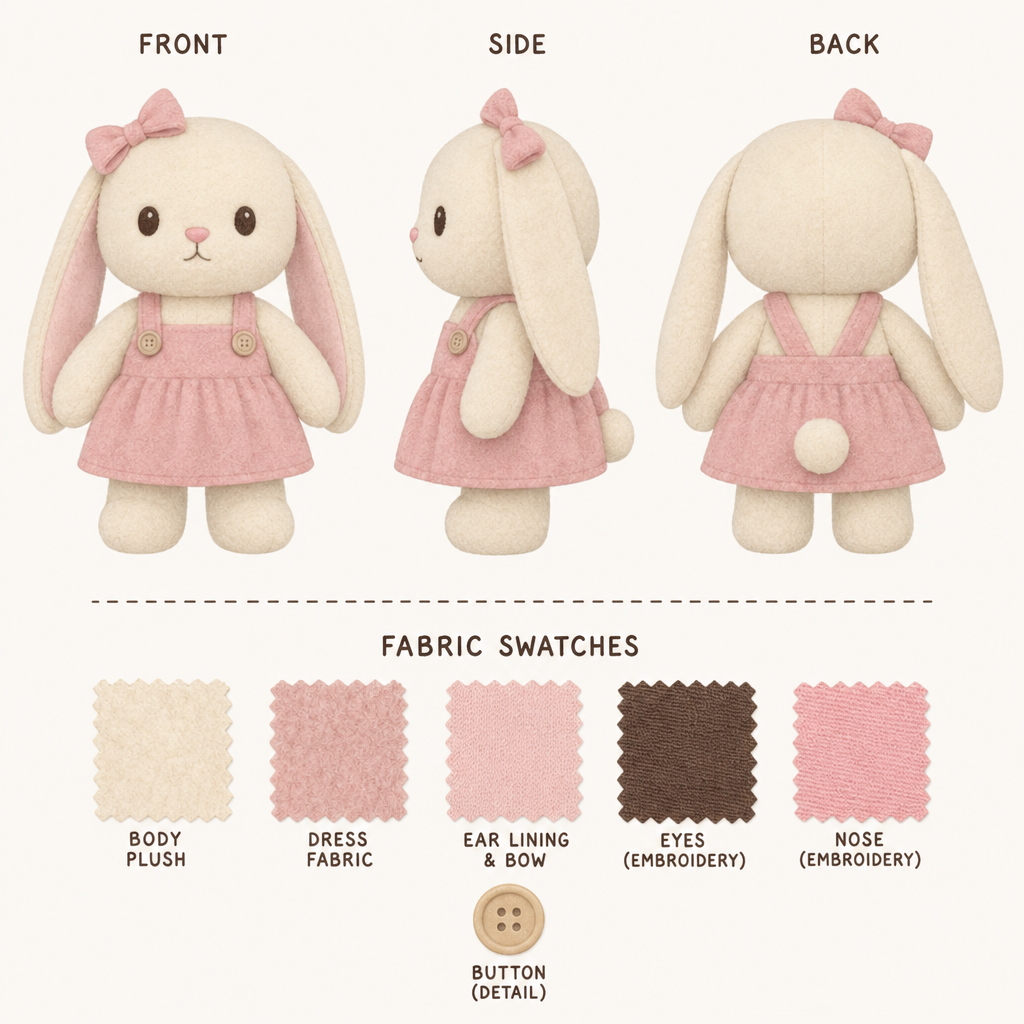
Design references: Front, side, and back views, plus close-ups of important features.
Dimensions: Target height or length, measurement method, and acceptable variation.
Materials: Preferred fabric texture, filling, colors, and any material restrictions.
Construction: Embroidered or attached features, clothing, accessories, and moving parts.
Audience and market: Intended users, age range, sales countries, and distribution channels.
Order scope: Quantity per design and color, packaging, labels, and delivery destination.
Development needs: Whether you need pattern development, artwork interpretation, or only production.
Distinguish personalized plush toys from fully original designs. If you want a name embroidered on an existing animal, describe that scope explicitly. If you need custom stuffed animals developed from original artwork, ask suppliers to quote the development work separately.
For example, specify whether a character’s ears must stand upright or may flop naturally. That detail gives a supplier something concrete to assess and gives you a clear approval criterion later.
Verify the business behind the portfolio
Investigate who you would actually contract with before paying for development or production. The U.S. International Trade Administration recommends due diligence on potential overseas partners and provides company-background research resources. Use that principle to guide your own checks rather than relying solely on marketplace badges or sales presentations.
Request the registered company name, business documentation, manufacturing address, and an explanation of the relationship between the seller and production facility. Ask whether the business manufactures directly, coordinates subcontractors, or acts as a trading company. Focus on transparency and accountability rather than treating one business model as automatically preferable.
Use a live video meeting to walk through the proposed workflow. Ask to see relevant work areas and discuss which operations happen elsewhere. For a significant commitment, consider an independent site visit or factory assessment; the EU SME Centre recommends checking business information and, where possible, inspecting premises and goods.
Also ask who handles technical questions, sample revisions, and production problems. Keep unresolved identity or payment-detail discrepancies open until you have independently confirmed the explanation.
How can you tell whether a plush manufacturer fits your project?
Evaluate fit by asking the supplier to explain how it would make your specific design, then checking that explanation against relevant samples and a written development plan. Look for clear questions about materials, proportions, construction, and intended use. Do not make selection decisions on enthusiasm alone.
Give shortlisted suppliers the same technical challenge. Ask how they would preserve a narrow neck, reproduce a facial expression, or attach a removable jacket. Request explanations of proposed changes rather than accepting a vague promise that everything is possible.
Use a comparison sheet with these decision criteria:
|
Criterion |
Evidence to request |
|---|---|
|
Design interpretation |
Comparable projects and comments on your artwork |
|
Development process |
Sample stages, revision terms, and approval checkpoints |
|
Production control |
Material confirmation, inspection procedures, and subcontracting disclosure |
|
Commercial fit |
Itemized pricing, quantity requirements, and payment milestones |
|
Communication |
Written answers that resolve technical questions |
You can also compare custom plush toy manufacturers in the USA using the same brief. Ask where sampling and bulk production occur, who manages importing, and what delivery terms include. Compare specific proposals rather than assuming a supplier’s sales-office locati0n determines its manufacturing locati0n or service quality.
Compare complete quotes, not headline prices
Request separate figures for development, samples, revisions, bulk manufacturing, labels, packaging, testing, inspection, and shipping. Ask suppliers to identify anything excluded. Keep the proposed specification beside the quote so you can see whether a lower price depends on different materials or simplified construction.
Clarify minimum order quantities by design, size, fabric color, and personalization option. If your project includes several characters, do not assume the total quantity satisfies every individual minimum. Ask what happens to pricing if you reduce one variant or reorder only your strongest seller.
For your own planning, calculate an estimated landed cost that includes all relevant purchasing and delivery expenses. Have a customs broker review classification and applicable duties rather than accepting an unverified supplier estimate. CBP places responsibility for reasonable care in classification, valuation, and entry information on the importer of record.
Request carton dimensions, packed quantities, and shipping weights before comparing freight proposals. Ask whether the packaging method changes the toy’s presentation and require a packed sample if appearance on arrival is important.
Use sampling as a controlled approval process
Treat the first prototype as a development checkpoint, not automatic permission to manufacture. Review it against your written brief and record every requested change in one organized document. Number revisions so the supplier cannot confuse an earlier comment with your latest approval.
Examine the features that define your character: silhouette, head-to-body proportions, expression, color placement, and accessory positioning. Assess the physical sample as well as photographs. Handle it, check its intended pose, and inspect how clothing and packaging work together.
Use a practical sample checklist:
Compare measurements with the agreed specification.
Review seams, embroidery, exposed threads, and overall finish.
Check filling distribution and the feel you intend to approve.
Confirm label wording, placement, packaging, and accessories.
Photograph the accepted sample from multiple angles.
Document any limitations that require professional testing rather than visual judgment.
Once you approve a sample, identify it as the production reference and retain your own copy. Ask the supplier to confirm the matching materials and construction details in writing. Require approval before substitutions, even when the proposed replacement looks similar.
What safety requirements should you confirm before production?
Confirm requirements for the toy’s intended users and every market where it will be sold, using the final design and materials—not a generic supplier assurance. For U.S. children’s toys, CPSC guidance explains the applicable toy-safety framework and the testing and certification obligations for products intended primarily for children 12 or younger. Identify the requirements with a qualified testing provider before authorizing bulk production.
Ask the laboratory to review your specification, intended age range, accessories, and material list. CPSC’s requirements chart includes provisions addressing stuffing materials and stuffed or beanbag-type toys, alongside other potentially applicable requirements. Use this review to establish the test plan rather than guessing which tests your plush needs.
Request test reports that clearly identify the tested product and supporting details. Check whether those details match the design and materials you plan to purchase. If the supplier presents an existing report, ask the laboratory whether it supports your particular product and what additional work is necessary.
For imported U.S. children’s toys, do not assume the overseas factory takes over your compliance responsibilities. CPSC states that the domestic manufacturer or importer is responsible for identifying applicable toy-standard sections. Agree who will arrange testing, maintain records, and issue the required Children’s Product Certificate before shipment.
Put production expectations in writing
Before placing an order, consolidate the approved specification, sample reference, quantity, packaging, delivery terms, and payment milestones. Identify who can authorize changes and how approvals must be recorded. Ask qualified legal counsel to review contract terms when the commercial exposure warrants it.
For original characters, raise ownership and permitted use of artwork, patterns, samples, and production files before sharing the complete project. State your expectations about portfolio photographs, promotional use, and selling units outside your order. Seek legal advice on appropriate intellectual-property protection rather than treating an email request as a complete safeguard.
Build a schedule around distinct milestones: sample approval, material confirmation, production, testing, inspection, shipment, and arrival. Ask what must happen before each stage can begin. Keep your customer launch commitment separate from an unconfirmed factory completion estimate.
Plan inspection criteria before production starts. Specify which measurements, appearance details, packaging features, and quantities will be checked, and agree how discrepancies will be handled. A shared checklist gives both parties a clearer basis for accepting or correcting the order.
Recognize reasons to pause
Pause the process when important answers remain unresolved. Examples include inconsistent company details, unexplained payment changes, refusal to identify the manufacturing site, or pressure to approve production before receiving the agreed sample. Ask for evidence and clarification rather than trying to solve uncertainty by sending a larger deposit.
Watch your own process, too. Avoid these shortcuts:
Approving from flattering photos alone: Request the physical sample and review it against your brief.
Comparing different specifications: Normalize materials, quantities, packaging, and delivery terms first.
Leaving testing until shipment: Establish responsibilities and a test plan during development.
Treating silence as approval: Record explicit acceptance of revisions and substitutions.
If a supplier cannot resolve a critical issue, return to your shortlist. Keeping an alternative under consideration can help you make a deliberate decision rather than accepting unanswered questions because a launch date is approaching.
Choose evidence over promises
Learning how to find custom plush toy manufacturers in China is ultimately about turning a broad search into a documented purchasing decision. Start with a usable brief, verify the business, compare equivalent quotes, and approve the physical product before committing to scale.
Your next step is straightforward: prepare one specification sheet and send it to a focused shortlist. Choose the manufacturer whose work, answers, and written commitments best support your project—not the one offering the easiest promises.
Frequently Asked Questions About Plush Toy Manufacturers
What are the main factors to consider when selecting a custom plush toy manufacturer?
When choosing a manufacturer, consider their experience with similar products, quality of materials, production capabilities, compliance with safety standards, and communication practices.
How can I ensure the quality of my custom plush toys?
Request prototypes and conduct thorough inspections of samples to compare them against your design specifications. Establish clear communication about quality control throughout the production process.
What safety certifications should my plush toys have?
Ensure that the toys meet the safety standards applicable in your target market, such as CPSC standards in the U.S. for children's toys, and work with a qualified testing provider to confirm compliance.
What information should I include in my product brief for manufacturers?
Your product brief should include design references, dimensions, materials, construction details, audience and market information, order scope, and any special development needs.
How do I compare quotes from different manufacturers effectively?
Request detailed, itemized quotes that separate costs for development, samples, bulk production, testing, and shipping. Ensure that all quotes are based on the same specifications to make accurate comparisons.