Back To Blog
Importing trendy toys from China means choosing products with credible demand, verifying suppliers, meeting destination-market safety rules, and arranging shipping with a clear landed-cost budget.
This guide focuses on importing into the United States and explains what to check before paying a deposit, approving production, or releasing a shipment.
Treat sourcing, compliance, and logistics as one project—not separate problems to solve after the toys arrive.
How do you import trendy toys from China?
To import trendy toys from China, define your product and intended buyer, shortlist suppliers, evaluate samples, establish applicable safety requirements, and calculate the full delivered cost.
Then place a documented order, verify production quality, prepare compliance and customs information, and coordinate shipping with your broker and freight provider. Use approval checkpoints so an unresolved problem cannot quietly become a bulk shipment.
Build your first order around these stages:
Validate demand: Identify the customer, sales channel, realistic selling price, and evidence of buying interest.
Specify the product: Record materials, dimensions, functions, age range, packaging, and acceptable workmanship.
Verify the supplier: Establish who manufactures the toys and who receives payment.
Approve compliance: Confirm testing, certification, labeling, and import-data requirements.
Control production: Approve a reference sample and inspect against written specifications.
Manage delivery: Confirm freight responsibilities, customs filings, duties, and warehouse requirements.
For a first shipment, consider limiting the assortment rather than buying every promising design. Give yourself a manageable number of products to evaluate thoroughly. Expand after you understand actual demand, delivery performance, and customer feedback.
Validate the trend before choosing the toy
Start with a defined customer rather than a supplier’s bestseller list. A gift buyer shopping for a preschooler needs a different product proposition from an adult collector seeking a display figure. Write down who will buy the toy, who will use it, and why they would choose your offer.
Review your intended sales channels for repeated customer needs. Look beyond listing popularity: examine complaints, product demonstrations, packaging expectations, and competing offers. Use these observations to develop a hypothesis you can test, not as proof that your own inventory will sell.
For example, if reviews repeatedly mention difficult assembly, ask whether clearer instructions or a simpler design could make your offer more useful. If packaging matters to collectors, include presentation and transit protection in your specification. Avoid making unsupported sales forecasts from social-media views alone.
Create a product scorecard covering demand evidence, differentiation, target margin, compliance complexity, shipping practicality, and intellectual-property concerns. Score each candidate before requesting detailed quotations. This keeps an appealing design from bypassing the checks you apply to less exciting products.
Set a stopping point, too. Decide what evidence would make you reject the product before spending money on samples or customization.
Build a focused supplier shortlist
Use the Chinese toy market as a research pool, not a single interchangeable source. Compare individual businesses against your product brief rather than assuming that a polished catalog proves manufacturing capability. Searches such as “China toys” are useful starting points, but narrow them by product type, material, function, and intended age.
You can investigate suppliers through business-to-business marketplaces, trade-show exhibitor directories, referrals, or sourcing agents. Whichever route you choose, ask the same core questions so you can compare answers fairly:
Who is the contracting company, and where will production occur?
Are you dealing with the manufacturer, a trading company, or an agent?
What work is subcontracted, and how are subcontractors controlled?
Which comparable products has the business produced?
What are the minimum quantities by design, color, and packaging format?
Will the supplier support independent testing and inspection?
Request the business license and verify the legal name against contracts and payment instructions. Ask for a live walkthrough or independent verification when appropriate. Clarify discrepancies before sending money, especially when a payment beneficiary differs from the contracting business.
If you hire a sourcing agent, document their fee, responsibilities, supplier relationships, and reporting obligations. Specify whether their role includes factory checks, sampling, production follow-up, or inspection coordination. Do not leave “full service” undefined.
Compare quotations using one product specification
Send shortlisted suppliers the same written brief. Include dimensions, materials, components, functions, color references, packaging, intended age range, and destination market. Ask each supplier to identify assumptions and exclusions instead of filling gaps silently.
Request separate figures for the product, tooling, customization, packaging, samples, and any quoted testing or inspection services. Ask for carton dimensions, gross weight, units per carton, and minimum quantities for each variation. These details let you request comparable freight quotations before committing to production.
Keep a comparison sheet that records what each price actually includes. A lower quotation is not useful if it assumes different materials, simpler packaging, or a larger order than your plan allows. Resolve differences in writing before choosing a supplier.
Describe the trade term precisely, including the named place or port and the applicable Incoterms version. Incoterms allocate important delivery responsibilities, costs, and risks; the rules distinguish between terms suitable for any transport mode and those intended for sea and inland-waterway transport. Select the term with your freight provider rather than treating abbreviations as interchangeable.
Finally, request milestone dates for sample approval, production, inspection readiness, and dispatch. Build your purchasing decision around the complete offer, not just the unit price.
Which safety documentation do U.S. toy imports need?
U.S. toy imports need documentation that matches the product’s applicable safety rules. For children’s toys intended primarily for ages 12 and younger, this generally includes applicable testing by a CPSC-accepted third-party laboratory and a Children’s Product Certificate, or CPC.
The importer must identify the relevant requirements rather than accepting a generic claim that a toy is “certified.”
Ask a qualified laboratory to review the exact design, intended age, materials, and functions before production. The mandatory toy standard incorporates ASTM F963, but its scope and the age threshold for mandatory third-party testing are not identical.
Toys intended for children under 14 fall within the standard’s scope, while children’s-product testing and certification requirements generally concern products intended primarily for children 12 and younger.
Give the laboratory a complete product description, including coatings, soft plastics, stuffing, accessible components, sound features, magnets, and batteries where present. Ask it to identify applicable mechanical, chemical, and other requirements rather than requesting an undefined “full toy test.” Testing requirements vary with product characteristics and intended users.
Check that supporting reports identify the product and materials you are buying. An importer may rely on another party’s testing under applicable rules, but must exercise due care and have access to supporting records; simply forwarding a foreign manufacturer’s certificate is not enough.
Do not assume a CE mark or overseas-market report establishes U.S. compliance. Ask the laboratory to map existing evidence against the U.S. requirements for your exact toy before deciding what additional work is necessary. (
Prepare certificates, labels, and electronic filings
Build a compliance folder for each product before authorizing shipment. Keep the approved specification, test reports, certificate, packaging artwork, and production identifiers together. Use a consistent product identifier across these records to make review and retrieval easier.
The CPC and supporting test reports must be in English. The certificate identifies the product, applicable safety rules, responsible certifying business, testing and manufacturing information, and relevant contacts. Follow current CPSC guidance rather than copying an old supplier template without checking its contents.
Children’s products also require permanent, distinguishing tracking information on the product and packaging to the extent practicable. That information must make details such as the responsible business, production locati0n and date, and batch or run identifiable. Approve the actual marking method and locati0n, not merely a statement that a label will be added.
Review applicable warnings, age-related labeling, instructions, and producer markings with your compliance adviser. Requirements depend on the toy’s design, components, and intended age group; one packaging template will not necessarily suit every product.
Account for electronic certificate filing. CPSC’s general import eFiling requirements took effect on July 8, 2026; the stated effective date for merchandise entered from foreign-trade zones is January 8, 2027.
Confirm the applicable process with your broker before dispatch, including who supplies certificate data and who transmits it.
Approve samples and control production changes
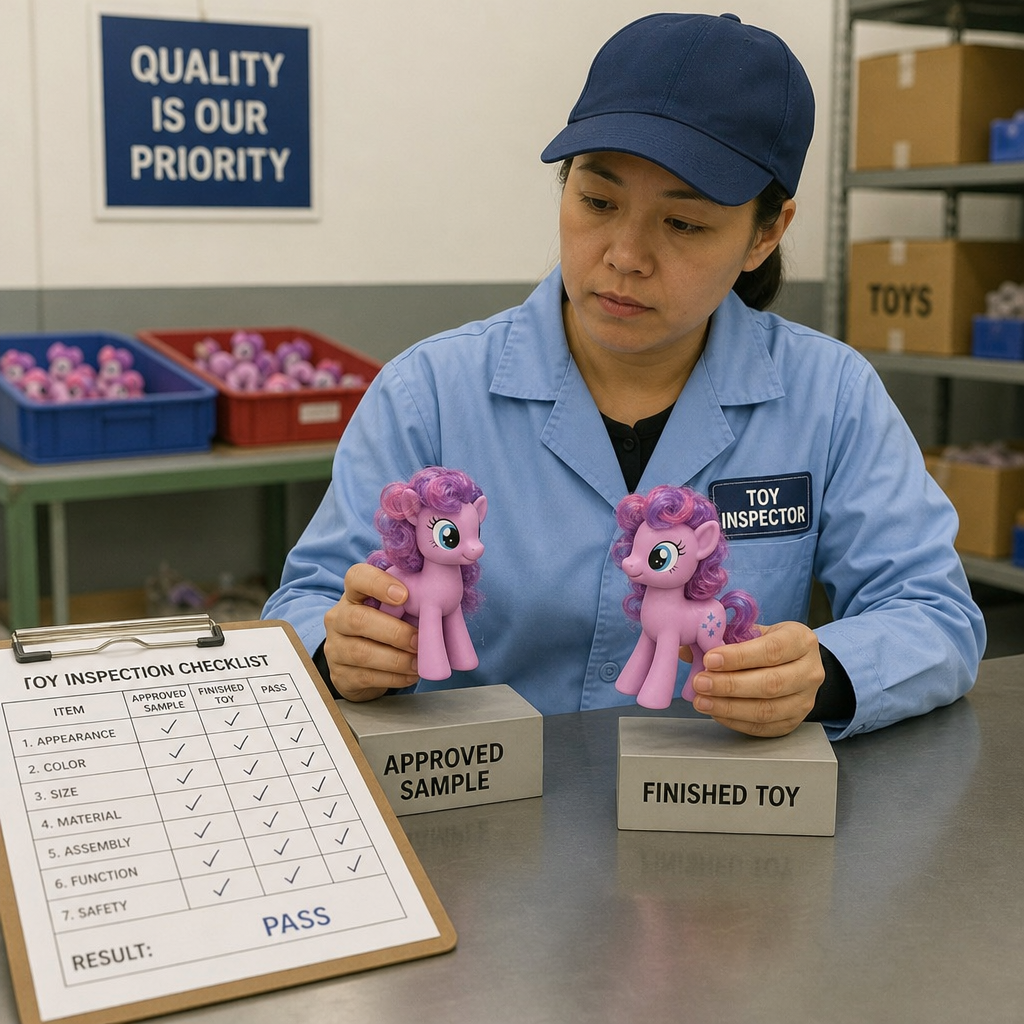
Order samples against your written specification and record the results. Check assembly, finish, functionality, packaging, instructions, and the consistency of included parts. Treat these checks as commercial quality review, not a replacement for required laboratory testing.
Create an approved reference sample and photograph its important features. Identify anything the supplier must change before production, then approve the corrected version rather than relying on a promise. Where possible, retain matching reference samples with you and the factory.
Include these controls in the purchase order or manufacturing agreement:
Product specification: Identify approved materials, components, dimensions, functions, and artwork.
Change approval: Require written permission before substitutions or design changes.
Inspection access: Define when independent inspectors may examine production and finished goods.
Defect handling: Agree how nonconforming goods will be corrected and checked again.
Payment milestones: Link agreed payments to documented deliverables and approvals.
Ask your laboratory how material or design changes affect the testing basis and whether additional testing is needed. CPSC guidance includes ongoing testing and material-change considerations, so the original sample’s results should not be treated as permission for unrestricted substitutions.
Before final payment, review the inspection findings against the purchase order. Require evidence of corrective work where necessary. Keep commercial inspection records separate from laboratory reports so each document’s purpose remains clear.
Check intellectual-property rights before customization
Make intellectual-property review part of product selection, especially when evaluating recognizable characters, distinctive designs, names, or packaging. Ask the supplier what rights support the offer and request documentation for any claimed authorization. Do not treat catalog availability as your clearance process.
For licensed merchandise, have a qualified adviser review whether the authorization covers your territory, sales channel, product category, and intended use. For private-label products, investigate your proposed brand and design before paying for molds or printed packaging. USPTO guidance recommends due diligence on foreign partners and working with counsel on an intellectual-property protection strategy.
Document ownership and permitted use of artwork, molds, packaging files, and other custom assets in your agreement. State what the supplier may retain, reproduce, or sell to others. Keep original design files and approval records under your control rather than depending entirely on the supplier’s archive.
If rights remain unclear, pause that product. Resolve uncertainty before adding your brand, commissioning photography, or building a launch campaign around it.
What does it cost to import toys from China?
Your import budget should cover the purchase price plus every cost needed to deliver saleable inventory to your receiving locati0n. Calculate a landed cost per saleable unit, then separately assess selling expenses and profit. Use actual quotations and clearly labeled estimates rather than a single supplier-provided shipping figure.
Build the calculation from these categories:
|
Cost category |
Items to include in your estimate |
|---|---|
|
Product and preparation |
Toys, packaging, customization, tooling, and samples |
|
Verification |
Laboratory work, inspections, and corrective-action checks |
|
Freight and handling |
Origin transport, international freight, insurance, and destination charges |
|
Import clearance |
Brokerage, applicable duties, taxes, fees, and bond costs |
|
Receiving |
Inland delivery, unloading, warehouse intake, and preparation |
Divide the shipment’s allocated costs by the units you realistically expect to sell. Decide how you will allocate one-time development costs, and keep that method consistent when comparing products. Run a second scenario with higher freight or fewer saleable units to see how much room remains.
For duties, have your broker verify the correct Harmonized Tariff Schedule classification and all applicable additional measures. The USITC publishes the tariff schedule, while USTR provides a Section 301 lookup based on HTS subheadings. Do not use an old blanket percentage for all Toys from China or assume the ordinary tariff rate represents the entire duty burden.
Finally, deduct marketplace fees, fulfillment, advertising, returns allowances, and other selling costs from expected revenue. Keep these separate from landed cost so you can see where your margin goes.
Plan logistics around the complete delivery route
Request freight quotations using confirmed carton counts, dimensions, weights, cargo descriptions, and delivery addresses. Ask providers to compare suitable services for your order rather than choosing from a headline transit estimate. Request a complete route description from factory pickup through warehouse receipt.
For each logistics quotation, clarify origin charges, destination handling, customs services, delivery arrangements, insurance, and exclusions. Ask how storage, examinations, missed appointments, or other exceptions would be charged. Record quotation validity and what information could change the price.
Build your delivery plan backward from the date inventory must be available for sale. Include production, testing, inspection, corrective work, booking, transport, clearance, and warehouse receiving. Give each milestone an owner and require updates when an earlier delay threatens later commitments.
For vessel shipments, coordinate the Importer Security Filing in advance. CBP generally requires eight importer data elements no later than 24 hours before loading aboard a vessel destined for the United States, with separate timing provisions for remaining information. Establish who collects the data and who confirms submission.
If a supplier offers delivered-duty-paid shipping, ask who will be the importer of record and how you will receive entry and compliance records. Have your broker review the arrangement before accepting it. ICC guidance specifically cautions that DDP transactions can involve complications despite appearing convenient for small importers.
Review customs records before the goods leave
Send draft shipping and commercial documents to your broker early enough to correct discrepancies before departure. Ask for a shipment-specific checklist rather than assuming last order’s paperwork will work again. Keep names, quantities, product identifiers, values, and shipment references consistent across the records.
Have the broker review the commercial invoice’s descriptions and required information. CBP expects meaningful invoice detail; a vague description such as “plastic items” does not provide the same classification information as a description of the actual merchandise. Give your broker the product specification and photographs where helpful.
Use accurate transaction information and ask about any required valuation adjustments. CBP guidance explains that invoice value relates to the purchase transaction rather than your eventual U.S. retail selling price, and that certain additional payments or contributions may need consideration. Never approve an artificially low invoice merely to reduce duties.
Confirm whether a customs bond is required and which arrangement suits your importing activity. CBP describes single-entry and continuous bonds as different options for guaranteeing payment of duties, taxes, and fees. Arrange the appropriate bond through a qualified provider rather than discovering the issue during clearance.
Finally, confirm the importer-of-record details, certificate filing arrangements, delivery contact, and document-access process. Keep your own organized copies after clearance.
Start small and improve each reorder
Set written release criteria for the first shipment: approved product, resolved inspection findings, complete compliance records, reviewed customs documents, and confirmed delivery arrangements. Do not replace a missing approval with an optimistic launch date. If a requirement remains unresolved, hold the shipment while you investigate.
On receipt, compare cartons and units against the order, record damage or discrepancies, and retain identifying information. Track customer feedback by product and batch where possible. Use those records to distinguish presentation issues, fulfillment mistakes, and potential product concerns rather than grouping every return together.
Before reordering, review actual landed cost, selling performance, defects, returns, and supplier responsiveness. Update specifications and check whether changes require compliance review. Reorder because the product has earned another purchase—not because the original trend still looks exciting.
The strongest approach to importing trendy toys combines disciplined sourcing with documented safety checks and realistic logistics planning. Begin with a focused assortment, verify the details before shipment, and use each order to build a more reliable process.
Frequently Asked Questions About How to Import Trendy Toys from China
What are the essential steps to import trendy toys from China?
To import trendy toys from China, you must validate demand, specify the product, verify suppliers, approve compliance, control production, and manage delivery. Each step should be thoroughly documented to ensure a smooth importing process.
What kind of safety documentation is needed for U.S. toy imports?
U.S. toy imports generally require a Children’s Product Certificate (CPC) along with applicable safety testing by a CPSC-accepted third-party laboratory. It’s essential to identify the specific safety requirements based on the product's design and intended age group.
How do I ensure the quality of toys before shipment?
You should order samples based on your written specifications and perform a commercial quality review, checking assembly, finish, functionality, and packaging. Approval of an accurate reference sample and ongoing inspections during production is also crucial.
What costs should I consider when importing toys?
Your import budget must cover the purchase price, verification costs (laboratory testing, inspections), freight and handling expenses, import clearance fees, and any receiving charges. All these components contribute to your total landed cost.
How can I mitigate risks when selecting suppliers?
It’s important to compare suppliers based on a consistent product specification, verify their business licenses, conduct site visits if possible, and ask detailed questions about production processes and minimum order quantities. Document everything to ensure you hold suppliers accountable.