Back To Blog
Kakobuy vs Superbuy: Best Online Shopping Service
Kakobuy and Superbuy are online shopping tools that help international buyers purchase from Chinese marketplaces, receive warehouse inspection photos, consolidate items, and ship parcels overseas.
The short version: Kakobuy is attractive if you want a newer, streamlined agent with 100 days of storage, while Superbuy is stronger if you value a long-established platform with clearly published fee rules and 90 days of free storage.
This kakobuy vs superbuy comparison focuses on the criteria that actually affect your order: fees, storage, payment, quality checks, shipping control, and ease of use.
Which service is better for your order?
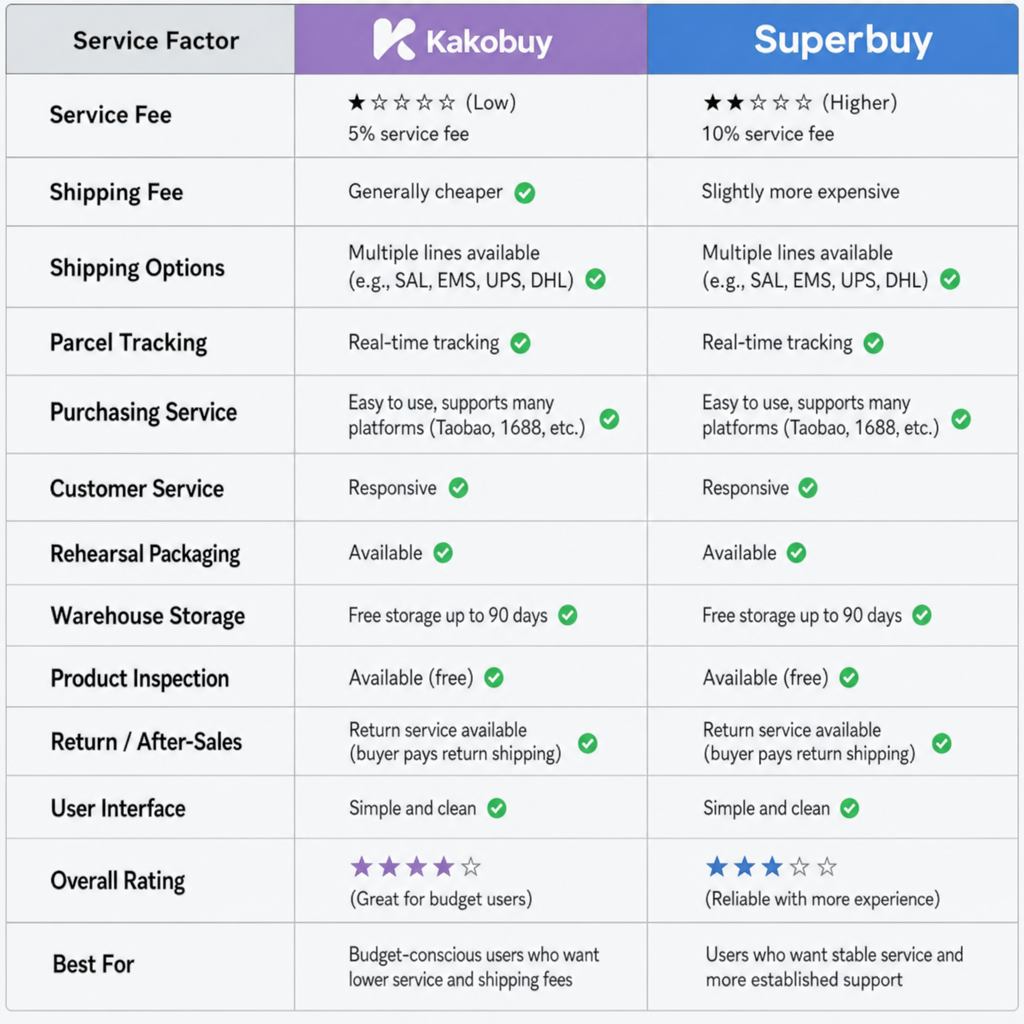
Kakobuy is usually the better fit if you want a simple agent flow, PayPal support, and a little more warehouse time before consolidating a parcel. Superbuy is usually the safer pick if you want more transparent published fee documentation, a mature shopping-agent system, and broad global forwarding coverage.
Neither is automatically the best buying service for every buyer, because the final cost depends on your item price, domestic shipping, parcel weight, destination, selected shipping line, and optional services.
Use Kakobuy if you plan to build a haul slowly and want 100 days of normal package storage before the item is treated as overdue. Use Superbuy if you want 0% standard purchasing service fees on mainstream platforms such as Taobao, Tmall, JD.com, and 1688, with exceptions clearly listed for secondhand or unlisted platforms.
Kakobuy’s help center says its shopping-agent cost is based on item cost, international shipping, customs-related charges, packaging, and optional value-added services, while Superbuy publishes a detailed fee composition page with platform-specific service-fee rules.
Side-by-side comparison
|
Decision factor |
Kakobuy |
Superbuy |
Practical takeaway |
|---|---|---|---|
|
Core service |
Buys from Chinese sellers, receives items at its warehouse, inspects goods, stores them, and ships internationally. |
Lets users submit product links, buys items, sends them to a warehouse, provides QC photos, and ships worldwide. |
Both cover the basic agent workflow. |
|
Standard purchasing fee |
Kakobuy says it provides free shopping-agent service and requires no handling fee apart from item and shipping-related costs. |
Superbuy says no service fee is charged for mainstream platforms including Taobao, Tmall, JD.com, and 1688. |
Both can be low-fee for standard orders, but read exceptions. |
|
Storage period |
Normal package storage is 100 days, with a reminder after 90 days. |
Items receive 90 days of free storage; after that, storage fees may apply, and the maximum storage period is 180 days. |
Kakobuy gives more free time; Superbuy gives clear late-storage rules. |
|
Payment options |
Kakobuy lists balance payment, PayPal, and Alipay; another official page references PayPal, WeChat, and Alipay. |
Superbuy lists credit cards, WeChat, Alipay, Chinese debit cards, and bank telegraphic transfer in its app guidance. |
Choose the platform that supports your preferred funding method. |
|
QC and inspection |
Kakobuy says it performs quality control, takes photos, and gives feedback if problems are found. |
Superbuy advertises free QC photos and warehouse storage. |
Both provide inspection support before overseas shipping. |
|
Cost predictability |
Total cost can include commodity cost, international freight, packaging fee, and optional value-added services. |
Cost includes product cost, international shipping, and value-added service fees, with final shipping determined by the logistics provider’s bill. |
Always estimate shipping after items reach the warehouse. |
|
Best for |
Buyers who want PayPal availability, a straightforward flow, and slightly longer free storage. |
Buyers who want published fee rules, established processes, and 90-day free storage. |
The right choice depends on your risk tolerance and parcel plan. |
Fees and total cost decide more than the homepage promise
A useful kakobuy review should not stop at “no handling fee” or “0 service fee,” because buying-agent costs usually appear across several steps. You may pay the product price, domestic shipping from the seller to the warehouse, payment or currency-conversion costs, international freight, packaging, customs-related charges, and optional add-ons.
Kakobuy’s own cost explanation includes commodity cost, international freight, packaging, and optional value-added service fees; Superbuy’s fee page similarly separates product cost, international shipping, and value-added services.
That means the cheapest service at checkout is not always the cheapest service after consolidation. A heavy parcel, a volumetric shipping line, extra photos, reinforced packaging, or a route surcharge can change the final total.
Before choosing either platform, compare the estimated international shipping options for your destination and do not judge value only by the first payment screen.
Which service is cheaper to run over multiple orders?
Kakobuy may be cheaper for some users because it offers 100 days of normal package storage, giving you more time to wait for multiple items before submitting one parcel. Superbuy may be cheaper for others because its standard purchasing fee rules are clearly published for mainstream platforms, which can make planning simpler. The better long-term option depends on your buying pattern, not just the agent’s advertised fee.
For small, frequent orders, payment convenience and shipping-line availability may matter more than storage length. For larger hauls, storage time and consolidation flexibility become more important because you may wait for several sellers to ship before forwarding everything together.
If you are comparing online shopping tools for repeat use, create a simple test basket with the same item links, destination country, approximate weight, and preferred shipping speed on both platforms before committing to a large order.
Cost checklist before you choose:
- Check whether your product source is a mainstream platform or a special/secondhand platform.
- Confirm domestic shipping from the seller to the warehouse.
- Review payment-method fees and currency-conversion assumptions.
- Wait for actual warehouse weight and volume before trusting shipping estimates.
- Compare optional service fees such as extra photos, special packaging, or storage extension.
- Read the return, cancellation, and after-sales rules before paying.
Storage and consolidation can change the experience
Storage matters because most buyers use agents to combine several purchases into one international parcel. Kakobuy’s normal package storage period is 100 days, and its help center says goods not submitted for a waybill after that period may be treated as abandoned. Superbuy provides 90 days of free storage, with fees after the free period and a stated maximum storage period of 180 days.
The practical difference is simple: Kakobuy gives you a longer free window, while Superbuy provides a more explicit extended-storage framework. If you buy slowly, wait for restocks, or order from sellers with inconsistent domestic shipping times, Kakobuy’s extra days may help. If you are organized and usually ship within a month or two, the 10-day difference may not matter much.
Shipping control and QC both require active checking
Both services are useful because they put a warehouse step between the seller and your final address. Kakobuy says it performs quality inspection, stores items, and allows users to submit a shipment from the warehouse after inspection. Superbuy promotes a similar flow: submit a link, it purchases and warehouses the item, provides QC photos, and supports overseas shipping.
However, QC photos are not the same as a guarantee that you will like the product, that the seller accepts returns, or that customs will be smooth. Treat inspection photos as a decision point: check size tags, color, visible defects, quantity, and seller accuracy before international shipping. Once a parcel leaves the warehouse, fixing a problem is usually slower and more expensive.
Which service is easier for first-time buyers?
Superbuy is easier if you want a more documented platform and clear fee pages before ordering. Kakobuy is easier if your priority is a direct flow, familiar payment options such as PayPal, and a longer free storage period. First-time buyers should choose the service that makes the buying steps, payment rules, warehouse status, and shipping estimate easiest to understand.
A beginner should start with one low-risk order rather than a large haul. Paste the product link, confirm the item description, pay attention to domestic shipping, review QC photos carefully, and only then submit international shipping. This small test order will teach you more about the interface, support speed, and shipping options than any single comparison page can.
Best-fit recommendation
Choose Kakobuy if you want 100 days of normal storage, PayPal availability, and a straightforward agent process for building a consolidated parcel. It is a good candidate for buyers who need more time between purchases and who are comfortable checking all fees during checkout and shipping submission.
Choose Superbuy if you want a more established shopping-agent platform with published standard purchasing-fee rules, free QC photos, and 90 days of warehouse storage. It is a strong option for buyers who value documentation, predictable process steps, and broad payment and shipping support.
For most shoppers comparing Kakobuy vs Superbuy, the best buying service is the one that gives you the lowest total landed cost with the least confusion. Build the same sample order on both platforms, compare storage limits, payment fees, shipping estimates, and optional services, then start small before scaling up.
Frequently Asked Questions About Kakobuy and Superbuy Services
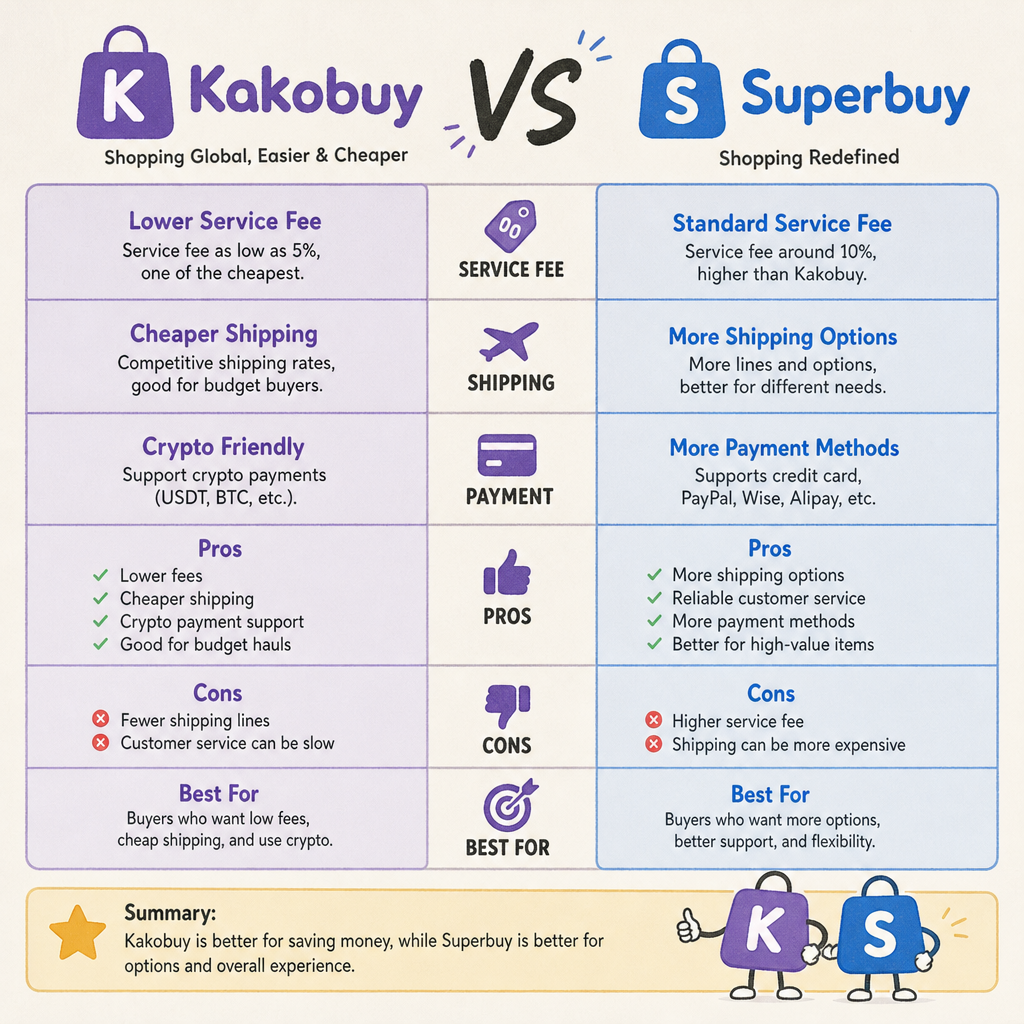
What are Kakobuy and Superbuy?
Kakobuy and Superbuy are online shopping tools that facilitate international purchases from Chinese marketplaces. They provide services such as receiving items at their warehouses, inspecting products, consolidating purchases, and shipping parcels worldwide.
How do Kakobuy and Superbuy differ in terms of fees?
Kakobuy offers free shopping-agent services and no handling fees, while Superbuy charges no service fees for mainstream platforms like Taobao, Tmall, JD.com, and 1688. It’s essential to understand the specific fee structures of each platform, as hidden costs may arise during the purchasing process.
What is the standard storage period for items in Kakobuy and Superbuy?
Kakobuy provides a storage period of 100 days for normal packages, while Superbuy offers 90 days of free storage with a maximum of 180 days. Understanding these time frames can help buyers plan their orders effectively.
Which payment options are available on Kakobuy and Superbuy?
Kakobuy supports payment methods such as balance payment, PayPal, WeChat, and Alipay. Superbuy offers various payment options, including credit cards, WeChat, Alipay, Chinese debit cards, and bank telegraphic transfers. Buyers should choose the platform that accommodates their preferred payment method.
How can first-time buyers decide between Kakobuy and Superbuy?
First-time buyers should consider their individual priorities, such as ease of understanding the buying process, payment options available, and storage time before making a decision. Trying a low-risk order on both platforms can help determine which one feels more intuitive and meets their needs.
Here are some related articles you may find interesting: