Back To Blog
Sourcing a makeup mixing palette wholesale from China starts with a clear product brief, comparable supplier quotes, and samples you can evaluate before ordering.
For beauty retailers, distributors, academies, and working artists, the goal should be a dependable tool at a workable total cost—not simply the lowest advertised price.
This article explains how to specify palettes and spatulas, assess samples, and prepare a bulk order without relying on vague quality promises.
What should you look for when buying makeup mixing palettes wholesale from China?
Look for a supplier that can document the material, dimensions, finish, included accessories, packaging, and inspection requirements for your order.
Request a sample that represents the version you intend to buy, then record your approved specifications in the purchase agreement.
Alibaba’s buyer guidance recommends detailed purchase orders, sample requests, and production monitoring or inspection as sourcing safeguards.
Before contacting suppliers, define who will use the product. A palette for a traveling makeup artist deserves a different evaluation from one intended for a classroom workstation or retail gift set. Start with the customer’s working environment, then decide which features are necessary.
Use these questions to build your initial brief:
Who is the buyer? Specify professional artists, students, salon teams, or home users rather than requesting a general beauty accessory.
What is included? State whether you need a palette alone, a matching spatula, a protective sleeve, or retail packaging.
How will it be handled? Identify whether the palette will be held during application, placed on a workstation, or packed for travel.
What must remain consistent? List the dimensions, material, surface appearance, accessory count, and branding requirements you will inspect.
This preparation gives suppliers the same starting point. It also makes their responses easier to compare without guessing whether two quotations cover equivalent products.
Define the product before comparing prices
The term “palette” needs clarification in your inquiry. State explicitly that you want an empty cosmetic mixing surface, not a filled color collection or an empty magnetic storage case. Attach a reference image or drawing, but explain which details matter instead of asking a supplier to reproduce an image without instructions.
A clear description might read: “Reusable Makeup Mixing Palette with matching spatula, smooth finished edges, protective individual packaging, and dimensions confirmed before sampling.” Treat that as a starting template, not a finished specification. Add the material, measurements, finish, and branding details once you have decided what your range requires.
For professional makeup palettes, separate appearance from function. A polished sample may photograph well, but your approval process should also cover handling, stability, edge finishing, and the practicality of cleaning it. Ask the people who will actually use the tool to take part in that assessment.
Match the material and shape to the intended workflow
Commercial mixing palettes include stainless steel models, finger-hole designs, and palette-and-spatula sets. Qosmedix, for example, lists a stainless steel artist palette with a mirror finish and thumb hole, alongside other mixing palette formats. These are useful reference points for describing a product, not evidence that every supplier’s version performs identically.
Material and surface finish
Ask the supplier to identify the material precisely rather than accepting “metal” or “premium quality.” If a particular grade or composition matters to your purchasing decision, put it in writing and request supporting documentation.
Alibaba’s order guidance specifically recommends measurable material, grade, finish, and tolerance requirements instead of subjective quality descriptions.
During sampling, assess the surface under the lighting your customer would use. Try the intended cosmetics, examine residue after cleaning according to the supplied care instructions, and photograph the results. If the product has a colored or coated finish, include its appearance after repeated handling in your approval notes.
Shape, grip, and working area
Compare proposed shapes through tasks rather than photographs alone. Ask a tester to hold the palette, place several separate portions on it, and move between mixing and application. Record whether the working area feels adequate and whether the grip remains comfortable throughout the trial.
For a finger-hole design, inspect the opening as carefully as the outer perimeter. Run your acceptance checks around every accessible edge, and reject uncomfortable or unfinished samples. For a tabletop format, check stability on the type of workstation your customers use.
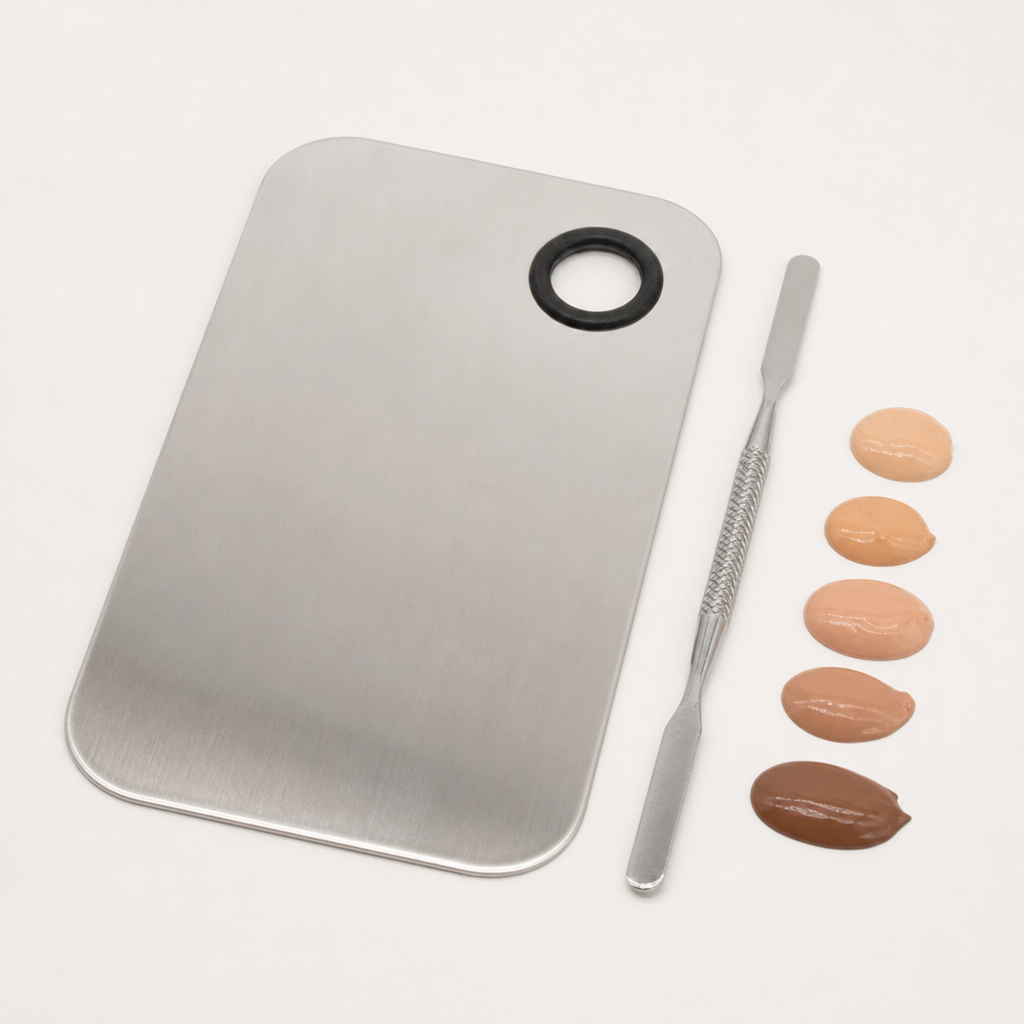
Choose Spatula Sets as carefully as the palette
Decide what each spatula needs to do before selecting its shape. Your evaluation might include removing a small portion from a container, transferring it to the palette, and blending that portion without awkward handling. Test those actions with the actual sample rather than judging the accessory by its photograph.
Use the same scrutiny for bundled accessories as for the main product. Ask for close-up images of both ends, confirm the overall dimensions, and check the grip and edge finishing yourself. If you offer multiple Spatula Sets, give each combination a separate specification so that accessories cannot be substituted without approval.
For makeup artist supplies, a useful bundle should feel intentional. A compact palette with an oversized accessory, or a retail set without clear contents labeling, deserves another review before approval. Evaluate the complete packaged set, not just loose components supplied separately for sampling.
How can you compare suppliers beyond the unit price?
Compare suppliers using an identical written request and a consistent sample evaluation process. Ask each business to confirm what it will supply, what remains excluded, and how it will address a mismatch with the approved specification.
For orders through Alibaba, its guidance emphasizes documenting product specifications, quantity, shipping details, and relevant attachments in the order.
Avoid making assumptions about production arrangements. Ask whether the business manufactures the palette, coordinates production through another factory, or supplies an existing stock item. Then ask who controls material selection, finishing, packaging, and final inspection for your particular order.
Request answers to these practical points:
|
Buying detail |
What to request |
|---|---|
|
Product identity |
Model reference, material description, dimensions, finish, and accessory list |
|
Order quantity |
Minimum quantity for the exact version, including logo and packaging choices |
|
Sampling |
Sample cost, shipping arrangements, and whether it represents planned production |
|
Customization |
Artwork requirements, approval process, and any separate setup charges |
|
Packaging |
Individual protection, units per carton, carton dimensions, and gross weight |
|
Scheduling |
Sample approval, production, inspection, and shipment milestones |
|
Quality resolution |
Written procedure for shortages, defects, or specification mismatches |
For bulk makeup tools, keep a comparison sheet showing both the quotation and unresolved questions. Leave uncertain fields marked as unconfirmed instead of filling them with assumptions. A complete response deserves more weight than an attractive price attached to an incomplete offer.
Approve samples against a written checklist
Use a repeatable checklist to decide whether a sample is acceptable. Alibaba recommends requesting samples and considering inspection services before committing to the full order. It also advises buyers to describe the order in detail, giving the evaluation a written reference rather than relying on general expectations.
Build your sample review around the following checks:
Identity: Confirm that the sample matches the quoted model, material description, finish, and included components.
Measurements: Compare the palette and spatula against the agreed dimensions and proposed tolerances.
Handling: Examine accessible edges, grip comfort, flatness, and stability during intended use.
Working surface: Test product transfer and mixing with representative cosmetics under realistic lighting.
Care: Follow the supplied cleaning instructions and inspect the finish afterward.
Packaging: Check whether components remain separated and protected during ordinary handling.
Branding: Review logo placement, artwork clarity, printed text, and presentation against approved files.
Photograph your observations and distinguish unacceptable defects from minor cosmetic variations. Keep the approved reference sample and identify its version in your records. If you request a change, obtain confirmation of the revised specification before approving production.
Keep hygiene guidance specific and realistic
A Mixing Palette should support a defined hygiene routine, not replace one. University of California performing-arts guidance recommends transferring portions from shared makeup containers with a clean palette knife and never returning a used applicator to a shared container. FDA guidance also emphasizes clean hands, clean containers, and following cosmetic labels.
For cosmetic mixing tools, request written care instructions that address the supplied material and finish. Avoid adding claims such as “sterile,” “antibacterial,” or “safe with every disinfectant” to your product copy without appropriate evidence. Describe the tool and its intended use accurately, and distinguish supplier instructions from marketing language.
Be equally careful with Eyeshadow demonstrations. Mixing a cosmetic on a separate surface does not change where that cosmetic is intended to be applied. FDA advises using products near the eyes only when they are intended for that area, so demonstrations should follow the cosmetic manufacturer’s directions.
What should you confirm before placing a bulk order?
Confirm the final product specification, approved sample reference, quantity, packaging, payment milestones, inspection arrangements, shipment timing, and discrepancy procedure before payment.
If using Alibaba Trade Assurance, review the protection applicable to that order and follow its payment and communication requirements. The platform advises keeping detailed order records and relevant communications within its system.
Next, compare the expected total delivered cost rather than the quoted product price alone. Build your own worksheet with separate lines for samples, customization, packaging, inspection, transportation, and any destination charges you need to verify. Ask the relevant service provider to confirm uncertain amounts instead of treating a supplier’s headline quotation as an all-inclusive budget.
Treat each makeup palette bulk order as a specific purchase configuration. Plain packaging and branded retail packaging should have separate quotations if their costs or requirements differ. Likewise, confirm whether the minimum order applies to the complete purchase, each model, each finish, or each packaging version.
Agree on the response to discrepancies before shipment. Ask how the parties will document missing accessories, damaged packaging, incorrect artwork, or products outside the agreed specification. If ordering through a platform, ensure these expectations are reflected in the recorded order rather than left in a disconnected conversation.
Build a focused range and reorder from evidence
For a first assortment, consider a limited selection tied to distinct customer needs. You might evaluate one travel-oriented set and one larger workstation format, rather than approving many similar designs at once. Use customer feedback and sample testing to decide whether those differences justify separate products.
Make product listings specific. Show the palette beside its included spatula, identify what comes in the package, and provide the approved measurements and care instructions. Avoid implying that cosmetics shown in demonstration photographs are included when the offer covers tools only.
After delivery, record inspection findings, packaging issues, and customer questions against the relevant model. Review that evidence before reordering, and reconfirm the specification rather than assuming the next batch will be unchanged. The strongest wholesale decision is a product you can describe clearly, evaluate consistently, and reorder with confidence.
Frequently Asked Questions About Sourcing Makeup Mixing Palettes
What should I consider when selecting a supplier for makeup mixing palettes?
Look for suppliers who can provide documentation of materials, dimensions, finishes, and packaging. It's crucial to compare detailed quotations and request samples that represent the product you intend to buy.
How can I ensure the quality of the makeup mixing palettes before placing a bulk order?
Request samples and establish a repeatable checklist for quality evaluation that includes identity verification, measurements, handling comfort, working surface testing, and packaging checks. This allows for an informed decision before committing to a bulk order.
Are there specific hygiene guidelines I should follow when using makeup mixing palettes?
Yes, always use clean tools for transferring cosmetics and follow care instructions provided by the supplier. Ensure that hygiene practices align with guidance from reliable sources, such as the FDA and performing arts safety protocols.
What are common mistakes to avoid when ordering makeup mixing palettes in bulk?
Avoid assumptions about product specifications, overlook the importance of detailed supplier communication, and fail to assess the samples thoroughly. Keep a comparison sheet for different suppliers to track what each offers clearly.
Can I customize the design of my makeup mixing palettes, and what should I know about this process?
Yes, customization is often possible but requires clear communication with the supplier regarding artwork, approval processes, and potential setup charges. Ensure all customization details are documented in the purchase agreement.