Back To Blog
Keeping pens, pencils, and small supplies organised shouldn’t be a daily struggle. Whether you’re packing a school bag, preparing for a meeting, or arranging a creative workspace, pencil cases, pen pouches & stationery organisers help keep your essentials protected and easy to find.
From slim zip pouches to spacious cases with separate compartments, each design serves a different purpose. The right choice depends on what you carry, how much space you have, and how you use your supplies.
In this guide, we’ll explore popular styles, compare materials, and explain what to look for when buying for personal use or sourcing for your business.
Pre-article message: A well-chosen stationery organiser makes everyday tools easier to find, carry, and protect.
Understanding Pencil Cases, Pen Pouches & Stationery Organisers
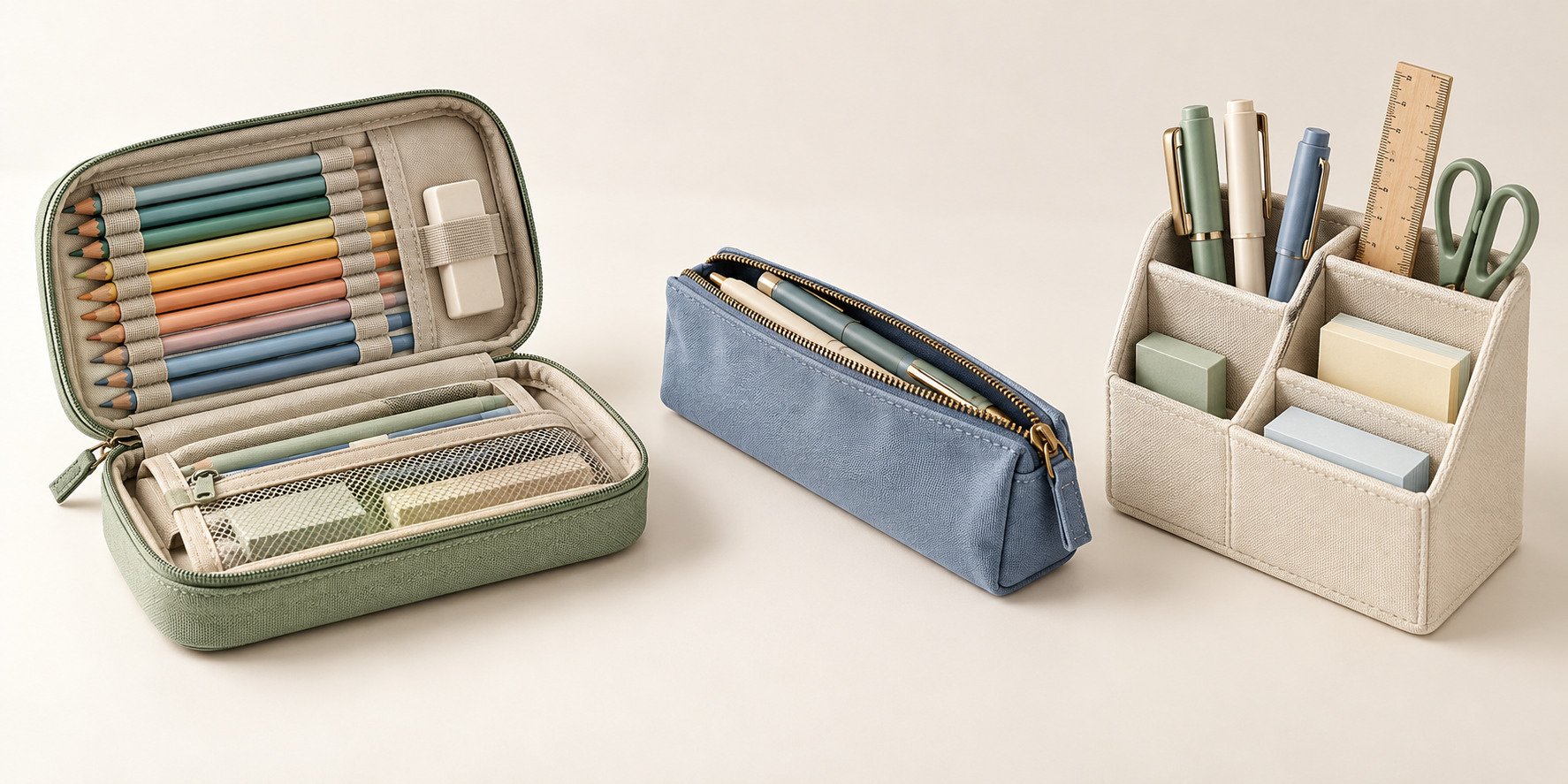
Pencil cases, pen pouches & stationery organisers keep writing tools together, but they don’t all serve the same purpose. Some protect a few pens during a commute. Others hold school supplies, separate drawing tools, or keep a busy desk tidy.
The best choice starts with a simple question: What do you need to carry or store each day? A student with coloured pencils needs a different layout from an office worker carrying two pens and a highlighter. Likewise, an artist may need individual slots that a basic pouch doesn’t offer.
Product names can overlap between shops and suppliers. Therefore, compare the actual design, measurements, and features instead of relying only on the name.
What Is a Pencil Case?
A pencil case is a portable container for pens, pencils, and small stationery items. It may have a soft fabric body, a padded structure, or a rigid outer shell.
Common contents include:
- Writing pens and pencils.
- Erasers and enclosed sharpeners.
- Highlighters.
- Short rulers.
- Sticky notes.
- Small correction tools.
A traditional school pencil case often has one main compartment. More structured designs add elastic loops, internal dividers, or separate sections.
Its main advantage is convenience. Users can move their essential supplies from a backpack to a desk in one step. However, the level of protection depends on the construction. A thin fabric case and a rigid case shouldn’t be expected to perform alike.
What Is a Pen Pouch?
A pen pouch usually has a soft, flexible body and a simple closure. Many designs are slim enough to fit inside a laptop bag, handbag, or small backpack pocket.
This style suits people who carry a modest selection of tools. It also works well as a separate pouch for highlighters, markers, or spare supplies.
The flexible shape can save space when partly filled. On the other hand, it may offer limited protection against pressure from heavy books. Padding and an internal lining can improve the design, but buyers should inspect those features rather than assume they’re included.
What Is a Stationery Organiser?
A stationery organiser focuses on separating supplies so they’re easier to see and retrieve. It may be portable or designed to stay on a desk.
Examples include divided fabric cases, pen trays, drawer inserts, desktop caddies, and storage boxes.
A good organiser gives different items a clear home. Pens may sit in upright sections, while clips and erasers go into shallow trays. This arrangement can make small supplies easier to find.
However, extra compartments aren’t always helpful. Narrow sections may waste space if they don’t match the items being stored. The layout should support the user’s routine.
Why the Right Storage Matters
Useful stationery storage offers four practical benefits.
First, it improves access. A wide opening or clear layout makes it easier to find a tool without emptying the whole case.
Second, it helps protect belongings. A suitable case separates writing tools from other bag contents. Still, pens should remain capped, since an ordinary pouch isn’t a guaranteed barrier against leaks.
Third, it simplifies moving between places. Students, commuters, and travelling workers can keep a ready-to-use set together.
Finally, it supports tidier work areas. Returning tools to the same place helps prevent small items from spreading across a desk.
These benefits come from a suitable design and consistent use. Simply buying a larger case won’t solve a clutter problem if it becomes a home for every spare pen.
Match Storage to the User
Different users need different priorities.
| User | Main priority | Features to consider |
|---|---|---|
| Primary school student | Simple access | Easy closure, manageable size, name label |
| Secondary school student | Everyday capacity | Dividers, ruler space, strong seams |
| University student | Portability | Slim profile, lightweight body |
| Office worker | Compact organisation | Subtle design, lining, pen separation |
| Artist or illustrator | Tool arrangement | Individual slots, roll-up layout, clear access |
| Traveller | Flexible packing | Secure closure, compact shape |
| Home office user | Desk visibility | Stable base, divided sections |
For younger users, consider how easily they can open the case and return items without help. For adults, check how the product fits into an existing bag or workspace.
Appearance matters too. A design that users enjoy may encourage them to keep using it. Nevertheless, practical details should lead the decision. A stylish case still needs enough internal length for the tools it will hold.
12 Practical Styles of Pencil Cases, Pen Pouches & Stationery Organisers
The following twelve styles cover a wide range of school, office, creative, and travel needs. Some combine several features, so treat these categories as a starting point.
Styles 1–4: Everyday Essentials
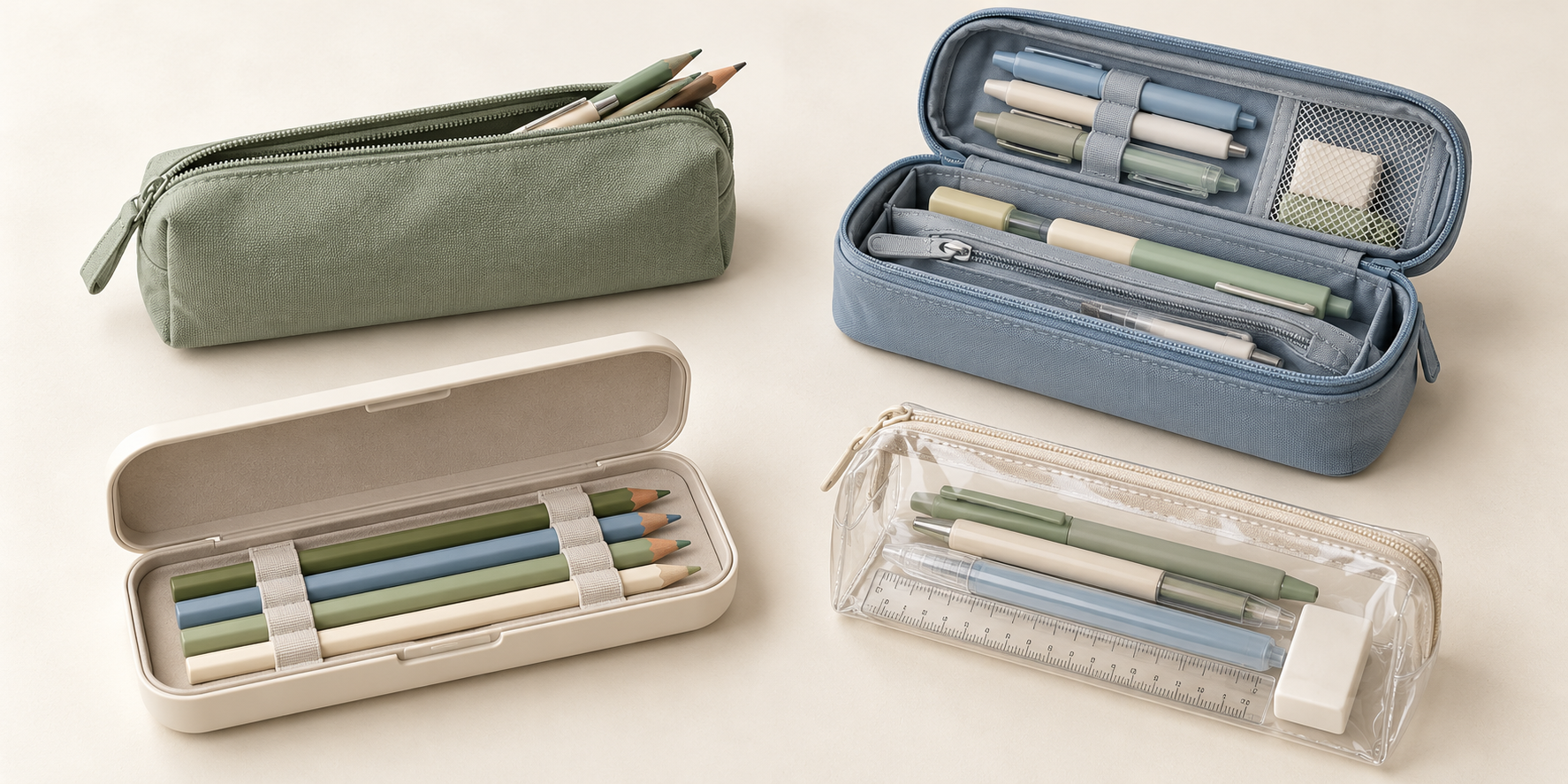
1. Classic single-zip pencil case
This familiar design has one main storage space and a zipper across the top. It’s straightforward to pack and works well for a small daily kit.
Look for an opening that allows tools to enter without catching at the ends. A flat base can also make the case easier to use on a desk.
2. Large-capacity pencil case
A larger case suits users carrying several types of stationery. Internal sections can separate writing pens from colouring tools or small accessories.
However, capacity claims need context. A case advertised for many thin pencils may hold far fewer thick markers. Check sample photos and test it with representative items.
3. Hard-shell pencil case
A rigid or semi-rigid body adds structure and can help resist pressure inside a bag. Some versions include internal straps or mesh pockets.
The trade-off is bulk. A hard case generally won’t compress into a small space as easily as a soft pouch.
4. Clear stationery pouch
Transparent panels make contents visible. This can help users check their supplies quickly.
Clear pouches may also suit settings that specify transparent storage. Always check the relevant school or examination rules, because requirements can differ.
Styles 5–8: Flexible Organisation
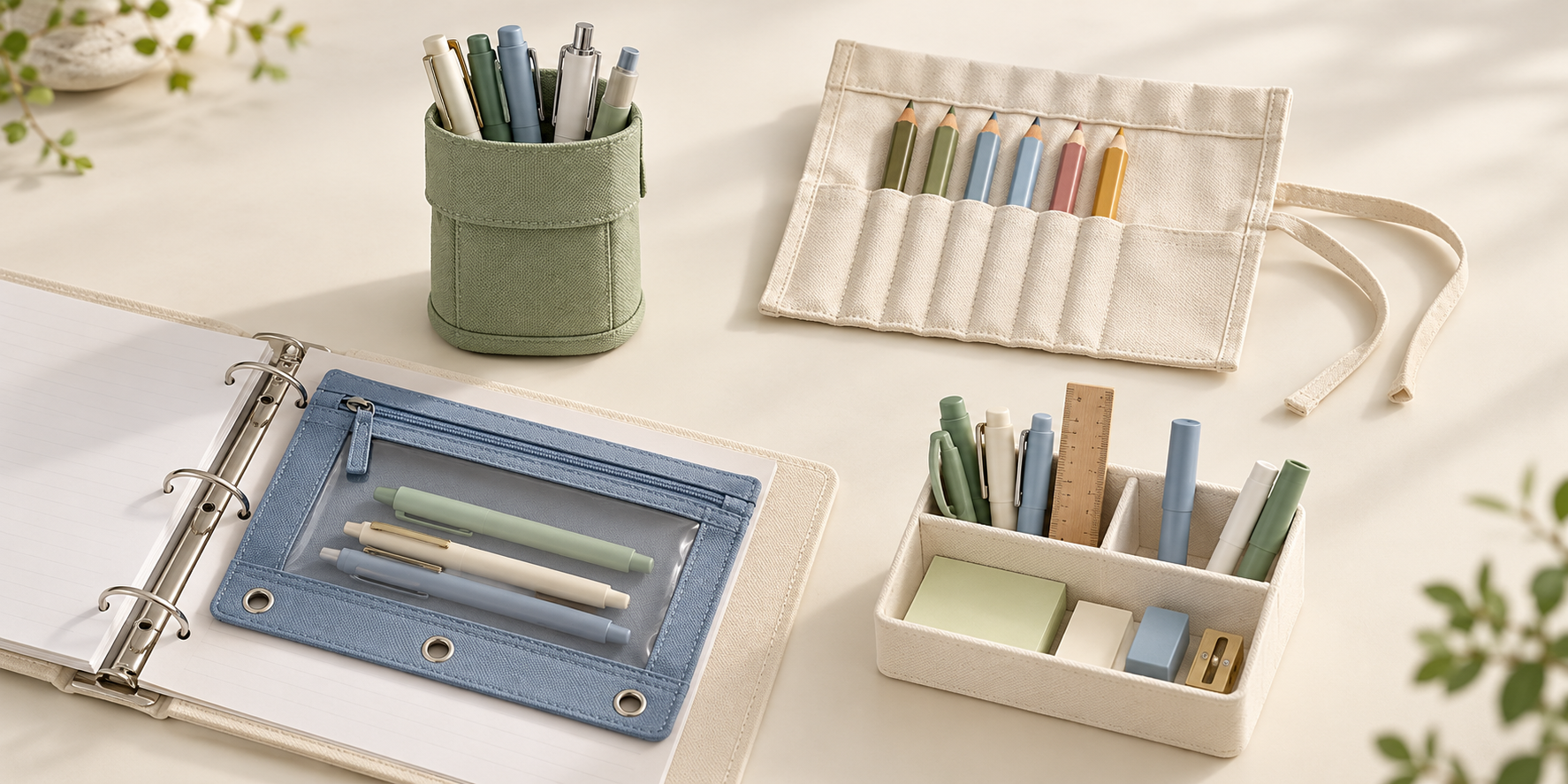
5. Standing pencil case
A standing case converts into an upright holder or has a base designed to remain vertical. It lets users reach tools while keeping them gathered together.
Check stability with the case both full and partly empty. A wide base and balanced layout matter more than the product photo alone suggests.
6. Roll-up pen organiser
A roll-up organiser places tools in separate slots before folding or rolling closed. It can suit drawing pencils, fineliners, and selected brush pens.
Slot width is important. A layout designed for thin pencils may not fit chunky markers. Also, make sure exposed tips won’t press into the fabric when rolled.
7. Binder pencil pouch
This style attaches inside a compatible ring binder. It keeps small stationery close to notes and worksheets.
Check the hole spacing, pouch thickness, and binder clearance. An overfilled pouch can make the binder awkward to close or carry.
8. Desktop stationery organiser
A desktop organiser provides fixed storage for pens and other office supplies. Designs range from simple cups to divided caddies.
Choose compartments based on the items used most often. Small supplies are easier to retrieve from shallow sections than from deep pen holders.
Styles 9–12: Specialist Options
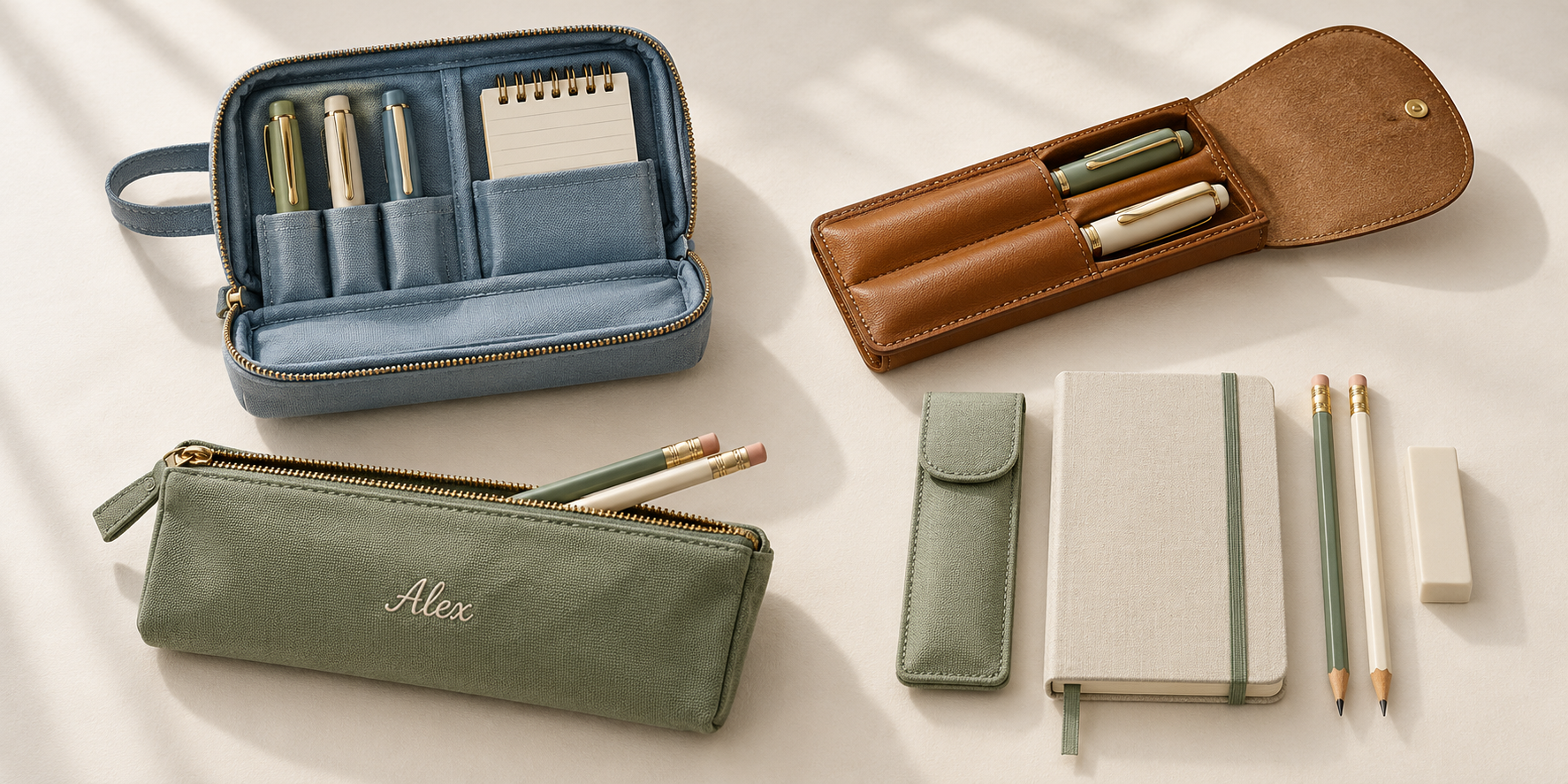
9. Travel stationery pouch
A travel pouch prioritises compact packing and secure storage. Internal pockets can separate writing tools from small accessories.
Consider how it opens in tight spaces. A case that spreads widely across a table may be less convenient on a train or during a meeting.
10. Leather or leather-look pen case
These cases offer a more formal appearance for office use or gifting. Some include individual sleeves for selected pens.
Confirm whether the material is genuine leather, coated fabric, or synthetic leather. Care needs and wear patterns differ.
11. Personalised pencil case
Names, initials, or original artwork can make a case easier to identify. Personalised designs also suit school gifts and promotional projects.
Check the printing or embroidery position before ordering. Decoration should leave enough space around seams and closures.
12. Coordinated stationery set
A matching set combines a case with selected supplies, such as a notebook, pencils, or ruler.
This format can work well for gifting or retail bundles. However, assess every item separately. Attractive packaging shouldn’t hide a weak zipper or poor writing tools.
Compare Common Materials
Material affects appearance, weight, cleaning, and feel. Yet the finished construction matters just as much as the material name.
| Material | Practical characteristics | What to check |
|---|---|---|
| Cotton canvas | Textured fabric suitable for many printed designs | Fabric weight, lining, colour transfer |
| Polyester | Used in many lightweight fabric cases | Weave, coating, stitching, lining |
| Nylon | Available in lightweight and heavier constructions | Fabric grade, seam quality, surface finish |
| Silicone | Flexible surface that may be easy to wipe | Closure quality, dust attraction, care instructions |
| Genuine leather | Natural texture and varied finishes | Leather type, lining, care requirements |
| Synthetic leather | Leather-like appearance with varied backing materials | Coating durability, flexibility, edge finish |
| Clear plastic | Visible contents and smooth panels | Flexibility, seam strength, material specification |
| Rigid or moulded shell | Structured storage | Hinge, closure, lining, impact performance |
Water resistance should be assessed at product level. A coated outer fabric doesn’t automatically make the seams or zipper waterproof.
Similarly, a thick fabric doesn’t guarantee a long service life. Poor stitching, weak attachment points, or an unsuitable closure can undermine an otherwise appealing material.
How to Choose, Organise, and Maintain Your Stationery Storage
Choosing well involves more than picking a colour. The most useful case fits its contents, opens easily, and stands up to the way it will be used.
A short practical check can reveal more than a long feature list. If possible, place your everyday supplies inside the case before deciding.
Check Internal Dimensions and Realistic Capacity
Start with the longest item you need to store. This might be a new pencil, ruler, or brush pen.
Then check usable internal dimensions. External measurements can include thick walls, padding, and curved corners that reduce the available space.
For example, a case’s stated length may exceed the length of its opening. A ruler could fit inside but still be difficult to insert.
Use this simple selection process:
- Gather the tools used during a normal day.
- Measure the longest and widest items.
- Identify anything needing separate protection.
- Check the opening as well as the interior.
- Leave enough room to close the case easily.
Avoid choosing a case that only works when packed with great care. Daily storage should be convenient when you’re in a hurry.
Inspect Zippers, Seams, and Lining
The closure is one of the most frequently handled parts. Open and close it several times, paying attention to corners and points where fabric may catch.
Look for:
- Smooth movement.
- Secure zipper ends.
- Firmly attached pull tabs.
- Even stitching.
- Reinforced handles, where included.
- A lining that stays clear of the zipper.
Don’t force an overfilled case shut. YKK explains that excessive load from an overfilled bag can damage zipper elements and tape. Reduce the contents before closing it. YKK Africa
Seams deserve equal attention. Check where the zipper meets the body and where handles attach. These areas may receive repeated pulling during everyday use.
Choose Compartments That Solve a Real Problem
Compartments work best when each has a clear purpose.
A main section can hold everyday pens. A small pocket can separate erasers and clips. Elastic loops can keep selected tools in place.
However, too many fixed sections can limit flexibility. If your supplies change often, a roomy pouch with one removable divider may suit you better.
For artists, individual slots help maintain a chosen order. For school use, a simple layout may make packing faster.
Visibility and access matter more than the number of pockets. Ask whether you can find an item quickly and return it without rearranging everything else.
Build a Simple Organisation System
Divide supplies into three groups:
- Daily essentials: Items needed most days.
- Occasional tools: Supplies used for specific tasks.
- Spare stock: Replacement pens, refills, and duplicate items.
Keep daily essentials in the main case. Store occasional tools separately when practical. Leave spare stock at home or in a desk drawer.
This approach prevents a portable case from becoming a storage bin.
For instance, a basic daily kit might include two writing pens, a pencil, an eraser, a highlighter, and a short ruler. An art session can have its own pouch.
Once a week, remove dried-out pens, loose shavings, and scraps of paper. A quick reset keeps the system useful without turning tidying into a major job.
Clean According to the Finished Product
Always follow the manufacturer’s care instructions. A case may combine washable fabric with components that shouldn’t be soaked.
For light cleaning:
- Empty every compartment.
- Shake out loose debris.
- Use a soft brush for dry dust.
- Test a damp cloth on a hidden area.
- Clean gently with a suitable method.
- Let the case dry fully before refilling it.
Don’t assume that canvas, polyester, or nylon products are machine washable. Printing, coatings, stiffeners, and linings can change the care requirements.
Leather and leather-look materials also need different treatment. Avoid applying a leather care product to an unidentified synthetic surface.
Prevent Leaks and Unnecessary Wear
Cap pens firmly and retract exposed tips before packing. Keep marker lids secure, and separate tools with residue from clean supplies.
Enclosed sharpeners help contain shavings, but they should still be emptied regularly. Sticky correction products should remain properly closed.
Store the case somewhere dry, away from unnecessary heat and prolonged direct sunlight. If a spill occurs, remove the contents promptly and follow the care guidance.
Good maintenance needn’t be complicated. Carry a sensible amount, close the case without force, and deal with dirt early. These habits support more reliable daily use.
Wholesale Buying Guide and Frequently Asked Questions
For retailers, distributors, and private-label brands, pencil cases, pen pouches & stationery organisers can support school, office, gift, and creative product ranges.
The strongest sourcing decisions begin with a clear target customer. A budget school pouch, a premium pen case, and a branded promotional organiser require different materials, presentation, and quality expectations.
Prepare a Clear Product Specification
Write a specification before asking suppliers for quotations.
| Specification | Details to confirm |
|---|---|
| Product format | Pouch, structured case, roll-up, desktop organiser |
| Dimensions | External size and minimum usable interior |
| Materials | Outer fabric, lining, coating, backing |
| Closure | Zipper, snap, drawstring, or other system |
| Interior layout | Pockets, loops, dividers |
| Branding | Print, embroidery, patch, label |
| Colours | Approved physical reference or colour standard |
| Packaging | Individual pack, retail display, carton |
| Quality checks | Agreed measurements and functional checks |
For decorated products, confirm ownership or permission for the artwork. Using original designs or properly licensed characters reduces avoidable disputes.
Compare Samples and Complete Quotations
Evaluate samples with realistic contents. Check the opening, closure, seams, print finish, and overall shape.
Then compare quotations on the same basis. Confirm sample fees, decoration costs, packaging, minimum order quantities, production time, and shipping terms.
Ask whether minimum quantities apply per colour, design, or overall order. A low unit price may come with conditions that change the practical cost.
Before production, approve a final sample and keep a record of the agreed specification. Product requirements for the destination market should also be identified before committing to a bulk order.
Verify Environmental Claims
Terms such as “green” and “eco-friendly” need supporting detail. Ask what specific feature is being claimed and which components it covers.
For recycled textiles, Textile Exchange’s Recycled Claim Standard and Global Recycled Standard provide frameworks for third-party certification of recycled materials and chain of custody. Request evidence relevant to the supplied product and claim. Textile Exchange
A recycled outer fabric doesn’t automatically mean that the lining, zipper, and packaging are recycled too. Keep product descriptions precise.
Conclusion
The right pencil cases, pen pouches & stationery organisers make everyday supplies easier to manage. A compact pouch suits a small daily kit, a divided case supports larger collections, and a desktop organiser keeps frequently used tools within reach.
Start with the contents, then compare internal space, access, material, and construction. For wholesale purchases, use clear specifications and approved samples to keep expectations consistent.
Choose storage that fits the routine, closes comfortably, and makes tools easy to find. That’s the foundation of a useful stationery system.
Post-article message: Before publishing, add your own product photographs, verified specifications, and internal links to relevant stationery categories to help readers move from research to the right product.
Frequently Asked Questions About Pencil Case and a Pen Pouch
1. What’s the difference between a pencil case and a pen pouch?
A pencil case is a broad category that includes soft and structured designs. A pen pouch usually refers to a flexible, simple container. Since sellers use these names differently, compare the measurements, construction, and interior layout.
2. Which pencil case is best for school?
Choose one that holds the required supplies, opens easily, and fits the school bag. Younger students may benefit from a simple layout and a name label. Older students may prefer separate sections for writing tools and small accessories.
3. Are hard pencil cases better than soft ones?
Hard cases provide more structure and can help resist pressure. Soft cases are often easier to fit into a crowded bag. Neither style is always better; the right choice depends on the tools, available space, and construction quality.
4. How can I check whether a pouch will fit my pens?
Measure the longest pen with its cap attached. Compare that measurement with the usable interior and zipper opening. Allow some clearance so the pen can be inserted and removed without bending the case or straining the closure.
5. Can pencil cases go in the washing machine?
Some can, but only follow this method when the manufacturer allows it. Fabric type alone isn’t enough to decide. Coatings, prints, internal boards, leather details, and glued components may require spot cleaning instead.
6. What should wholesale buyers check first?
Start with the target customer, product specification, and sample quality. Next, confirm minimum quantities, branding, packaging, production timing, and complete costs. Make sure the quotation matches the approved sample and intended sales market.
7. How do I keep a stationery organiser tidy?
Give each section a purpose and keep only useful supplies inside. Remove broken or dried-out tools during a weekly check. Store spare stock separately so the organiser remains easy to use.