Back To Blog
Buying teddy bear plush keychains wholesale means choosing more than a cute design: you need a product, quantity, and supplier agreement that fit your business.
This article explains how to compare styles, assess samples, plan customization, and calculate an order’s full cost.
Whether you are stocking a gift shop or preparing promotional merchandise, the goal is to turn an appealing accessory into a manageable purchasing decision.
What should you look for when buying bear plush keychains wholesale?
Start with the intended customer, the way the keychain will be used, and the requirements you can verify before ordering. A suitable teddy bear plush keychain should meet your expectations for appearance, construction, attachment hardware, packaging, and total cost.
Put those expectations into a written specification so suppliers can quote against the same brief; Alibaba’s itbuyer guidance similarly recommends describing sourcing requirements in detail.
Before browsing dozens of designs, decide what job the product needs to do. A checkout accessory might need a clear display card and a compact footprint. An event giveaway might need recognizable branding and a dependable delivery plan. A gift-set accessory might need to coordinate with other products without overwhelming the packaging.
Build your initial brief around five decisions:
Audience: Identify the intended buyer or recipient rather than targeting everyone.
Use: Specify whether the bear is primarily a key accessory, bag charm, gift addition, or promotional item.
Appearance: Describe the preferred colors, expression, pose, and overall style.
Quantity: Separate your initial requirement from a possible future reorder.
Budget: Set a total purchasing budget, not just a desired unit price.
This brief gives you a consistent basis for evaluating otherwise very different offers.
Choose a design that fits the buying occasion
Treat design selection as a merchandising decision, not simply a search for the cutest photograph. Consider where customers will encounter the product, what they might pair it with, and how you will describe it. Choose a look you can present clearly rather than an assortment that needs a different sales story for every bear.
Size, shape, and expression
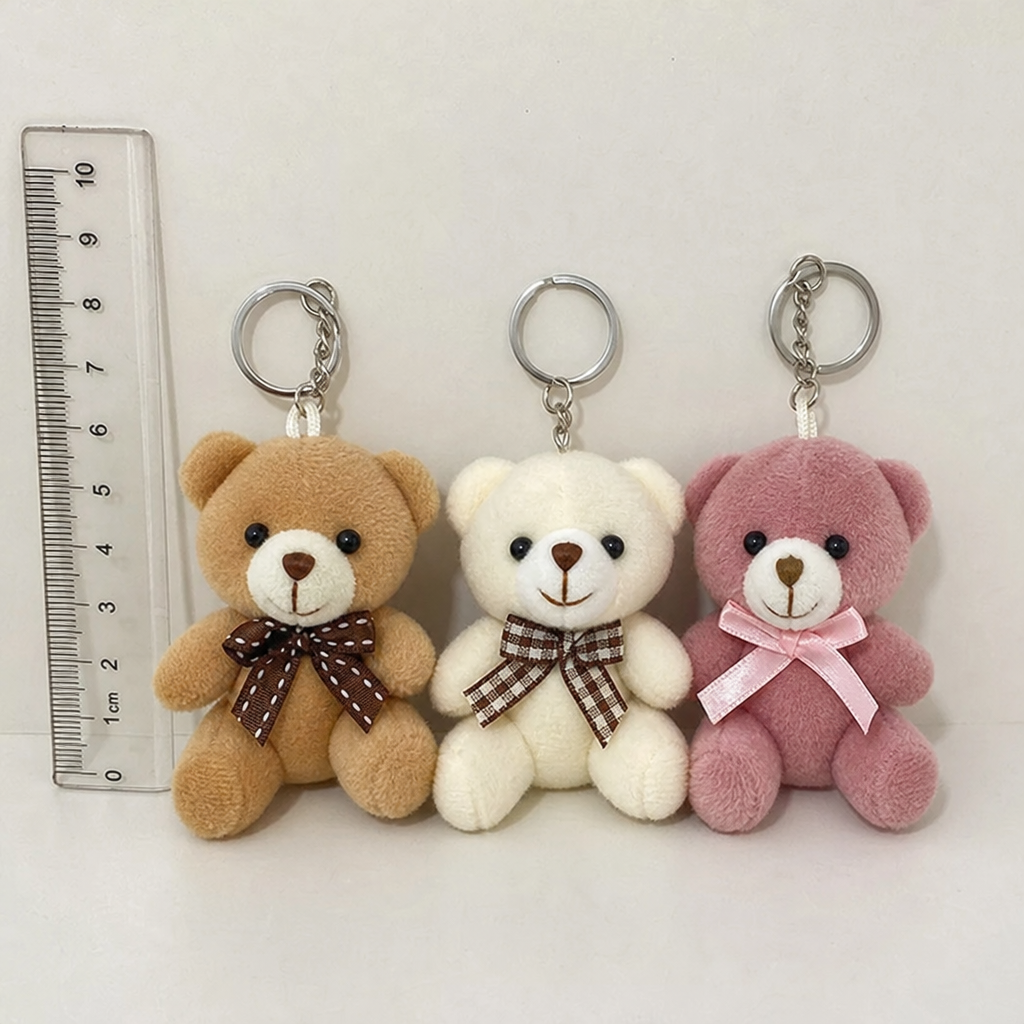
Ask suppliers for the plush body measurements separately from the full hanging length. Also request a photograph showing scale beside a ruler or another clearly identified reference. This helps you judge whether the proposed size suits your intended display and packaging.
Compare expressions and proportions deliberately. You might choose a simple teddy bear with a neutral expression for a coordinated gift collection, or a more playful design for a colorful accessory display. Neither direction is automatically better; the useful question is which one supports your intended presentation.
Color and assortment planning
Begin with a focused selection unless you have a clear reason to offer many variations. Ask whether the minimum order applies to the total purchase, each design, or each color. Record the quantity of every variation rather than accepting an unspecified mixed assortment.
For example, you could build a collection around matching neutral shades or a small seasonal palette. Keep the choice intentional: every additional variation should have a place in your display, photography, and inventory records.
How can you check quality before placing a bulk order?
Request a physical sample and compare it with your written requirements before approving bulk plush keychains. Review the complete product, including the bear, attachment loop, hardware, and packaging—not just the fabric. Alibaba’s wholesale sampling guidance recommends evaluating samples before committing to a larger order.
Use the same review process for each shortlisted supplier. Take photographs under similar lighting, record observations, and distinguish personal preferences from defects. “I prefer a rounder face” is a design preference; “the supplied face differs from the approved design” is a specification issue.
Review the plush body
Examine the face from the front and both sides. Look for the expression you approved, balanced positioning of features, and an overall shape that matches the reference. Check visible seams, loose threads, exposed filling, and unfinished areas.
Handle the sample as an accessory rather than leaving it on a desk. Assess whether you like the fabric feel and whether the filling gives the bear the shape you want. These observations help establish acceptance criteria, but they are not a substitute for any required product testing.
Review the attachment and packaging
Inspect where the loop connects to the plush body. Open and close the clasp, if supplied, and check whether the hardware suits your intended use. Note sharp-feeling edges, awkward operation, or visible finish problems for discussion with the supplier.
Review the packaging separately. Check that the product fits, the presentation matches your brief, and any card or label is legible. Keep the approved sample and specification version as references for the production order, as Alibaba’s bulk-buying guidance recommends.
Compare quotations using the complete order cost
Do not compare a bare product quote with another supplier’s packaged, delivered offer. Ask each supplier to quote the same design, quantity, packaging, and delivery arrangement. Alibaba’s supplier-question guidance highlights that shipping terms affect responsibilities and the transfer of risk, making them an important part of quotation comparisons.
For a plush keychain wholesale purchase, use a comparison sheet with these fields:
|
Cost or condition |
What to clarify |
|---|---|
|
Product price |
Exact design, size, material description, and quantity covered |
|
Minimum order |
Whether it applies per order, design, color, or packaging version |
|
Sampling |
Sample price, delivery charge, and what the sample represents |
|
Customization |
Artwork, setup, sample revision, and production charges |
|
Packaging |
What is included and what requires an additional charge |
|
Delivery |
Shipping method, destination, responsibilities, and quoted exclusions |
|
Order problems |
Agreed process for shortages, defects, or incorrect goods |
Keep uncertain costs visible rather than treating them as zero. If a charge is not included, ask who will establish it and when you will receive confirmation.
You can also calculate an internal planning figure: divide your expected total purchasing cost by the number of units you expect to have available for sale or distribution. State your assumptions clearly, especially where delivery expenses or inspection outcomes remain unresolved.
A lower unit price is only useful if the full order still meets your budget and requirements.
Keep customization focused and verifiable
If you are sourcing plush teddy bear keychains wholesale for a branded project, choose where the branding should appear before requesting artwork. Ask what the supplier can actually produce on the selected design. Do not assume that a logo shown on a digital mockup will have the same clarity on a small physical accessory.
Possible requests to discuss include:
A printed hangtag carrying your brand message.
A fabric label with a simple brand mark.
A coordinated ribbon or clothing detail.
A backing card designed for your display.
Treat these as options to confirm, not standard inclusions. Ask about minimum quantities, placement, artwork requirements, and approval stages for each proposed change.
Consider keeping the plush bear itself simple while using packaging for more detailed messaging. That approach may suit a project where you want the accessory to remain visually versatile. Whichever route you choose, specify the approved wording, colors, placement, and packaging version in the order documents.
What safety information should a wholesale buyer request?
Request documentation relevant to the exact product, intended audience, and market where it will be sold or distributed. For the United States, requirements depend on product classification and applicable rules; CPSC guidance explains testing obligations for toys and restrictions on small parts in products intended for children under three. Do not assume that calling an item a keychain resolves its classification.
Ask the supplier to identify the model covered by any report and explain whether it corresponds to your chosen materials, components, and design. If a document does not clearly match the product, seek clarification before relying on it. Have a qualified compliance professional review uncertainties rather than trying to resolve them through appearance alone.
Pay particular attention to detachable components and the intended age group. The CPSC advises keeping toys with small parts away from children younger than three. A stuffed bear keychain should not be presented as suitable for that age group simply because its body is soft.
Also avoid unsupported descriptions such as “certified safe,” “hypoallergenic,” or “suitable for all ages.” Keep product copy limited to characteristics and claims you can substantiate.
Plan the display before choosing the final assortment
Think through how you will present cute bear keychains before you commit to packaging quantities. Sketch the display, decide which product information customers need, and check whether the sample works in that setting. This exercise can reveal practical requirements that a product photograph does not answer.
For a physical store, test your planned hooks, baskets, or counter display with the sample. Check whether the face remains visible, the attachment tangles with neighboring products, or the packaging hides important details. Make adjustments while you can still change the brief.
For an online listing, prepare a photography checklist. Include a front view, a side view, an attachment close-up, a clear scale image, and the packaging customers will receive. Describe the included quantity explicitly so a group photograph does not create confusion.
You can also plan combinations: a teddy bear plush accessory beside a greeting card, a coordinated gift bag, or another complementary item. Treat these as merchandising ideas to test, not promises of increased sales. Leave enough flexibility to change the presentation after observing customer response.
Put the final agreement into a usable order checklist
Before placing a bear keychain bulk order, consolidate the approved details into one accessible document. Avoid leaving the final specification scattered across messages, images, and earlier quotations. Alibaba’s buyer guidance recommends confirming product specifications, payment terms, delivery commitments, and quality standards in writing before payment.
Use this final review:
- Confirm the product version. Record the design reference, dimensions, colors, materials as described by the supplier, and attachment type.
- Confirm quantities. List units by design and color, along with the total order quantity.
- Confirm presentation. Attach approved artwork and specify individual packaging, labels, and carton arrangements.
- Confirm approval points. Identify which sample or reference governs production and how changes will be authorized.
- Confirm timing. Distinguish sample approval, production completion, dispatch, and expected arrival rather than using one ambiguous delivery date.
- Confirm issue handling. Document how shortages, incorrect goods, and agreed defects will be reported and addressed.
If you have a fixed event date, work backward from when the goods must be ready for use. Include time for receiving, checking, and preparing the products, not just transportation. Ask the supplier to identify uncertainties instead of accepting an unexplained assurance.
For a first purchase, consider an order size that lets you evaluate the relationship without committing your entire purchasing budget. Make that decision against the supplier’s minimums and your actual requirements.
Make the first order a foundation for better reorders
A successful wholesale purchase starts with a clear brief and ends with a record of what arrived. Inspect the delivery against your agreement, document issues promptly, and keep notes on the assortment’s performance. Use those observations—not just the original product photographs—to decide what deserves a reorder.
The strongest next step is straightforward: shortlist suitable designs, request comparable quotations, and evaluate samples against one written standard. That gives your teddy bear keychain purchase a practical basis beyond appearance alone.
Frequently Asked Questions About Teddy Bear Plush Keychain Wholesale
What factors should I consider when selecting a supplier for plush keychains?
When choosing a supplier, consider factors such as product quality, minimum order quantities, customization options, delivery timelines, and pricing. Always request samples to evaluate the quality before placing a bulk order.
How can I ensure the quality of the teddy bear plush keychains I order?
To ensure quality, request physical samples before committing to a bulk order. Review the samples thoroughly, including the plush body, attachment hardware, and packaging. Compare these against your specifications to make sure they meet your requirements.
What are the common customization options available for plush keychains?
Common customization options include branded hangtags, fabric labels, packaging designs, and specific colors or features tailored to your target audience. Discuss these with your supplier to confirm available options and any associated minimum order quantities.
How do I calculate the total cost of my bulk order for plush keychains?
To calculate the total cost, obtain quotations that include product pricing, minimum order details, sampling fees, customization costs, packaging fees, and shipping arrangements. It's important to compare offers on a consistent basis to understand the full cost.
What safety information should I request from my supplier?
Request documentation related to safety standards, particularly if the plush keychains are intended for children. Ensure the supplier can provide compliance certifications and testing records that match the specific product and intended market.