Back To Blog
Temu and AliExpress are online marketplaces connecting shoppers with third-party sellers, so the better choice depends on the listing—not just the platform.
This Temu vs AliExpress comparison explains how to weigh checkout prices, product details, delivery promises, and return conditions before buying.
Neither marketplace deserves an automatic win on price or quality; use the checks below to find the better purchase for your needs.
Which is better: Temu or AliExpress?
Choose Temu when its checkout total, delivery estimate, and return terms make the purchase easier to justify. Choose AliExpress when you find a seller offering the exact specifications you need with acceptable delivery and after-sales conditions.
That is a buying recommendation rather than a claim that either platform consistently beats the other. Marketplace shopping requires evaluating the seller and product separately from the website hosting them.
Temu describes itself as a marketplace connecting consumers with sellers, manufacturers, and brands. AliExpress is also a consumer marketplace, allowing purchases in small quantities rather than requiring wholesale buying. Neither description tells you whether a particular organizer, accessory, or building set is worth buying.
Use this decision framework instead of choosing a permanent favorite:
|
Your priority |
What should decide the purchase |
|---|---|
|
Lowest cost |
The total for an equivalent item at checkout |
|
Exact fit or compatibility |
Clear dimensions, model information, and seller answers |
|
Arrival before an event |
The delivery window for your address |
|
Easy returns |
Eligibility, deadlines, return costs, and refund method |
|
Confidence in the product |
Detailed descriptions and credible, relevant reviews |
These are the practical checks recommended by consumer-protection guidance for marketplace purchases. Apply them to both carts before choosing.
Price comparison starts with equivalent products
A useful price comparison begins by matching what you are actually buying. Record the model, size, material, quantity, and included accessories before comparing totals. The FTC recommends comparing product details and the full cost, including shipping, taxes, and other fees—not simply the advertised price.
Imagine two listings for a drawer organizer. One offers a single small tray; the other includes several larger trays. Even if their photographs look similar, their prices answer different questions. First establish which option fits your drawer and how many pieces you need, then calculate the cost of meeting that requirement.
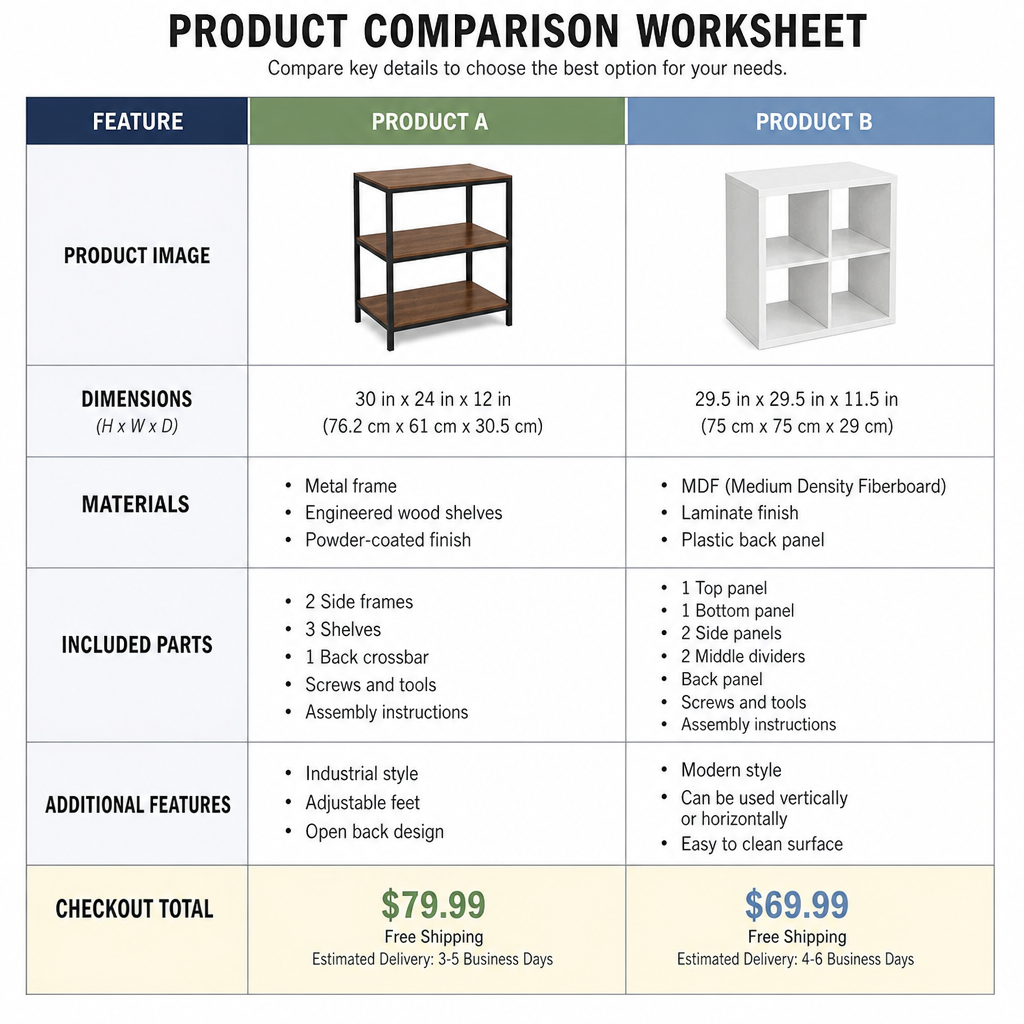
For an AliExpress vs Temu comparison, build a simple worksheet:
Selected variant: Match the size, color, capacity, or model you intend to order.
Usable quantity: Compare the cost per item you will actually use, not just the bundle price.
Included components: Check whether mounting hardware, cables, lids, or other necessary parts are included.
Checkout total: Record delivery charges and any other fees shown before payment.
Offer conditions: Note whether the discount requires additional purchases or a qualifying spend.
This method follows the FTC’s comparison-shopping advice while keeping the decision tied to your specific purchase.
Set your maximum spend before browsing. If reaching a promotional threshold requires adding products you did not want, compare that larger basket with buying only the original item. Treat the extra spending as part of the decision—not as a saving.
Product selection matters most when your needs are specific
For a decorative item, appearance and dimensions may be enough to narrow your options. For a replacement component, the search should begin with the exact model or specification. The more particular your requirement, the less useful a broad claim about which marketplace has “better selection” becomes.
AliExpress operates as a marketplace for individual consumers buying from different sellers. Its Choice service adds a distinct model in which AliExpress takes greater responsibility for functions including pricing, delivery, and after-sales service. A traditional seller listing and a Choice listing therefore should not be treated as identical buying experiences.
Temu also connects buyers with multiple sellers and brands, and says shipping origins vary by product. Avoid assuming every item comes from the same supplier or locati0n. Check the individual offer rather than carrying expectations from one purchase to the next.
My recommendation: search both platforms using the same precise terms. Favor the listing that answers your practical questions, even if another listing has more attractive photography.
How does product quality compare?
Product quality should be assessed at the product and seller level; the marketplace name alone is not enough evidence. Read specifications, investigate the seller, and look for reviews that discuss the same item and intended use.
The Better Business Bureau specifically advises marketplace shoppers to examine seller reviews and product descriptions rather than relying on images or appealing prices.
Turn vague expectations into requirements before searching. For a storage container, write down the dimensions and closure style you need. For clothing, identify the measurements and fabric information you want confirmed. This gives you a reason to reject an unclear listing rather than buying and hoping.
Read an AliExpress review for useful detail
An AliExpress review is most helpful when it explains what arrived, which version was ordered, and how the item performed. Apply that same standard to Temu reviews. The FTC cautions shoppers not to rely on star ratings alone, because reviews and ratings can be misleading or fake.
When reading, look for answers to your own questions: Did the dimensions match? Was assembly straightforward? Did the material suit the intended use? Treat a comment about fast delivery as delivery feedback, not proof of durability.
For anything you consider safety-critical, make verifiable product information a nonnegotiable requirement. My recommendation is to skip the purchase if the listing leaves important safety questions unanswered, however tempting the discount.
Shipping promises belong to the individual order
Temu says its item pages show delivery dates and that delivery estimates account for processing and transit. After purchase, shoppers can find delivery information in their orders. That makes the live product page more useful than a blanket claim that Temu always delivers within a particular number of days.
AliExpress Choice offers delivery-related benefits in selected markets, but availability and conditions matter. Alibaba’s description of Choice does not justify assuming every AliExpress listing includes the same shipping service. Check the benefits attached to the actual item and destination.
For a birthday, trip, or project deadline, use a conservative rule: choose an option whose displayed arrival window leaves room before you need it. If neither listing does, look elsewhere. My recommendation is to prioritize a workable arrival date over a small price difference when lateness would make the purchase useless.
Returns and customer service need separate checks
A return policy explains eligibility and procedure; it does not establish how quickly every customer service case will be resolved. Compare the written conditions first, then consider whether you would be comfortable following them. Avoid declaring either marketplace the service winner based on one enthusiastic review or one complaint.
Temu’s return policy
Temu’s U.S. return policy generally allows returns for eligible items within 90 days of purchase. Some electronics have seller-dependent windows of 45, 60, or 90 days, and certain categories are excluded. The policy provides a free first return for eligible items from each order, subject to its conditions.
The purchase-date wording matters: do not automatically count the window from delivery. Before ordering, check the item’s eligibility and read the instructions for submitting and shipping a return. If buying several items, inspect them before initiating a return so you can consider eligible unwanted items together.
AliExpress return conditions
AliExpress’s Free Return terms apply to participating products carrying the relevant label and include eligibility conditions. They also distinguish the return service from other policies a seller may offer.
Do not assume that buying on AliExpress automatically means every item has the same free-return entitlement or deadline.
Before paying, locate the return conditions attached to your offer. My recommendation is to save the listing, selected variant, and stated benefits alongside your order confirmation. If a problem arises, that creates a clear reference for explaining what you ordered and what resolution you are requesting.
AliExpress vs Temu for LEGO and building sets
For shoppers comparing AliExpress vs Temu for LEGO, the first decision is whether they want genuine LEGO products or another brand’s building blocks.
Those are different purchases and should not be compared as though the branding were interchangeable.
LEGO warns that imitations of its product names, logos, and shapes can mislead consumers into believing they are buying genuine products.
If authenticity is essential, my recommendation is to buy directly from LEGO or a retailer whose authorization you can verify. Do not treat a familiar-looking photograph as sufficient reassurance. For an alternative-brand set, evaluate it under its own manufacturer’s name rather than assuming it carries LEGO’s identity or support.
Use this building-set checklist to frame questions before ordering:
Brand identity: Is the actual manufacturer clearly named?
Brick format: What dimensions or compatibility information does the listing provide?
Contents: Are instructions, figures, accessories, and packaging described?
Assembly expectations: Do relevant reviews discuss building the set, not merely receiving it?
Missing pieces: What assistance does the seller say it provides if the contents are incomplete?
Intended recipient: Are age guidance and warnings available for you to assess?
These are suggested buying criteria, not assurances that either platform or any seller meets them. Leave an unanswered question unresolved rather than filling the gap with an assumption.
For a gift, I would prioritize clear contents and dependable support over the largest advertised piece count.
A practical routine for finding the best deals
The best deals should meet your needs without requiring an uncomfortable compromise. Before opening either app, define the item, acceptable specifications, spending limit, and latest useful arrival date. That makes online shopping a search for a suitable purchase rather than a reason to build a larger basket.
Try this routine:
Write a short requirement list. Separate essential features from preferences you can drop.
Shortlist one credible listing per platform. Eliminate offers that leave essential questions unanswered.
Ask a specific question if needed. Request a measurement or model confirmation rather than asking whether the product is “good.”
Compare complete offers. Consider the item, delivery window, total cost, and return terms together.
Make a deliberate decision. Buy the suitable option—or close both carts if neither qualifies.
This is a suggested workflow, not a guarantee of savings. Its purpose is to make a tempting offer easier to evaluate against the purchase you originally intended to make.
The takeaway: choose the better listing, not a permanent winner
My recommendation is to keep both marketplaces in consideration without giving either automatic preference. Temu’s stated return arrangements may matter most for one purchase; a clearly specified AliExpress offer may suit another. Check the applicable terms rather than extending those advantages to every listing.
Start with what you need, compare equivalent products, and decide how much uncertainty you are willing to accept. If the cheaper offer leaves a crucial question unanswered, it has not yet earned your money.