Back To Blog
Buying 3D puzzles wholesale for Amazon means evaluating more than a supplier’s unit price. You need products you can list, documentation you can verify, packaging you have inspected, and margins that survive fulfillment costs.
This article explains how to compare puzzle formats, assess suppliers, and test an assortment before committing to a larger order.
What should Amazon sellers look for in wholesale 3D puzzles?
Look for a wholesale 3D puzzle with clear product specifications, traceable sourcing, consistent assembly quality, and a workable cost structure.
Before purchasing inventory, check your eligibility to sell the exact product: Amazon notes that some products require approval supported by documents such as a manufacturer or distributor invoice or brand authorization. A wholesale offer alone does not establish listing eligibility.
Start with a written buying brief rather than a supplier catalog. Define your intended customer, preferred puzzle format, acceptable order commitment, and fulfillment method. This gives you a consistent basis for rejecting attractive-looking products that do not fit your business.
Your brief should answer:
Who is the buyer? Choose a specific audience, such as adult hobbyists, gift shoppers, or families buying age-appropriate activities.
What is the intended experience? Consider a display model, an assembly challenge, or a shared building project.
What must the supplier provide? Request samples, specifications, invoices, packaging details, and relevant compliance records.
What makes the order viable? Set purchasing limits using estimated costs and conservative selling-price assumptions.
The goal is not the largest possible assortment. It is a manageable selection you can inspect, describe accurately, and replenish with confidence.
Choose puzzle formats around the customer experience
Treat each format as a separate buying decision. Compare actual samples rather than assuming every product labeled “3D” offers the same assembly process or finished result. Your listing should explain what customers build and what they receive.
Foam puzzles: inspect the sheets and connections
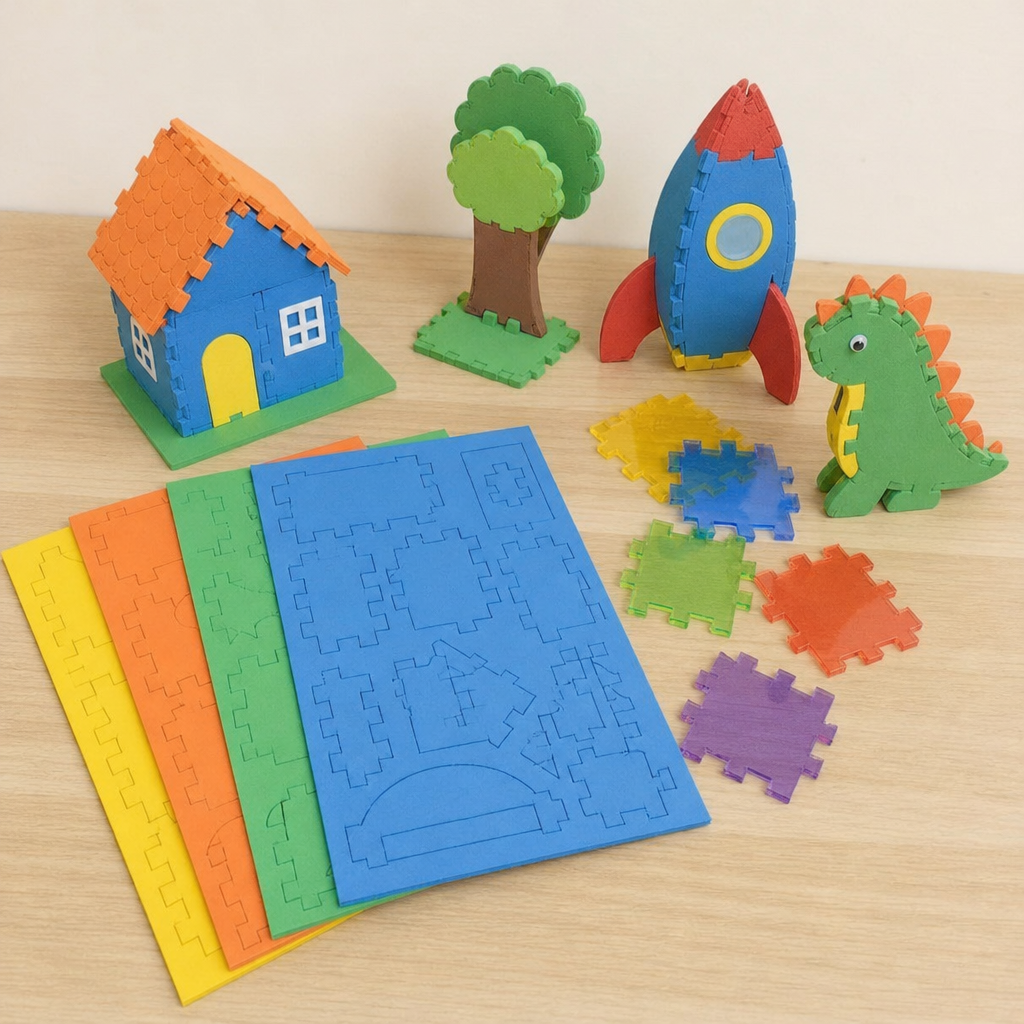
For 3D foam puzzle wholesale sourcing, request the exact material composition. One manufacturer’s foam model listing, for example, specifies EPS foam and coated paper; that specification should not be assumed for every foam puzzle. Obtain details for each SKU you intend to purchase.
During sampling, check whether pieces release cleanly from their sheets and whether tabs fit without excessive force. Inspect printed surfaces, narrow sections, and the assembled base. Record any tearing, loose connections, or unclear assembly steps before discussing a production order.
Photograph both the unassembled contents and the completed model. This helps you explain the building experience without relying entirely on polished supplier images.
Crystal puzzles: verify the finish and assembly sequence
For 3D crystal puzzle wholesale purchases, confirm the material rather than treating “crystal” as proof of glass construction. University Games describes its Original 3D Crystal Puzzles as having translucent, interlocking crystalline pieces. Use the exact supplier’s material specification when preparing your own product details.
Inspect sample pieces under good lighting for surface marks, cloudiness, and color inconsistency. Build the model using the included instructions, paying attention to connecting rods and small components. University Games’ instructions for one model specifically warn against excessive force on delicate pole pieces, illustrating why assembly checks matter.
Keep adjacent puzzle categories distinct
If you also source wholesale jigsaw puzzles, maintain separate evaluation sheets for flat puzzles and dimensional models. Record piece count, packaged size, finished dimensions, and the assembly steps for each product. Do not reuse a flat-puzzle description for a model-building kit simply because the artwork is similar.
Where should you source wholesale 3D puzzles?
Start by comparing manufacturers, authorized distributors, and wholesale suppliers against the same requirements: product traceability, documentation, samples, order terms, and replenishment capability.
Amazon’s wholesale sourcing guidance recommends researching suppliers and verifying their legitimacy before purchasing. It also distinguishes wholesale purchasing from simply finding discounted retail stock.
When contacting wholesale 3D puzzle makers, ask whether you are buying existing branded stock or commissioning a product under your own brand. Keep those discussions separate. For an existing product, request its identifiers and supporting documents; for a proposed custom product, request a written specification and approval process.
A puzzle distributor should receive equally specific questions. Ask which brands it supplies, whether the exact products are available for Amazon resale, and what documentation accompanies an order. Request written answers rather than relying on a verbal assurance that the stock is “Amazon ready.”
Use directories, trade events, and supplier websites to build a shortlist, then verify each candidate independently. Compare the business named on the quotation with the invoice issuer and payment recipient. Resolve unexplained differences before sending a deposit.
Compare quotations beyond the headline discount
Discount 3D puzzles deserve the same inspection as full-price wholesale stock. Ask why the price is reduced and request photographs of the actual inventory, including retail boxes and labels. Do not assume a promotional image represents the condition of the units being offered.
Send every shortlisted supplier the same quotation request:
|
Buying detail |
What to request |
|---|---|
|
Product identity |
Brand, model number, barcode, piece count, and material |
|
Order commitment |
Minimum order per design, case quantity, and mixed-case options |
|
Pricing basis |
Quantity tiers, quote currency, and included services |
|
Packaging |
Retail-box measurements, packed weight, and carton details |
|
Availability |
Stock status or production schedule and dispatch estimate |
|
Quality support |
Inspection terms, missing-piece process, and defect remedies |
|
Documentation |
Invoice details and relevant product-specific records |
Keep the quotation separate from your assumptions. If freight, inspection, labeling, or preparation is excluded, leave those costs visible in your comparison rather than treating them as zero.
Before paying, turn the accepted quotation into a clear purchase order. Identify the approved sample, product specifications, quantities, packaging, and agreed remedies. This gives both parties a shared reference if the delivered goods differ from expectations.
Check documentation before committing to inventory
For U.S. sales, establish the product’s intended age group and applicable safety requirements early. CPSC states that toys intended primarily for children aged 12 or younger require testing by a CPSC-accepted third-party laboratory and certification by the manufacturer or importer in a Children’s Product Certificate. Requirements depend on the product; a generic “tested” claim is not enough.
Ask for records that identify the actual model you plan to buy. Compare the model number, product photographs, materials, manufacturer details, and labeling with the sample. Investigate mismatches rather than accepting a report for a visually similar item.
Children’s products also have tracking-label requirements covering identifying information such as the manufacturer or importer, production locati0n and date, and batch details, to the extent practicable. CPSC explains that these markings apply to the product and its packaging. Include this in your packaging review where applicable.
Check Amazon’s current requirements for the exact product in Seller Central before ordering. Keep supplier invoices, correspondence, photographs, and compliance records together by SKU. If age classification or importer responsibilities are unclear, resolve them with a qualified compliance professional before purchase rather than changing the age label to avoid the issue.
Calculate the economics using the packaged product
Use measured retail-package dimensions and weight when estimating fulfillment costs. Amazon’s Revenue Calculator lets sellers compare fulfillment options and enter product information and costs; Amazon cautions that the resulting fees and profit figures are estimates subject to change. Run the calculation for each SKU rather than applying one margin assumption across the assortment.
Build a worksheet with separate lines for:
Acquisition: product cost, sample allocation, inspection, and payment charges.
Landed inventory: freight, applicable import costs, brokerage, and receiving.
Preparation: labels, protective packaging, assembly of approved packs, and handling.
Selling: marketplace and fulfillment fees, advertising, promotions, and return allowances.
Inventory exposure: storage, removal, or disposal allowances where relevant.
Treat this worksheet as a planning model, not a promise of profit. Confirm which charges apply to your sourcing and fulfillment arrangement, and avoid counting the same expense twice.
Then test the proposal under less favorable assumptions. Reduce the expected selling price, increase advertising spending, and allow for some unsellable returns. Choose those assumptions yourself based on your business evidence; there is no universal margin that makes every puzzle order worthwhile.
Compare the resulting cash commitment with your available purchasing budget. A lower unit price should not be the deciding factor if the larger order leaves insufficient funds for preparation, launch, and replenishment.
Inspect samples as both a seller and a customer
Build a sample without coaching from the supplier. Follow only the instructions a buyer would receive, and note where the process becomes confusing. This is your opportunity to identify issues while changes or a different product choice remain possible.
Use a repeatable inspection checklist:
Inventory the contents. Compare pieces, accessories, and instructions with the stated specification.
Complete assembly. Record confusing steps, poor-fitting parts, and fragile connections.
Inspect the finish. Check print alignment, surface marks, and color consistency.
Review the presentation. Examine box condition, readable instructions, labels, and warnings.
Document the result. Photograph issues and obtain written responses before approving stock.
Ask how missing pieces and manufacturing defects will be handled after delivery. Specify what evidence is needed, who approves a claim, and whether the remedy is replacement stock, a credit, or another agreed solution. Do not confuse a supplier’s commercial remedy with your responsibilities to customers.
Keep the approved sample and inspection notes as purchasing references. For repeat orders, compare incoming goods against that reference rather than assuming the specification has remained unchanged.
Build accurate listings and launch a controlled test
First determine whether you are offering an exact existing product or introducing a genuinely new one. Amazon generally requires industry-standard product identifiers for creating product pages and offers in most categories. Verify the relevant identifier requirements and match the product accurately instead of treating a similar-looking catalog entry as interchangeable.
Prepare listing information from the approved sample and verified specifications. Show the finished model, included contents, and a clear size reference. Distinguish assembled dimensions from package measurements, and state material, piece count, intended age, and required tools only when confirmed.
Avoid unsupported promises about educational outcomes or assembly time. If a supplier provides a difficulty rating, establish what it means before repeating it. Clear expectations are more useful than a broad claim that every puzzle is suitable for everyone.
For your first order, choose a limited assortment with a reason for every SKU. You might test different themes within one format rather than changing theme, material, price position, and packaging simultaneously. Set a review point before launch so you know when to evaluate results.
Track sales, advertising costs, returns, customer questions, and defect reports by product. Reorder based on observed performance and cash needs, not enthusiasm for the complete supplier catalog. Use feedback to improve descriptions or resolve quality problems before increasing volume.
Make the next order easier to justify
A disciplined approach to 3D puzzle wholesale for Amazon sellers starts with verification, not volume. Choose products you can inspect, suppliers who answer specific questions, and order sizes supported by your own cost model.
Before committing, assemble the sample, confirm the paperwork, and calculate the packaged product’s economics. Scale only when the first order gives you a clear reason to buy again.
Frequently Asked Question About 3D Puzzle Wholesale for Amazon Sellers
What should I consider when choosing a wholesale supplier for 3D puzzles?
When selecting a supplier, consider product specifications, traceable sourcing, assembly quality, required documentation, and fulfillment costs. It's crucial to request samples and verify compliance records to ensure eligibility for selling on Amazon.
How do I ensure the quality of the 3D puzzles I plan to sell?
Inspect samples carefully, focusing on material composition, assembly instructions, and finished products. Document any issues during assembly and compare samples against stated specifications to confirm quality before making bulk purchases.
What are the documentation requirements for selling 3D puzzles on Amazon?
You need to check specific listing eligibility requirements from Amazon and obtain necessary documents like manufacturer or distributor invoices, compliance records, and certifications, especially for products targeted at children.
How do I calculate the costs associated with selling 3D puzzles?
Use a worksheet to estimate acquisition costs, landed inventory expenses (like freight and import costs), preparation costs for labeling and packaging, and selling expenses, including marketplace fees. Be sure to consider all potential costs before placing orders.
What are the risks of purchasing discounted 3D puzzles from wholesalers?
Discounted 3D puzzles should be inspected just as thoroughly as full-priced options. Check the reasons for price reductions, verify the condition of the inventory, and ensure that any promotional images reflect the actual stock to avoid unexpected quality issues.