Back To Blog
 STEM Toys for Kids: What Are STEM Toys? Benefits, Types, and How to Choose the Best Educational Toys
STEM toys for kids are educational toys designed to encourage learning through hands-on exploration, experimentation, problem-solving, and creative play.
They introduce children to concepts related to Science, Technology, Engineering, and Mathematics (STEM) while making learning interactive and enjoyable.
From building blocks and magnetic construction sets to coding robots, science experiment kits, and mathematical puzzles, STEM toys offer children opportunities to investigate how things work, test their ideas, and develop practical skills.
Unlike toys designed primarily for entertainment, well-designed STEM educational toys incorporate activities that encourage curiosity, logical reasoning, spatial awareness, experimentation, and creative thinking.
However, not every toy labeled "STEM" provides meaningful educational value. The most effective STEM toys combine age-appropriate challenges, active participation, clear learning objectives, and opportunities for discovery.
In this comprehensive guide, we explain what STEM toys are, how they work, their benefits for children's development, the different types available, and how to choose suitable STEM toys for toddlers, preschoolers, and school-age children.
What Are STEM Toys?
STEM toys are educational play materials that introduce children to science, technology, engineering, or mathematics through practical activities and exploration.
The acronym STEM represents four interconnected learning disciplines.
S – Science
Science toys encourage children to observe, investigate, experiment, and understand natural phenomena. Examples include magnifying glasses, microscopes, nature exploration kits, and simple experiment sets.
Technology toys introduce children to systems, coding, computational thinking, and technological tools. Examples include programmable robots, screen-free coding games, and interactive electronic kits.
E – Engineering
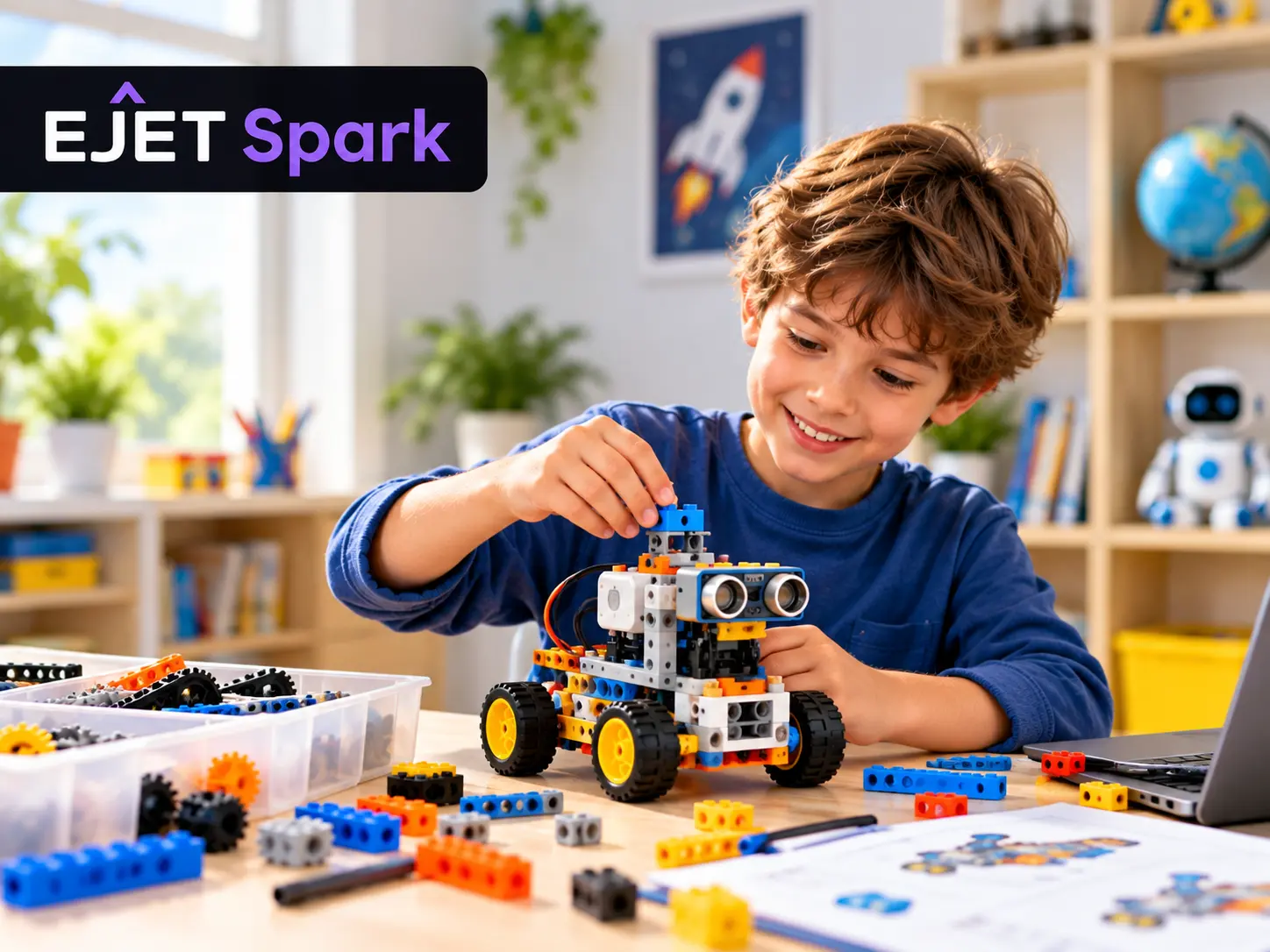
Engineering toys challenge children to design, build, test, and improve structures or mechanisms. Examples include construction blocks, marble runs, gears, bridges, and mechanical building sets.
M – Mathematics
Mathematics toys help children explore numbers, counting, patterns, shapes, measurements, and spatial relationships. Examples include counting cubes, number puzzles, geometric tiles, and logic games.
A single STEM toy may address one discipline or combine several learning areas.
For example, a marble run construction set can introduce engineering through structural design, science through gravity and motion, and mathematics through measurements and spatial relationships.
How Do STEM Toys Work?
STEM toys encourage children to learn through active exploration rather than passive instruction.
Instead of simply watching a demonstration, children manipulate objects, ask questions, make predictions, and observe outcomes.
Consider a child building a bridge using construction blocks.
The child may initially create a structure that collapses under weight. After examining the result, the child adds support pieces, changes the design, and tests the bridge again.
This process introduces several important learning behaviors:
-
Observation: Identifying what happens during an activity.
-
Prediction: Considering what might happen next.
-
Experimentation: Testing ideas through practical activities.
-
Problem-solving: Finding solutions when something does not work.
-
Iteration: Improving a design based on previous results.
-
Reasoning: Connecting actions with outcomes.
The educational value comes not merely from assembling a finished object, but from the thinking and experimentation involved.
Benefits of STEM Toys for Kids
STEM toys can support different areas of children's learning and development when the activities are appropriate for their ages, interests, and abilities.
1. Encourage Critical Thinking and Problem-Solving
Many STEM activities present children with challenges that have multiple possible solutions.
For example, a child building a marble run must consider how to connect tracks, maintain stability, and create a path that allows a marble to move successfully.
These challenges provide opportunities to analyze problems, test solutions, and make improvements.
2. Develop Creativity and Imagination
STEM learning is not limited to following instructions.
Open-ended construction toys allow children to create original structures, vehicles, machines, and imaginary environments.
By experimenting with different designs, children can combine creative expression with practical reasoning.
3. Introduce Early Mathematical Concepts
Counting toys, sorting games, geometric puzzles, and construction materials provide practical opportunities to explore mathematical ideas.
Young children can learn about quantities, shapes, patterns, comparisons, and spatial relationships through play.
For example, sorting colored blocks by shape introduces classification, while arranging blocks into repeating sequences encourages pattern recognition.
4. Support Fine Motor Skills
Many hands-on STEM toys require children to grasp, connect, rotate, stack, or manipulate small objects.
Activities involving construction pieces, gears, and puzzles can provide practice with hand-eye coordination and controlled movements.
We should ensure that toy components are appropriately sized and safe for the child's age.
5. Encourage Curiosity and Scientific Exploration
Science toys provide opportunities for children to investigate everyday questions.
Why do some objects float? How do magnets attract certain materials? What helps a seed grow?
When children explore these questions through observation and experimentation, they can develop greater familiarity with scientific thinking.
6. Build Persistence and Confidence
Some STEM activities require repeated attempts.
When a structure collapses or a programmed robot follows an unexpected route, children can modify their approach and try again.
With appropriate encouragement, these experiences may help children develop persistence and confidence in approaching unfamiliar challenges.
7. Promote Collaboration and Communication
STEM activities can also involve teamwork.
Children working together on a construction project may need to explain ideas, divide responsibilities, discuss solutions, and coordinate their actions.
These interactions provide opportunities to practice communication and cooperation.
It is important to recognize that STEM toys do not automatically produce these benefits. Outcomes depend on toy design, the child's engagement, the learning environment, and the support provided by adults.
Different Types of STEM Toys for Kids
STEM toys are available in numerous categories, from simple wooden puzzles to sophisticated programmable robotics kits.
Understanding these categories helps us identify suitable educational toys for different developmental stages.
1. Building and Construction Toys
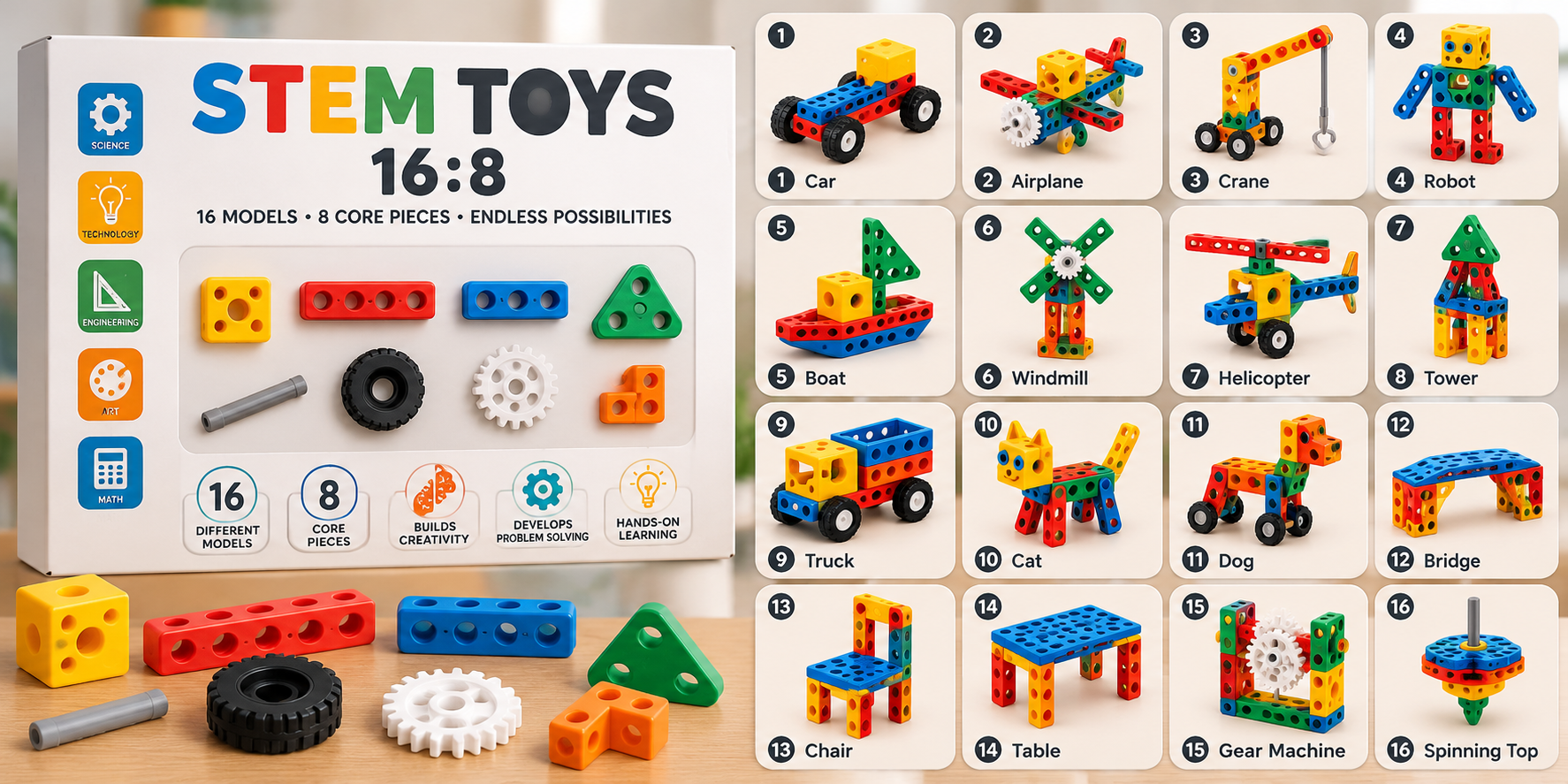
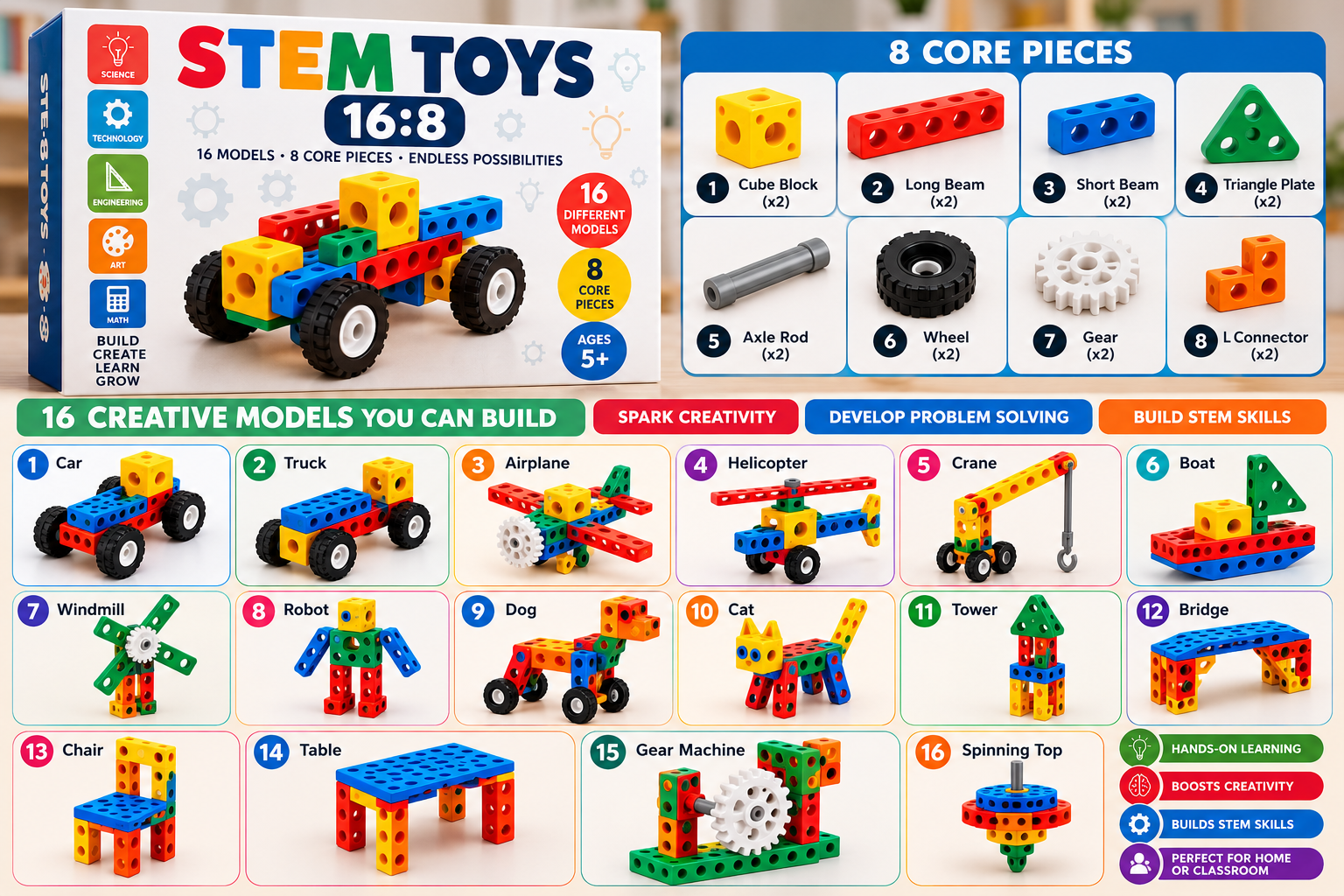
Construction toys encourage children to explore shapes, balance, stability, and structural design. Examples include building blocks, magnetic tiles, interlocking bricks, and bridge-building kits.
Learning focus: Engineering, spatial reasoning, design, and problem-solving.
2. Science Experiment Kits
Science kits introduce children to observation, measurement, and experimentation. Activities may explore plant growth, magnets, light, water, or basic chemical reactions.
Learning focus: Scientific inquiry, observation, and cause-and-effect relationships.
3. Coding and Robotics Toys
Coding toys allow children to create instructions, recognize sequences, and understand how programmable systems respond to commands. Some use physical coding cards; others involve apps or computers.
Learning focus: Computational thinking, sequencing, debugging, and technology.
4. Mathematics and Counting Toys
Mathematical toys help children explore counting, number relationships, sorting, patterns, and basic operations through physical interaction.
Learning focus: Numeracy, logical thinking, and mathematical reasoning.
5. Mechanical Engineering Toys
Mechanical toys introduce children to moving parts, gears, levers, wheels, and simple machines. They provide opportunities to explore how mechanical systems transfer movement and force.
Learning focus: Mechanics, physics, and engineering design.
6. Nature and Discovery Toys
Nature exploration kits may include magnifying glasses, observation containers, binoculars, and simple investigation tools.
Learning focus: Biology, environmental observation, classification, and scientific curiosity.
Best STEM Toys by Age Group
Children's interests, physical abilities, and learning needs change as they grow.
We should select STEM toys according to developmental readiness rather than assuming that a more complicated toy is necessarily more educational.
|
Age group |
Suitable STEM toy examples |
Main learning opportunities |
|---|---|---|
|
1–2 years |
Large stacking blocks, shape sorters, nesting cups |
Shapes, sorting, cause and effect |
|
3–4 years |
Large building blocks, simple puzzles, counting toys |
Patterns, coordination, early numeracy |
|
5–6 years |
Magnetic building sets, beginner science activities, marble runs |
Engineering, observation, problem-solving |
|
7–9 years |
Beginner robotics, circuit kits, mechanical construction sets |
Sequencing, circuits, logical reasoning |
|
10–12 years |
Coding projects, advanced engineering kits, scientific instruments |
Experimentation, programming, technical design |
|
13+ years |
Advanced robotics, electronics, programming, engineering projects |
Systems thinking, technical problem-solving |
These are general suggestions, not universal developmental rules. We must follow manufacturer age recommendations and product safety instructions.
STEM Toys for Toddlers Ages 1–3
For toddlers, we prioritize simple, durable toys that encourage sensory exploration and physical manipulation.
Suitable examples include large stacking blocks, shape sorters, nesting cups, and basic sorting activities.
At this stage, children benefit from exploring shapes, sizes, colors, and relationships between objects.
Safety is particularly important: Toys should not contain accessible small parts, loose magnets, or button batteries that could present ingestion hazards.
STEM Toys for Preschoolers Ages 3–5
Preschool children often enjoy building, sorting, experimenting, and imaginative play.
Suitable STEM toys may include age-appropriate construction sets, counting games, large-piece puzzles, and supervised nature exploration tools.
We can encourage learning by asking open-ended questions such as, "What do you think will happen if we add another block?"
STEM Toys for Kids Ages 6–8
Children in this age group may be ready for more structured challenges involving construction, experimentation, and logical sequences.
Examples include beginner coding robots, simple circuit kits, mechanical building sets, and age-appropriate science experiments.
Activities that combine instructions with opportunities for independent modification can be especially engaging.
STEM Toys for Kids Ages 9–12
Older children may enjoy projects requiring multiple steps, technical reasoning, and experimentation.
Suitable examples include programmable robotics, electronics projects, model engineering kits, and more advanced science activities.
We should choose challenges that are achievable with effort rather than unnecessarily frustrating.
STEM Toys vs. Traditional Toys: What Is the Difference?
Traditional toys and STEM toys are not mutually exclusive.
Many conventional toys, including wooden blocks, puzzles, and construction sets, can support meaningful STEM learning.
The distinction lies primarily in how a toy is designed and used.
|
Feature |
STEM-focused toys |
Traditional toys |
|---|---|---|
|
Primary purpose |
Encourage STEM-related exploration |
Entertainment, imagination, or general development |
|
Learning activities |
Building, testing, measuring, coding |
Varies widely |
|
Problem-solving |
Often explicitly encouraged |
May also be present |
|
Creative play |
Common in open-ended designs |
Common in many categories |
|
Educational instructions |
May include structured activities |
Not always included |
|
Technology required |
Not necessarily |
Not necessarily |
A simple set of wooden blocks can provide valuable engineering experiences when children experiment with balance, stability, and construction.
We should therefore evaluate the actual play experience rather than relying exclusively on the STEM label.
STEM vs. STEAM Toys: Understanding the Difference
Another term frequently used in educational toys is STEAM.
STEAM expands the traditional STEM framework by incorporating Arts.
-
STEM: Science, Technology, Engineering, Mathematics.
-
STEAM: Science, Technology, Engineering, Arts, Mathematics.
STEAM activities integrate creative expression, visual design, storytelling, or artistic experimentation with technical learning.
For example, children designing and constructing a model city may explore engineering principles while also considering architecture, color, aesthetics, and creative presentation.
Both STEM and STEAM approaches can support interdisciplinary learning.
How to Choose the Best STEM Toys for Kids
Selecting a STEM toy requires more than considering its appearance, price, or advertised educational benefits.
We recommend evaluating several important characteristics.
1. Choose Age-Appropriate Challenges
The toy should match the child's developmental stage, physical abilities, and experience.
An activity that is too easy may not maintain interest, while an excessively difficult task may lead to frustration.
2. Prioritize Safety and Quality
We should examine material quality, construction, component sizes, battery compartments, and potential hazards.
Age warnings and applicable safety standards are especially important for toys containing magnets, electronic components, or small pieces.
3. Look for Hands-On Learning
Effective STEM toys encourage children to manipulate objects, make decisions, and investigate outcomes.
We should favor activities where children participate actively rather than simply observe automated features.
4. Encourage Open-Ended Play
Open-ended STEM toys allow multiple solutions and different creative approaches.
For example, a construction set that can produce many structures may offer more opportunities for experimentation than a model with only one prescribed configuration.
5. Consider the Child's Interests
A child interested in animals may enjoy nature observation activities, while a child fascinated by machines may prefer gears or robotics.
Connecting STEM learning with existing interests can make activities more engaging.
6. Evaluate Durability and Reusability
Well-made STEM toys should withstand intended use and provide repeated learning opportunities.
Reusable construction systems and programmable toys can support progressively more challenging activities.
7. Review the Learning Objectives
We should identify what the toy actually helps children explore.
Does it introduce measurement, encourage experimentation, support logical sequences, or demonstrate engineering concepts?
Clear educational objectives make it easier to select meaningful products.
Are STEM Toys Safe for Kids?
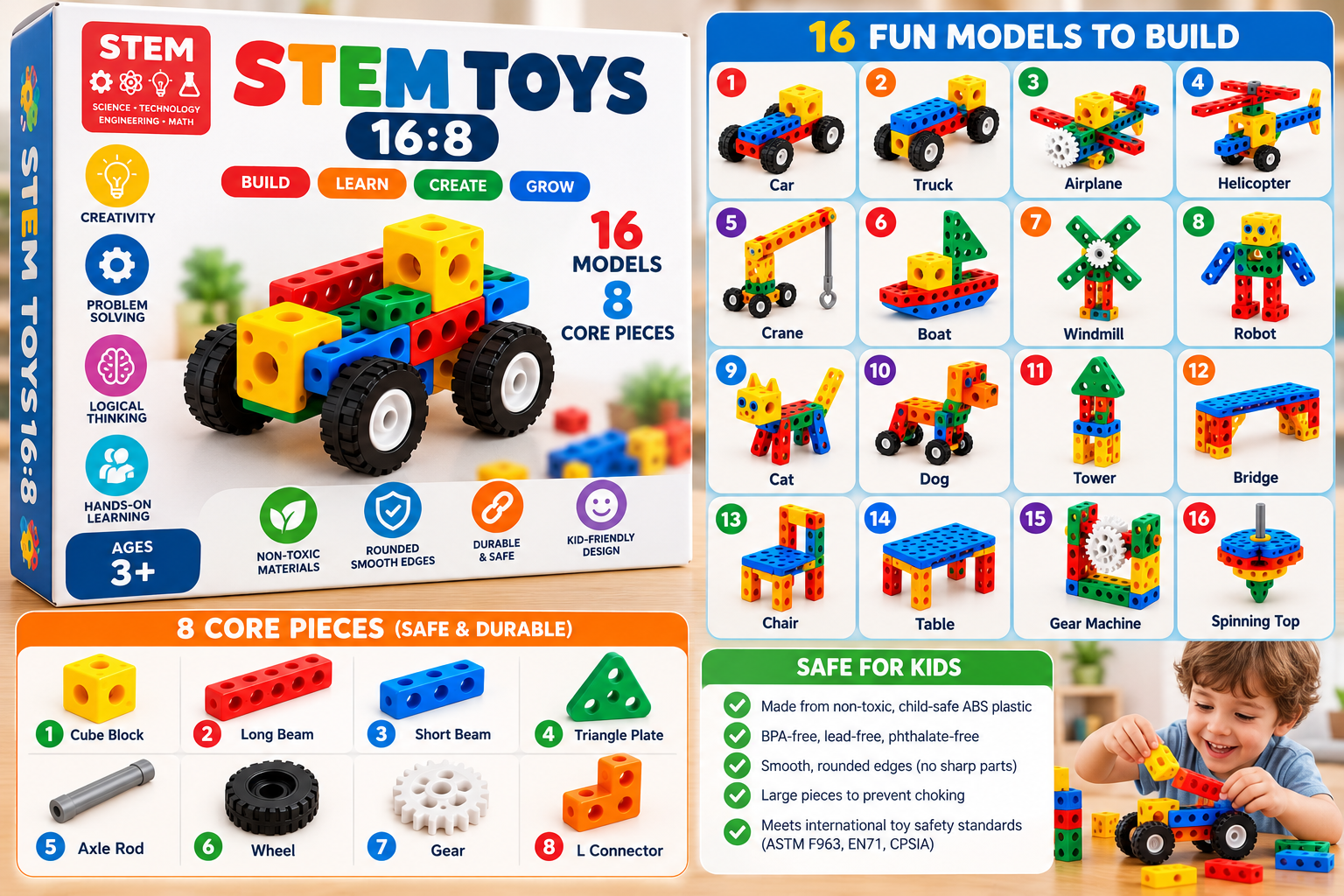
STEM toys must be selected and used with appropriate attention to safety.
We should consider the child's age, the toy's components, and the type of activity involved.
Small Parts and Choking Hazards
Toys containing small detachable pieces may be unsuitable for children under three years old.
We should follow applicable age restrictions and choking hazard warnings.
Magnets
Small, powerful magnets can cause severe internal injuries if swallowed.
We should avoid products with accessible high-powered magnets and ensure that magnetic components are securely enclosed where required.
Button and Coin Batteries
Swallowed button or coin batteries can cause life-threatening injuries.
Battery compartments should meet applicable safety requirements and remain inaccessible to young children without appropriate tools.
Chemical Experiment Kits
Science activities involving chemicals require suitable age recommendations, instructions, protective measures, and adult supervision.
We should never substitute household chemicals into experiments unless the activity is specifically designed and verified for their safe use.
Electrical Components
Electronic STEM toys should meet relevant electrical and toy safety requirements.
We should inspect wires, connectors, batteries, and power supplies before use.
How Parents Can Encourage STEM Learning at Home
STEM learning does not require expensive equipment or sophisticated electronics.
Everyday objects and simple activities can introduce valuable concepts.
Build a Tower Challenge
Provide age-appropriate blocks and challenge children to build a tall, stable tower.
Encourage them to experiment with different foundations and shapes.
Learning concepts: Balance, stability, measurement, and structural design.
Explore Sink and Float
Using a container of water and suitable household objects, ask children to predict which objects will float.
After testing, discuss the results.
Learning concepts: Observation, prediction, and buoyancy.
Create Patterns With Shapes
Use colored blocks or large geometric pieces to create repeating patterns.
Ask children to extend or modify each pattern.
Learning concepts: Classification, sequencing, and mathematical relationships.
Design a Paper Bridge
For older children, provide paper and safe construction materials.
Challenge them to create a bridge that can support a small, lightweight object.
Learning concepts: Engineering design, load distribution, and experimentation.
Practice Screen-Free Coding
Create a simple floor grid and use direction cards to guide a toy character through a route.
Children can arrange commands, test the sequence, and correct mistakes.
Learning concepts: Algorithms, sequencing, and debugging.
What Should Manufacturers and Wholesale Buyers Look for in STEM Toys?
For businesses sourcing educational toys, product quality and compliance are as important as educational value.
We should assess both the learning experience and the manufacturer's ability to deliver consistent products.
Material and Construction Quality
Materials should be suitable for the intended age group and use.
We should inspect edges, joints, surface finishes, fasteners, and moving components.
Educational Functionality
STEM toys should perform their intended learning activities reliably.
For example, a coding robot should respond consistently to instructions, while construction pieces should connect securely without excessive force.
Age-Appropriate Packaging and Instructions
Packaging should communicate the intended age range, product contents, safety warnings, and instructions clearly.
For products intended for international markets, language and labeling requirements must be considered.
Toy Safety Compliance
Depending on the destination market, relevant requirements may include:
|
Market |
Examples of relevant requirements |
|---|---|
|
United States |
ASTM F963, CPSIA, applicable CPSC regulations |
|
European Union |
Applicable EU toy safety legislation and harmonized standards, including relevant EN 71 provisions |
|
United Kingdom |
Applicable UK toy safety regulations and conformity requirements |
|
Other markets |
National toy safety, chemical, labeling, and import requirements |
Requirements vary by product, market, and date. Electronic, chemical, or connected toys may have additional obligations.
Quality Control and Product Testing
We should establish inspection procedures covering dimensions, materials, workmanship, functionality, packaging, and required documentation.
Independent laboratory testing may be necessary to demonstrate conformity with applicable requirements.
Frequently Asked Questions About STEM Toys for Kids
What does STEM stand for in toys?
STEM stands for Science, Technology, Engineering, and Mathematics. STEM toys use hands-on activities to introduce concepts from one or more of these disciplines.
What are examples of STEM toys?
Examples include building blocks, magnetic construction sets, coding robots, science experiment kits, counting puzzles, marble runs, gear systems, and beginner electronics kits.
Are STEM toys good for toddlers?
Age-appropriate STEM toys can provide toddlers with opportunities to explore shapes, sorting, stacking, patterns, and cause-and-effect relationships. We should choose products specifically designed for their developmental stage and follow safety warnings.
At what age should children start playing with STEM toys?
Children can begin exploring foundational STEM concepts during early childhood through simple activities such as stacking blocks, sorting shapes, and investigating everyday objects. More complex robotics and electronics activities are generally suitable for older children.
Do STEM toys help children learn mathematics?
STEM toys can provide practical experiences with counting, patterns, measurements, shapes, and spatial relationships. Their educational effectiveness depends on the activities and how children engage with them.
Do all STEM toys require batteries or technology?
No. Many effective STEM toys are entirely screen-free and battery-free. Wooden blocks, puzzles, construction sets, and counting materials can all support STEM-related learning.
Are STEM toys better than regular toys?
Not necessarily. Many traditional toys also encourage creativity, reasoning, problem-solving, and exploration. The quality of the play experience matters more than the marketing category.
What are the best STEM toys for a 5-year-old?
Age-appropriate construction blocks, beginner counting games, large-piece puzzles, simple science exploration tools, and suitable magnetic building sets can be useful choices, depending on the child's interests and the product's safety guidance.
What is the difference between STEM and educational toys?
Educational toys are a broad category covering many learning objectives, including language, literacy, music, and social skills. STEM toys focus specifically on science, technology, engineering, and mathematics.
Can STEM toys improve creativity?
Open-ended STEM toys can provide opportunities for creative design and experimentation. Children may invent new structures, develop alternative solutions, and explore original ideas through play.
Conclusion: Why STEM Toys Matter for Children's Learning and Development
STEM toys for kids provide opportunities to explore scientific ideas, engineering challenges, technology concepts, and mathematical relationships through active play.
From simple stacking blocks to advanced robotics kits, these toys can encourage curiosity, creativity, problem-solving, and experimentation when they are well-designed and appropriately used.
We should prioritize safety, developmental suitability, educational purpose, and hands-on engagement when selecting STEM toys.
For parents and educators, the goal is not simply to introduce technical subjects at an early age. It is to create enjoyable opportunities for children to investigate questions, test ideas, and learn through discovery.
For manufacturers and wholesale buyers, high-quality STEM toys should combine engaging educational activities with reliable construction, appropriate instructions, and compliance with applicable toy safety requirements.
By choosing STEM toys that balance learning, creativity, and enjoyment, we can support meaningful play experiences that encourage children to explore the world around them.
Here are some related articles you may find interesting: