Back To Blog
Writing tablets for kids bring drawing, handwriting practice, and simple games together on one reusable surface. From colorful LCD doodle boards to magnetic drawing tablets, these toys offer children a convenient place to explore ideas, practice letters, and create pictures without using a new sheet of paper each time.
Within the toys and games category, writing tablets suit a wide range of activities. A child can sketch a favorite animal, solve a number puzzle, play tic-tac-toe, or leave a message for a family member.
Their usefulness depends on choosing the right design: writing clarity, comfortable handling, reliable erasing, and age-appropriate construction matter more than decorative extras.
In this guide, we examine the main types of writing tablet toys, practical features to compare, and ways to make reusable drawing boards part of everyday play.
What Are Writing Tablet Toys?
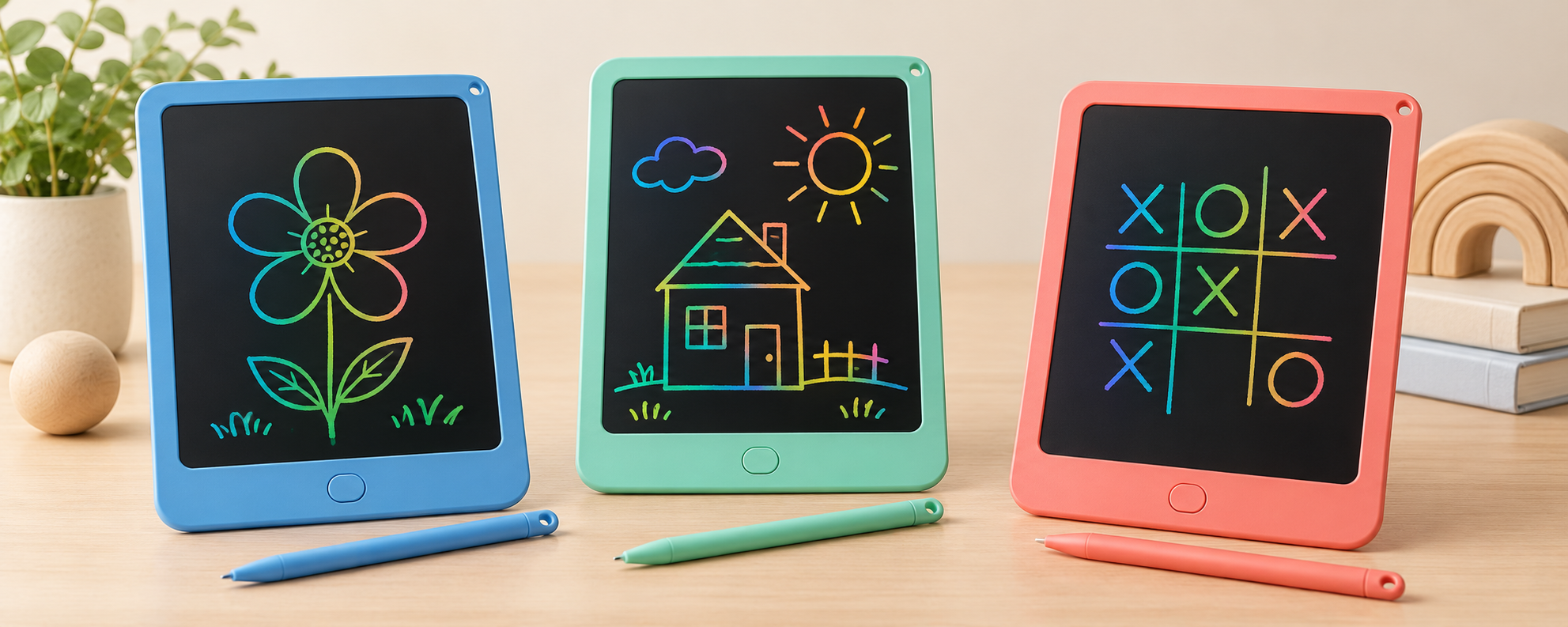
Writing tablet toys are reusable boards designed for drawing, writing, tracing, and interactive activities. Most use an included stylus, although the writing mechanism varies by product.
Some boards use a pressure-sensitive LCD surface with a button that clears the display. Others use a magnetic mechanism and a sliding eraser. Light-up tracing boards illuminate a surface beneath paper or compatible drawing materials.
We distinguish these products from general-purpose digital tablets. A basic LCD writing board usually does not run apps, connect to the internet, or play videos. It provides a dedicated writing surface with a limited set of functions.
However, “writing tablet” is a broad product term. Buyers should check the description carefully to understand whether a product is a simple doodle board, an illuminated tracing tool, or an electronic learning device.
Popular Types of Writing Tablets in Toys & Games
LCD Writing Tablets for Kids
LCD writing tablets use a pressure-sensitive surface that displays marks made with a compatible stylus. On many models, pressure affects line thickness, allowing children to produce a mixture of fine lines and broader strokes.
A typical board includes:
- A reusable writing screen.
- A stylus and storage slot.
- An erase button.
- An erase-lock switch on selected models.
- A battery compartment for the electronic clearing function.
Many basic LCD boards use power primarily when clearing the screen. Battery requirements and operating methods vary, so we check the individual specifications rather than assuming every model works in the same way.
These tablets suit freehand drawing, spelling practice, short calculations, and quick games.
Magnetic Drawing Boards
Magnetic drawing boards create visible marks when a magnetic stylus moves across the surface. A sliding mechanism generally clears the drawing area, allowing children to start again.
Some models include shaped stamps, such as circles or stars, that add variety to play. Others divide the drawing surface into colored sections.
Magnetic boards can be useful for children who prefer a substantial frame and a large drawing area. We examine how smoothly the eraser moves and whether the stylus and accessories are suitable for the intended age group.
Light-Up Tracing Tablets
Light-up tracing tablets illuminate a work surface so children can see a design beneath a sheet of paper and trace its outlines.
These products suit structured activities such as:
- Tracing letters and numbers.
- Copying simple illustrations.
- Practicing repeated patterns.
- Creating layered drawings.
- Following prepared activity sheets.
Some products marketed as light-up drawing boards use different materials and methods. We verify whether paper, special markers, templates, or replacement accessories are required before purchasing.
Electronic Learning and Writing Tablets
Some electronic writing toys combine drawing or handwriting activities with sounds, prompts, or guided exercises. Their functions vary considerably.
When comparing these products, we look beyond the number of advertised activities. Clear instructions, suitable language options, usable controls, and age-appropriate content determine how practical the toy will be during regular use.
How to Choose the Best Writing Tablet for Kids
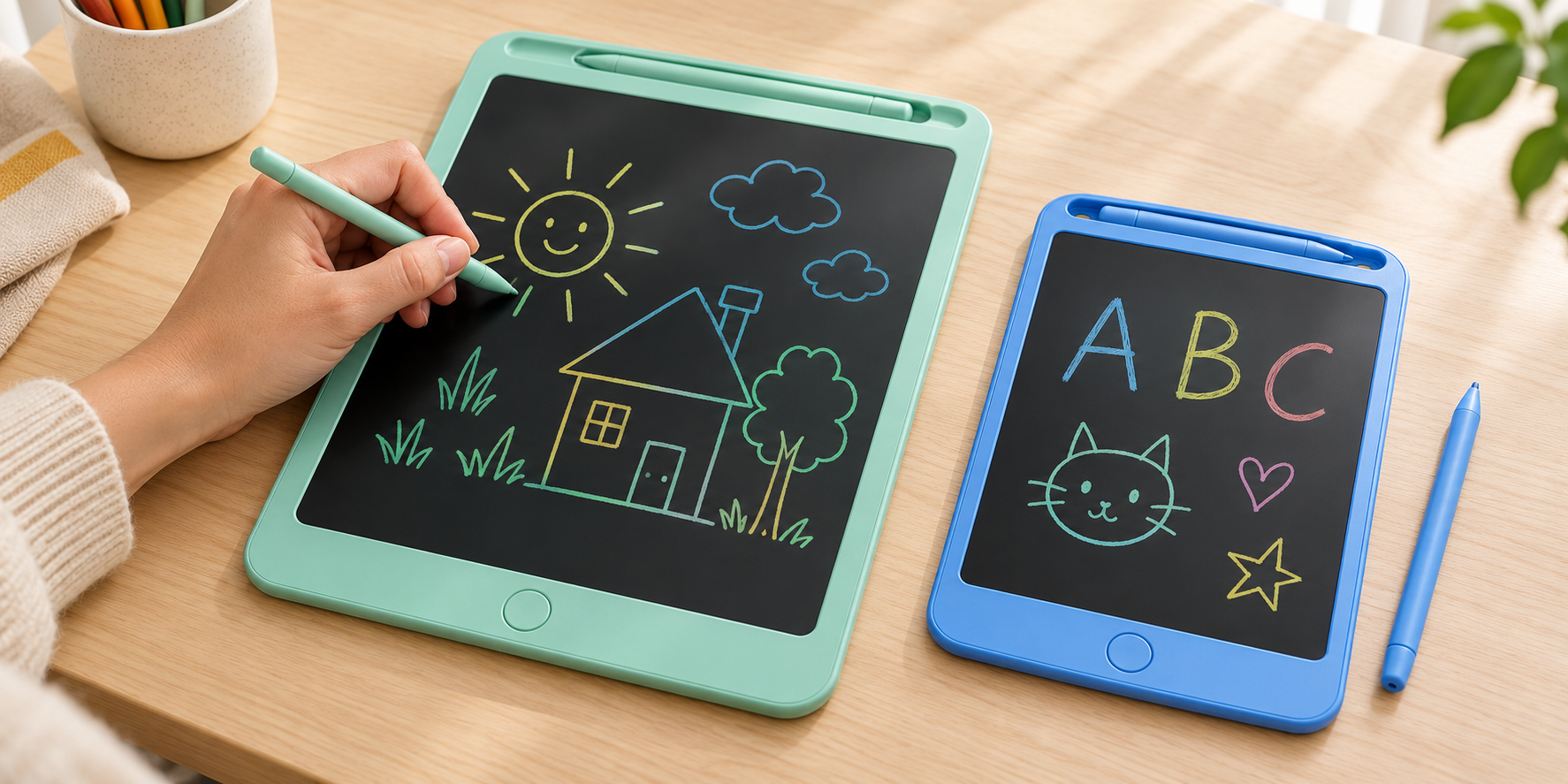
Match the Tablet to the Child’s Age and Activities
The best writing tablet is one a child can comfortably hold, understand, and use.
For younger children, we prioritize a sturdy frame, straightforward controls, and accessories designed for their age group. For older children, a larger writing area and clear line visibility may matter more.
We also consider the activity. A compact board may work well for quick sketches during outings, while a larger surface provides more room for handwriting practice and two-player games.
Always follow the manufacturer’s age grading, including any warnings about detachable parts or accessories.
Compare Writing Area and Portability
Overall product dimensions can be misleading because the frame may occupy a considerable portion of the board.
We compare the usable drawing area, not simply the advertised tablet size. A wide frame with a small screen may be easy to grip but leave limited space for longer words or detailed pictures.
For travel, we consider weight, thickness, stylus storage, and how easily the board fits into a bag. For home use, writing space may take priority over compact dimensions.
Check Screen Contrast and Visibility
A writing tablet should display marks clearly under the lighting conditions in which it will be used.
We examine:
- Contrast between the writing and background.
- Visibility of light-pressure strokes.
- Whether the surface produces distracting reflections.
- How clearly different colors appear.
- Whether marks remain visible near the screen edges.
A colorful screen can look appealing, but clear writing matters more than the number of advertised colors.
Look for Reliable Erasing and an Erase Lock
A dependable erase function helps keep play moving. For LCD boards, we check that the button clears the surface consistently. For magnetic boards, we assess whether the sliding eraser moves smoothly.
An erase-lock switch can prevent accidental clearing while a child is showing a drawing or completing a puzzle. It generally does not save the work as a digital file.
If keeping drawings is important, we check for an actual saving function. Otherwise, a photograph can preserve a finished picture before the board is cleared.
Examine the Stylus and Storage Design
The stylus should be comfortable to hold and easy to return to its storage position.
We consider grip thickness, tip shape, and replacement availability. A stylus that is too narrow or slippery may make the board less convenient to use.
If a product includes a tether, we assess its design and follow the manufacturer’s age and usage guidance. Storage clips and slots should hold the stylus securely without requiring excessive force.
Creative Writing Tablet Games for Children
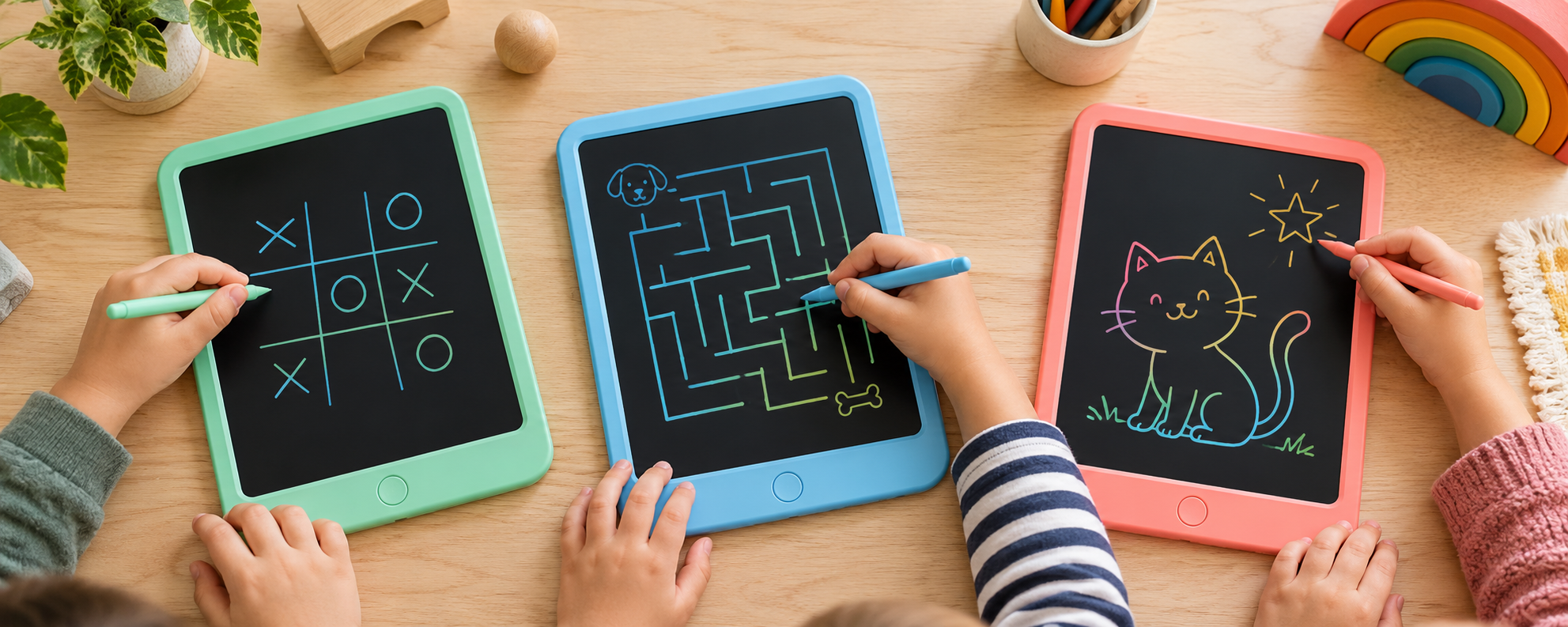
Drawing and Guessing Games
One player draws an object while another guesses what it is. We can use familiar themes such as animals, food, vehicles, or household objects.
For an additional challenge, players can work within a time limit or draw using only a few lines. The reusable surface makes it easy to begin a new round.
Tic-Tac-Toe and Grid Games
Tic-tac-toe fits naturally on most writing tablets. Children can draw the grid, take turns adding symbols, and erase the board when the round ends.
Larger boards also provide space for simple mazes, connect-the-dots activities, and homemade grid puzzles. We keep the layout appropriate to the available writing area.
Letter and Word Challenges
A writing tablet provides a convenient surface for short language activities. We can write an initial letter and ask children to complete a word, display a word for copying, or create a simple missing-letter puzzle.
For beginners, short sessions with a few clear examples are easier to follow than a crowded screen full of exercises.
Number Games and Quick Calculations
Children can use a reusable board to write answers, compare quantities, or solve short arithmetic problems.
We can also draw groups of objects and ask children to count them, complete a number sequence, or create a matching calculation. The board becomes a temporary workspace that can be cleared after each activity.
Collaborative Story Drawing
One player draws the beginning of a scene, and the next adds another detail. Together, the players create a picture and describe what is happening.
A house might become a farm, a beach scene, or the setting for an adventure. This activity gives the drawing session a shared purpose without requiring prepared templates.
Writing Tablets for Travel, Restaurants, and Everyday Use
Portable writing tablet toys can provide a focused activity during waiting periods, family outings, and visits.
For these situations, we choose a board that fits comfortably in the child’s bag and keeps its stylus attached or securely stored. A simple design with few loose accessories is easier to manage away from home.
We also prepare a few activities in advance. A drawing prompt, a word challenge, or a familiar game can help children begin using the board without needing additional materials.
Writing tablets still need appropriate storage. We avoid placing heavy items against the screen or leaving the product in conditions outside the manufacturer’s recommended temperature range.
Safety, Cleaning, and Care
Before use, we inspect the frame, screen, stylus, and battery compartment for damage.
For products containing button or coin batteries, the compartment must remain securely closed. These batteries can cause severe injury if swallowed or inserted into the body. We keep loose batteries away from children and seek immediate emergency assistance if ingestion is suspected.
For cleaning, we follow the product instructions. A soft cloth may be suitable for routine wiping, but we avoid assuming that every board tolerates cleaning sprays, alcohol, or water.
We also use the recommended stylus. Sharp objects and unsuitable tools can scratch or damage the writing surface.
Buying Writing Tablets Wholesale for Toys & Games Retail
For retailers, wholesale writing tablets offer several possible product positions, including creative play, travel activities, gifts, and handwriting practice accessories.
Before placing an order, we request samples and compare practical performance:
| Buying Factor | What We Check |
|---|---|
| Writing quality | Clear, consistent marks across the usable surface |
| Erasing | Reliable clearing during repeated use |
| Construction | Secure frame, smooth edges, and stable controls |
| Accessories | Stylus fit, storage, and replacement options |
| Battery compartment | Secure closure and appropriate warnings |
| Packaging | Accurate descriptions, instructions, and age information |
| Product documentation | Reports and records applicable to the destination market |
| Customization | Logo placement, packaging artwork, and sample approval |
We confirm exactly what any compliance documentation covers, including the product model and applicable requirements. A supplier’s general claim that a product is “certified” should be supported by relevant, verifiable records.
Frequently Asked Questions About Writing Tablet Toys
Do LCD writing tablets need charging?
Some use replaceable batteries, while others are rechargeable. We check the individual model’s specifications before buying.
Can a writing tablet save drawings?
Many basic LCD doodle boards cannot save or export work. Saving capability must be explicitly included in the product features.
Are writing tablets suitable for handwriting practice?
They can provide a reusable surface for practicing letters, words, and numbers. Paper remains useful when exercises require permanent records, printed guidelines, or a particular writing tool.
Can children choose different colors on an LCD writing tablet?
Not always. Some multicolor boards display different colors in fixed screen regions. They may not allow users to select a color independently.
Are writing tablets completely mess-free?
Basic LCD and magnetic boards usually avoid ink and chalk during normal use. However, tracing sets or activity kits may include separate art materials that require additional care.
What matters most when choosing a writing tablet toy?
We prioritize age-appropriate construction, clear writing, comfortable handling, reliable erasing, and secure battery access. These features determine how well the tablet supports everyday drawing, learning activities, and games.