Back To Blog
Sourcing custom keychains from China starts with a clear product specification, followed by supplier checks, sample approval, and a written production agreement.
This article explains how to compare quotes, evaluate personalized keychains, and plan quality checks and delivery without choosing on price alone.
Use it to build a repeatable purchasing process for retail merchandise, promotional giveaways, or branded gifts.
What is the best way to source custom keychains from China?
The best approach is to send the same detailed brief to several potential suppliers, compare their responses, and approve a production-representative sample before committing to a bulk order.
Evaluate manufacturing capability, communication, total cost, and quality controls together. Canada's Trade Commissioner Service similarly recommends supplier due diligence, specifications, samples, and quality checks rather than relying on an attractive quotation alone.
Start with the purchasing decision your business actually needs to make. A giveaway for an event needs a firm delivery deadline and clear branding; merchandise for an online shop needs consistent presentation and a workable reorder process. Define those priorities before discussing finishes or negotiating discounts.
Keep your first order focused. Instead of launching multiple shapes, materials, and packaging styles simultaneously, consider testing one core design. That gives you a clearer basis for judging the supplier and deciding what to change next.
Turn your idea into a production-ready brief
Write a specification sheet that leaves as little as possible open to interpretation. Replace descriptions such as “premium quality” with drawings, dimensions, material requirements, and examples of acceptable appearance. Ask each supplier to flag anything they cannot reproduce before quoting.
Include the following information:
Intended use and audience: Retail merchandise, corporate gifts, event giveaways, or another defined purpose.
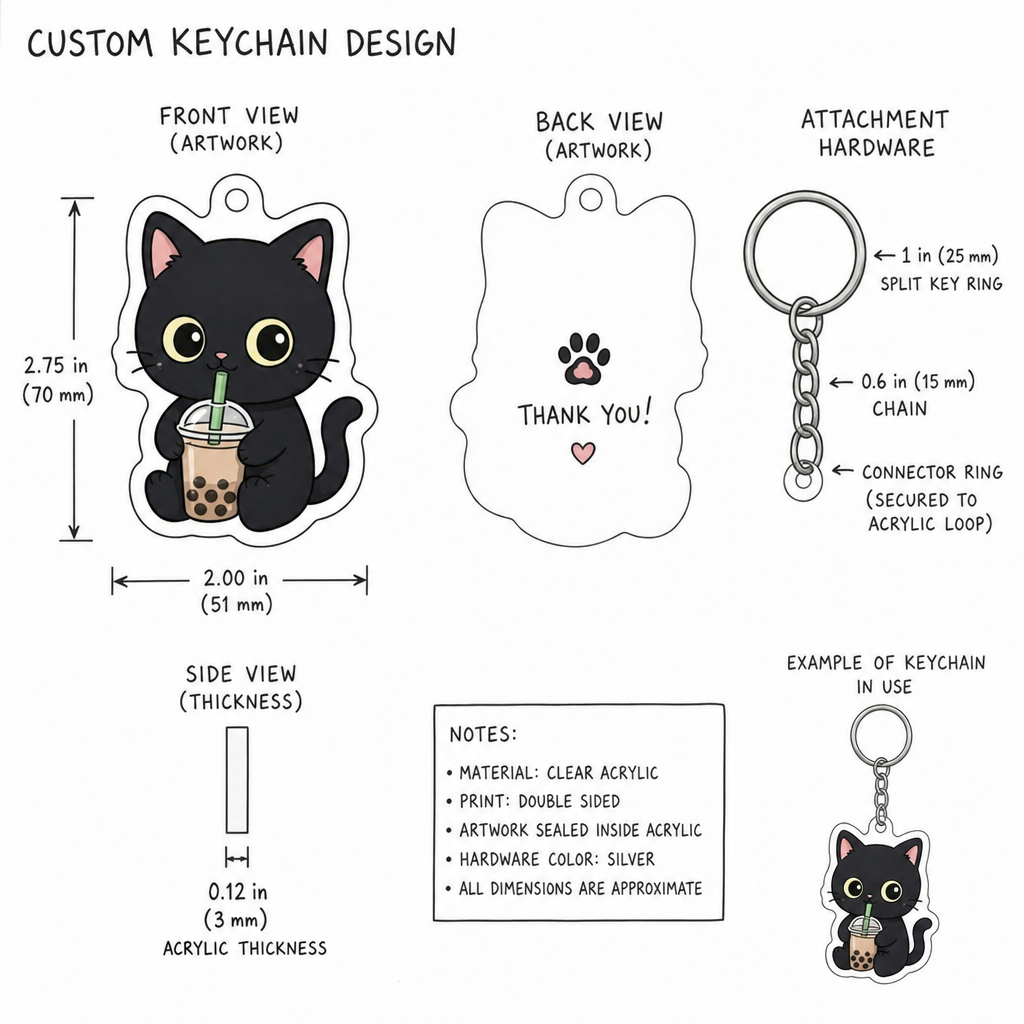
Design and dimensions: Artwork, overall size, thickness, shape, and attachment-hole position.
Materials and decoration: Requested material, printing or engraving method, surface finish, and color references.
Hardware: Ring, chain, clasp, connector style, and any attachment requirements.
Order breakdown: Total quantity and quantities per design, color, or personalized version.
Packaging: Individual protection, backing cards, labels, barcodes, and carton requirements.
Destination and timing: Delivery locati0n, required arrival date, and sample-approval deadline.
For personalized keychains with individual names or numbers, include a sample data file. Specify capitalization, punctuation, character limits, and how each item should be matched to its packaging. Require approval of the data layout before production.
Choose customization around the finished result
Rather than choosing a material from a catalog photograph alone, ask suppliers to propose options against your requirements. Request examples of the same production method, not just products with a similar shape. Compare legibility, edge appearance, attachment placement, and packaging in the samples you receive.
Unique keychains should still be practical. Check whether the design sits comfortably in a pocket, whether small lettering is readable, and whether the hardware obstructs the artwork. Simplifying a crowded design may be a better decision than adding another decorative feature.
Find and screen suitable keychain suppliers
Use sourcing marketplaces, direct manufacturer inquiries, and referrals to create an initial shortlist. Alibaba.com, for example, supports product searches and requests for quotation, with seller profiles and assessment information available for review. Treat that information as a starting point for questions, not a substitute for your own evaluation.
Search by process as well as product: “engraved metal keychain manufacturer” is more specific than “wholesale keychains.” Send your brief to suppliers whose examples match the work you need. A relevant portfolio gives you something concrete to discuss during screening.
Ask each candidate to identify the business accepting your order and the facility producing it. Request its registered business details, production address, and an explanation of any outsourced processes. Government sourcing guidance recommends checking export experience, qualifications, and subcontracting arrangements before selecting a supplier.
Use a short screening checklist:
Can the supplier explain how it would manufacture your exact design?
Will it provide a sample using the proposed materials and decoration?
Are quotation details consistent with your brief?
Does it answer questions about defects and rework directly?
Can it explain who handles production, inspection, and shipping?
Do not automatically reject a trading company or automatically prefer a factory. Instead, establish who controls the work, who resolves problems, and what service you receive for the quoted price. Pause if the seller avoids basic identity questions or pressures you to pay before specifications are settled.
How much will your custom keychains really cost?
Your useful comparison is the total landed cost per acceptable unit, not the advertised product price. Build a worksheet covering production, setup, packaging, inspection, transport, and applicable import charges. Compare quotations only after the specifications, quantities, and delivery responsibilities match.
For custom keychains wholesale orders, request separate figures for:
|
Cost item |
What to clarify |
|---|---|
|
Unit production |
Material, dimensions, decoration, hardware, and quantity basis |
|
Setup and tooling |
Artwork preparation, molds, engraving setup, and repeat-order charges |
|
Samples |
Sample price, delivery, revisions, and any agreed credit |
|
Packaging |
Individual bags, backing cards, labels, and outer cartons |
|
Quality checks |
Inspection scope, testing, and responsibility for reinspection |
|
Delivery |
Collection, freight, insurance, clearance, and final delivery |
Ask whether the minimum order quantity applies to the whole order or separately to each design and color. Request pricing at quantities you could realistically sell or distribute. Do not increase inventory simply to unlock a lower unit price.
For U.S. imports, have a customs broker confirm classification and applicable duties using the actual product details. CBP notes that import requirements depend on the commodity and may involve other agencies; do not assume that every keychain uses the same tariff treatment.
Approve samples against written acceptance criteria
Request a sample that represents the proposed production materials, decoration, hardware, and packaging. Identify any differences between the sample and the eventual order in writing. Keep an approved reference sample and label the artwork revision clearly.
Inspect the sample systematically rather than asking only whether it looks good:
Compare the design: Check spelling, layout, dimensions, colors, and front-to-back orientation.
Inspect the finish: Look for scratches, rough edges, print gaps, unwanted marks, or inconsistent decoration.
Try the hardware: Open the ring or clasp and check the assembled connections for obvious problems.
Review personalization: Match names or numbers to the approved source file and packaging instructions.
Check presentation: Assess protective packaging, label placement, and the unboxing result.
Record observations with photographs and clear descriptions. “Logo shifted toward the attachment hole” is more useful feedback than “printing looks wrong.” If a revision changes a feature that matters, request another sample before approving production.
A sample approval should not end quality control. The Trade Commissioner Service specifically cautions that a high-quality sample does not remove the need to check mass production. Plan a finished-goods inspection before shipment, with an agreed process for correcting failures.
Put production, payment, and ownership terms in writing
Build the purchase order around your approved specification, artwork revision, reference sample, quantity breakdown, and delivery milestones. Add acceptance criteria, inspection arrangements, and the proposed remedy for nonconforming goods. Ask the supplier to acknowledge the complete document rather than confirming scattered messages.
Negotiate payment milestones before paying. Where possible, connect the balance-payment decision to completed production and an agreed inspection outcome. Independently verify unexpected changes to payment instructions using a previously established contact method.
If you use Alibaba.com Trade Assurance, check the applicable eligibility, payment, and claim requirements for your order. Alibaba states that protection depends on the online order terms, supported payment process, evidence, and claim deadlines; it does not replace supplier screening or guarantee a refund for every disagreement.
For original designs, document expectations around artwork reuse, confidentiality, and tooling. Ask who owns any paid mold, how it will be stored, and what happens if you move production. Use qualified legal advice when design rights or enforceable cross-border agreements are commercially important.
Check product compliance before production
For U.S. sales, establish whether the keychains are general-use products or children's products before finalizing materials and marketing. CPSC considers intended use and other product characteristics when determining classification. A child-oriented design deserves a specific review rather than an assumption that every keychain follows identical requirements.
Children's products subject to applicable safety rules generally require third-party testing and a Children's Product Certificate. Ask a qualified testing laboratory which rules apply to your exact product, and obtain documentation tied to the relevant item and materials. A generic report for a different product is not sufficient evidence for your purchasing decision.
Small parts also need attention when products are intended for young children. CPSC prohibits certain products intended for children under three that present small-parts hazards, and warning-label requirements apply to certain other children's products. Do not treat an added warning as a substitute for determining the correct requirements.
Confirm country-of-origin marking and import documentation with your broker before packaging is printed. CBP's guidance identifies origin marking as an import consideration, alongside commodity-specific requirements. For sales outside the United States, obtain destination-specific advice rather than reusing a U.S. checklist unchanged.
Plan shipping backward from your required arrival date
Ask for a schedule that separates artwork approval, sample production, revisions, bulk production, inspection, and dispatch. Then obtain a shipping estimate for the actual destination. Make clear whether the supplier's promised date means goods ready at the factory, handed to the carrier, or delivered.
Request shipment estimates using expected packed weight and carton dimensions. Compare courier, air, or ocean proposals where appropriate, including handling and final delivery rather than freight alone. Ask the supplier and forwarder to identify foreseeable holiday closures and schedule constraints.
Before dispatch, confirm:
The inspection result and completion of agreed corrections.
Quantities by design, color, and personalization batch.
Invoice, packing-list, and transport-document details.
Carton labels, protective packaging, and shipment identification.
Who handles clearance, import charges, and delivery appointments.
After arrival, count and inspect the goods promptly. Keep photographs of packaging and any defects, and notify the supplier with specific evidence. Record actual costs and delivery performance so the next order starts with better information.
Build a repeatable sourcing process
Successful sourcing means making the specification, approval process, and commercial responsibilities clear before money and deadlines create pressure. Choose the supplier that can demonstrate a workable plan for your custom keychains, not simply the lowest quote. Keep approved files, samples, inspection records, and order terms together so reorders can follow the same standard.
Frequently Asked Questions About Sourcing Custom Keychains from China
What are the key factors to consider when selecting a supplier for custom keychains?
When selecting a supplier, consider their manufacturing capabilities, communication skills, total cost, quality control processes, and experience in producing similar items. It's essential to evaluate their portfolio and request samples before making a decision.
How do I create an effective specification sheet for custom keychains?
An effective specification sheet should include detailed information on intended use, design dimensions, materials, decoration methods, hardware requirements, order breakdown, and packaging needs. Clear and concise descriptions minimize the chances of misinterpretation by the supplier.
What is the average minimum order quantity (MOQ) for custom keychains?
The average MOQ for custom keychains can vary significantly depending on the supplier and the complexity of the design. It’s important to discuss the MOQ with suppliers upfront to ensure it aligns with your purchasing needs.
How can I ensure the quality of mass-produced keychains?
To ensure quality, it’s important to request samples that represent the final product before placing a bulk order. Additionally, you should plan for a finished-goods inspection before shipment and establish acceptance criteria for the final product.
What are the potential hidden costs in sourcing custom keychains?
Hidden costs may include setup and tooling fees, packaging costs, quality inspection charges, transportation fees, and applicable import duties. It’s crucial to request a breakdown of all costs from your supplier to avoid unexpected expenses.