Back To Blog
Sourcing custom stationery gift boxes starts with defining the contents, choosing a packaging partner, and approving a physical sample before committing to production.
Whether you need client thank-you gifts, retail collections, or employee welcome kits, this approach helps you compare suppliers on fit, presentation, and total cost—not just an attractive mockup.
How do you source custom stationery gift boxes?
Start by listing the stationery items, measuring the complete set, and documenting your quantity, budget, personalization needs, and delivery deadline. Send the same brief to shortlisted suppliers, compare itemized quotations, and test a packed sample before approving the final order.
Treat the stationery, presentation box, and shipping protection as one coordinated project.
Decide early whether you want an empty box or a finished gift. For an empty box, your team must source the contents, assemble each set, and manage fulfillment.
For a finished gift, ask the supplier to specify exactly which sourcing, printing, personalization, packing, and delivery tasks it will handle.
Assign one person to approve changes across the project. A notebook substitution or revised insert should trigger a fit check before production, rather than becoming a surprise during assembly.
Build the gift around its recipient
Before exploring custom box designs, write down what the recipient should actually do with the contents. A practical desk set might center on a notebook and pen; a correspondence collection might focus on note cards and envelopes. Let that purpose guide the assortment rather than adding accessories simply to fill space.
Consider these stationery gift ideas as starting points:
- Client appreciation: Coordinate note cards, envelopes, and a handwritten message around a restrained visual theme.
- Employee onboarding: Pair a notebook and pen with a welcome card that explains how the items fit into the new role.
- Personal milestones: Build personalized stationery gifts around a name, monogram, or meaningful illustration.
- Retail gifting: Create a defined collection with a clear contents list and consistent presentation across units.
For custom stationery sets, specify the details that affect everyday use: page layout, notebook binding, card dimensions, envelope compatibility, and the intended writing instruments. Request stationery samples where possible and try the items yourself. A coordinated appearance should not replace a comfortable writing experience.
Turn your concept into a supplier brief
Give every supplier the same requirements so their responses are comparable. Include a reference image if it helps explain your preferred appearance, but distinguish inspiration from nonnegotiable specifications. Ask suppliers to identify assumptions instead of silently filling in missing details.
Your brief should cover:
- Order scope: Empty packaging, stationery plus packaging, or fully assembled gifts.
- Quantities: Initial order, anticipated repeat orders, and quantities per artwork version.
- Contents: Item dimensions, weights, quantities, and reference samples where available.
- Packaging: Proposed box style, internal layout, insert requirements, and printed surfaces.
- Personalization: Shared branding, individual names, custom messages, or multiple recipient groups.
- Delivery: Destination, required arrival date, and whether distribution involves one address or many.
- Budget: Target total per completed gift, with a clear statement of what that includes.
Measure the actual products rather than relying only on catalog descriptions. Ask the packaging supplier to recommend internal dimensions and assembly clearance, then verify those recommendations with a sample. Include ribbons, sleeves, cards, and other layers in that fit check.
Where should you look for suppliers?
Look for packaging manufacturers, stationery printers, and gift-assembly providers according to the work you need completed. Use packaging specialists for box-focused projects, stationery printers when the printed contents are central, and assembly providers when you want a packed gift delivered. Confirm each candidate’s actual capabilities rather than assuming its service category covers everything.
Search terms such as “custom stationery packaging manufacturer,” “personalized notebook supplier,” and “gift kitting service” can help organize your shortlist. Review relevant product pages, then request examples that resemble your proposed materials, dimensions, and personalization method. Ask who will handle work that is subcontracted.
For example, Packlane offers configurable custom packaging, while MOO offers customizable notebooks with options that vary by product.
These illustrate separate sourcing routes, not a guarantee that either company will supply your entire finished gift. Check the current product specifications and request confirmation against your brief.
Shortlist a few suppliers you can evaluate thoroughly. Prioritize clear answers, relevant samples, and willingness to document specifications over a large gallery of unrelated packaging.
Choose packaging around fit and handling
Ask suppliers to propose a structure based on the contents and delivery method. Compare a presentation box placed inside a shipping carton with a box intended to serve both purposes. Request confirmation of the proposed shipping arrangement rather than assuming a decorative box can travel unprotected.
For your comparison, consider these options:
|
Packaging approach |
Use it as a starting point for |
What to verify |
|---|---|---|
|
Rigid presentation box |
A keepsake-style gift concept |
Storage space, assembly, closure, and outer protection |
|
Folding carton |
A compact retail gift concept |
Board specification, packed fit, and closure security |
|
Corrugated mailer |
A directly shipped gift concept |
Print appearance, product restraint, and transit protection |
|
Stock box with custom sleeve |
A project with limited structural customization |
Available dimensions, sleeve fit, and consistent supply |
Treat this table as a discussion brief, not a substitute for testing. Ask for the proposed material specification and a packed sample. Check whether the recipient can remove each item easily without tipping out the remaining contents.
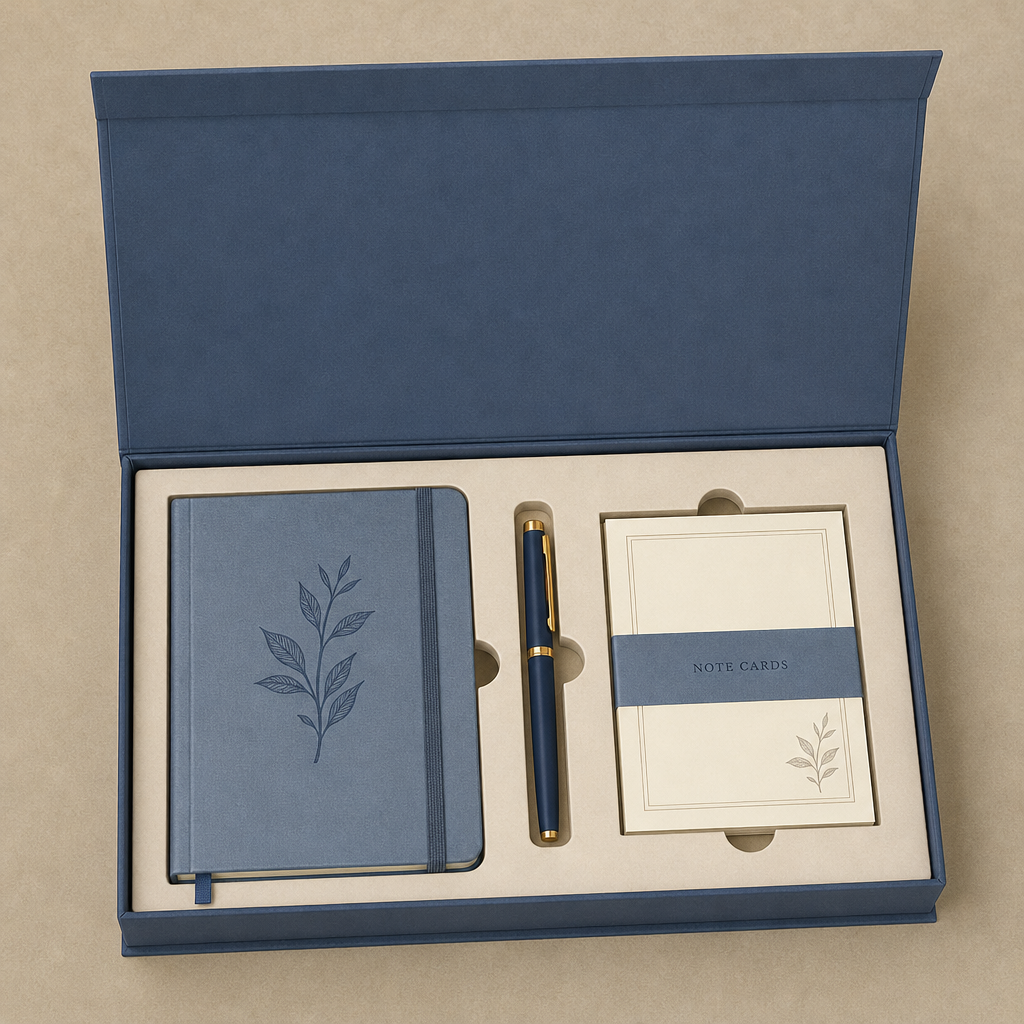
For the interior, request a layout showing how each item will be held. Test the box after closing, carrying, and reopening it. If products shift or rub together, revise the insert or arrangement before approving production.
Make personalization manageable
Separate shared branding from recipient-specific details. A logo repeated across every box is a different requirement from a unique name on each lid or notebook. Ask suppliers to quote those tasks separately and explain how they will match personalized components during assembly.
For personalized gift boxes, consider keeping the main packaging consistent and placing individual details on a card, sleeve, or removable label. Ask for a comparison against direct box personalization rather than assuming either approach will be cheaper. Choose the method that fits both the intended experience and your team’s ability to check it.
Prepare a recipient file with clear fields for names, messages, and any matching identifiers. Set a deadline for changes and nominate one approved version of the file. Request a test using a long name, punctuation, and any accented characters your project requires.
Also agree on how recipient information will be transferred, who needs access, and when the supplier should delete it. Keep mailing details separate from personalization data where the workflow allows.
Compare the complete cost, not just the box price
Request an itemized quotation for the completed project. Packlane’s configurator, for example, updates pricing according to choices including style, size, material, quantity, and print options—useful context for why quotations need matching specifications. Do not compare a basic exterior print quote with a fully finished, assembled gift.
Ask each supplier to separate stationery, boxes, inserts, personalization, setup, samples, assembly, shipping protection, and delivery. For cross-border sourcing, request clarification on who handles customs arrangements and which charges are excluded. Record taxes and other applicable charges separately where they are not included.
Use this comparison:
Total project cost ÷ expected usable completed gifts = effective cost per gift.
Include work your team must perform, such as unpacking components, matching names, assembling sets, and preparing shipments. Request quotations at your required quantity and a realistic repeat-order quantity, but avoid ordering surplus stock solely to obtain a lower unit price.
Confirm payment stages, quote validity, cancellation terms, and the process for reporting defects. Ask how shortages, damaged units, and incorrect personalization will be resolved, and get the agreed response in writing.
What should you check before approving production?
Check the packed fit, materials, artwork, personalization, and opening experience against the written brief before approving production.
Use a physical sample for handling and fit checks, and review the digital proof for layout and text. Packlane explicitly notes that an online proof is not an accurate reproduction of final printed color, so ask what physical color approval options are available when color matters.
Clarify what each sample represents. A general sample kit may help you assess materials without showing your exact design; Packlane, for example, states that its sample kits cannot be customized. Ask whether your proposed sample uses the production structure, materials, printing method, and finishes, and document any differences.
Use this approval checklist:
- Fit: Pack every component, close the box, and check for pressure, movement, or difficult removal.
- Stationery: Test the paper with intended writing instruments and inspect trimming, binding, and envelopes.
- Artwork: Check spelling, orientation, logo placement, and all recipient-specific details.
- Finish: Examine printed areas, corners, closures, and inserts for the appearance you agreed.
- Assembly: Build a complete gift using the proposed packing instructions and note any unclear steps.
- Delivery: Arrange a trial shipment using the intended protective packaging, then inspect the contents on arrival.
Use the supplier’s approved dieline for final artwork. Packlane’s guidance calls for checking panel orientation, keeping artwork within safe zones, and extending backgrounds into the required bleed area; follow your chosen printer’s specifications rather than transferring another company’s settings.
Save the approved files and sample references together. State who can authorize production and how later revisions will be handled.
Build a schedule with approval time included
Work backward from the date the recipient needs the gift, not merely the date you want boxes dispatched. Request separate allowances for sampling, revisions, artwork approval, production, assembly, and transportation. Packlane distinguishes production turnaround from transit time and notes that custom or bulk work can require additional preparation, illustrating why a single headline lead time is insufficient.
Add time for your own decisions, too. Assign someone to monitor proof emails and confirm the supplier’s approval policy before ordering. Packlane’s published process includes an automatic approval provision after its review window, so silence should never be your project-management method.
For custom gift packaging intended for repeat orders, retain the material specification, artwork version, insert layout, and packing instructions. Ask which components can be reordered independently and what changes would require a new sample.
Specify sustainability claims precisely
If responsible material sourcing is part of your brief, request evidence for the specific claim you intend to make. FSC distinguishes between FSC 100%, FSC Mix, and FSC Recycled labels; they do not describe identical material sourcing. Ask which claim applies to your actual packaging rather than describing every certified box as recycled.
For an FSC label on the finished packaging, FSC advises verifying the final supplier’s certification, requesting certified material, and specifying on-product labeling. Have the certified supplier handle the appropriate label and approval process.
In your design brief, also ask whether unnecessary layers can be removed and whether recipients can separate the components. Keep disposal instructions specific to the supplied materials and intended destination.
Start with a brief, finish with an approved gift
A useful sourcing decision balances the stationery, packaging, personalization, assembly, and delivery requirements together. Begin with one written brief, compare complete quotations, and approve a representative packed sample. Once those details are documented, you can place the order with a clearer understanding of what will arrive—and what your team still needs to do.
Frequently Asked Questions About Sourcing Custom Stationery Gift Boxes
What should I include in my supplier brief for custom stationery gift boxes?
Your supplier brief should cover order scope, quantities, contents (item dimensions and weights), packaging details, personalization needs, delivery requirements, and budget specifications. Ensuring all suppliers have the same information allows for better comparisons.
How do I choose the right supplier for custom stationery gift boxes?
Research packaging manufacturers, stationery printers, and gift-assembly providers based on your specific needs. Look for suppliers with relevant experience, provide samples, and are transparent about their processes. It’s crucial to assess their actual capabilities rather than assuming their service covers everything.
What are some stationery gift ideas I can consider?
You can create gift sets for different occasions, such as client appreciation (note cards and envelopes), employee onboarding (notebook and welcome card), personal milestones (personalized stationery), or retail gifting (defined collections with consistent presentations).
How do I ensure the personalization of gift boxes is managed effectively?
Keep shared branding separate from recipient-specific details and consider using cards or sleeves for individual information. Establish a file that clearly outlines names, messages, and identifiers, and set a clear deadline for any changes.
What should I verify before approving production of the stationery gift boxes?
Check for fit, materials, artwork accuracy, personalization details, assembly instructions, and the delivery method. Use a physical sample to ensure everything fits and functions as intended before proceeding with the full production.