Back To Blog
The best blind box toys wholesale suppliers in China depend on your assortment, sales territory, and purchasing model.
POP MART, 52TOYS, TOP TOY, and Robotime’s Rolife brand are useful starting points because they publish official business inquiry or wholesale channels. T
his article compares those options and explains how to assess authorization, order quantities, product quality, and landed costs before committing to inventory.
These are sourcing candidates, not guarantees of account approval or product availability.
Which blind box suppliers in China should you shortlist?
Start with POP MART for its character-led collectibles, 52TOYS for a varied collectible assortment, TOP TOY for blind boxes alongside other collectible formats, and Rolife for Nanci products within a broader creative-gift range.
Each has a different product focus and business contact route, so choose according to your store rather than treating them as interchangeable wholesale toy suppliers. The recommendations below are based on their published offerings and partnership channels, not independent factory audits.
|
Supplier |
Published product focus |
Official sourcing entry point |
|---|---|---|
|
POP MART |
Character collectibles, including MOLLY, THE MONSTERS, and SKULLPANDA |
North American wholesale application and regional overseas cooperation contacts |
|
52TOYS |
Blind boxes, figures, plush, keychains, and other collectibles |
Overseas business inquiry team |
|
TOP TOY |
Blind boxes, building blocks, and figurines |
Wholesale registration page |
|
Robotime / Rolife |
Nanci blind boxes and creative-gift categories |
Robotime B2B partnerships team |
These categories and contact routes come from the companies’ official pages. Confirm the exact series, destination, and purchasing entity before requesting commercial terms.
No universal MOQ or wholesale price is assumed here. Ask each supplier for a current, account-specific quotation rather than using consumer storefront prices as your purchasing benchmark.
Four suppliers worth evaluating
POP MART: A starting point for character-focused assortments
POP MART’s official cooperation page identifies characters including MOLLY, THE MONSTERS, SKULLPANDA, DIMOO, and CRYBABY. Its North American contact page provides a wholesale application route, while its China website lists regional contacts for overseas product supply and other business cooperation.
These are stronger starting points than an unrelated reseller claiming unrestricted access to every release.
Consider POP MART if your merchandising plan centers on particular characters and series. Build your inquiry around those specific products, your country, and your selling channels. Do not assume that approval for one account means every collection will be available.
Ask the wholesale team to confirm:
Which series your account can purchase and replenish.
Whether your physical store, website, and marketplace accounts are eligible.
How preorders, allocations, and unavailable products are handled.
What invoices and authorization documentation accompany purchases.
Keep corporate gifting separate from resale sourcing. POP MART describes bulk purchasing for institutional gifts and events separately from overseas product supply, so explain that you intend to resell rather than merely requesting a large consumer order.
52TOYS: A candidate for a varied collectible assortment
52TOYS’ official storefront includes blind boxes, figurines, mini figures, accessories, keychains, and plush toys.
Its company information describes original IP development and a broader collectible portfolio, while its contact page directs business inquiries to an overseas team. This makes it worth evaluating when you want more than one collectible format from a brand relationship.
For a first inquiry, separate your proposed assortment into clear groups: boxed figures, wearable accessories, and plush collectibles, for example. Request case quantities and availability for each group rather than asking for an undifferentiated catalog discount.
Pay particular attention to assortment rules. The official 52TOYS FAQ explains that individual blind boxes can contain duplicates and that a secret edition, when included in a whole set, replaces a regular edition according to the series rules. A secret figure is not guaranteed.
Before buying, ask how the wholesale packing configuration maps to those rules. Your purchase order should distinguish individual boxes, complete retail sets, and shipping cartons so your team does not promise customers an assortment the supplier never guaranteed.
TOP TOY: An option for multi-format collectible stores
TOP TOY describes its focus as blind boxes, building blocks, and figurines. Its official website also discusses licensed collaborations and original character development, and it publishes a wholesale registration page. Those features make it a sourcing candidate for retailers planning a mixed collectible department rather than a blind-box-only display.
Use the registration process as an introduction, not as proof that every product is available for your territory. Send a focused assortment proposal and ask which items can be supplied to your business. Request product-level information for licensed collections rather than relying on a general brand presentation.
For evaluation, ask TOP TOY to separate:
Ready-to-ship products from future releases.
Blind box case packs from other merchandise formats.
Original characters from third-party licensed collections.
Confirmed supply from products still awaiting allocation.
This creates a clearer comparison with other suppliers. It also lets you judge whether the additional categories genuinely support your store concept or simply increase the opening order without a defined merchandising role.
Robotime / Rolife: A fit to explore for creative-gift retail
Rolife is part of Robotime’s brand family, and Robotime identifies Nanci as an original character within its expansion into collectibles. Rolife’s published wholesale assortment includes Nanci blind boxes alongside miniature houses, book nooks, and other creative gifts. Robotime also provides an official B2B partnerships contact.
Consider this route if your store combines collectibles with hobbies, books, or gifts. Ask for a Nanci-specific quotation first, then evaluate complementary products separately. That prevents a broad catalog from obscuring whether the blind box offer itself meets your requirements.
Confirm the fulfillment route carefully. Robotime’s U.S. wholesale pages describe domestic warehouse fulfillment, which is different from arranging a direct China export order. Request separate quotations if you want to compare those purchasing models.
Also distinguish MOQ from minimum order amount. Ask for the required quantity per series, the total opening-order value, and whether mixed categories qualify. Get the applicable terms in writing for the particular account and warehouse you will use.
Match product types to your retail plan
Choose product types before requesting blind box bulk quotations. Write a short buying brief that identifies your audience, target selling-price position, display space, and preferred formats. Give suppliers a defined problem to solve rather than asking them to select whatever they want to sell.
Use these evaluation prompts:
Display figures: Request dimensions, materials, accessories, and packaging photographs. Check whether your shelves accommodate the figure and its retail box.
Plush and bag charms: Ask for close-ups of stitching, attachments, faces, and any rigid components. Review a physical sample before approving the finish.
Miniature or scene-based collectibles: Confirm included pieces, assembly requirements, and how the product is presented after opening.
Licensed character collections: Identify the exact collection, not just the franchise name, when requesting commercial and authorization documents.
For an opening assortment, give each series a role: an accessible introduction, a character-led collection, or a higher-consideration display item. Avoid buying several similar ranges without explaining why each deserves shelf space.
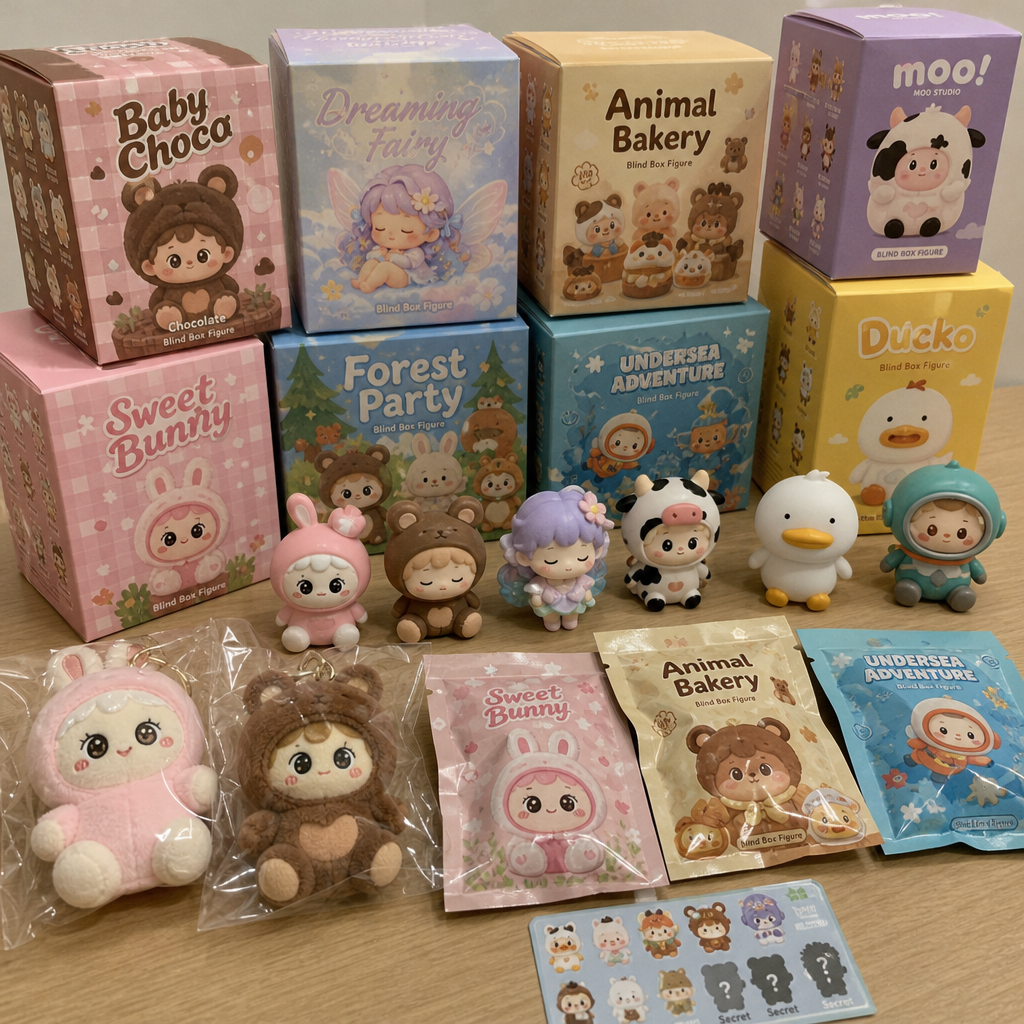
Plan the display before approving the order. Decide whether customers will handle sealed boxes, view an opened sample, or browse photographs beside the stock. Ask suppliers whether display samples and approved image assets are available, and record any additional cost separately.
How do you verify IP authorization before ordering?
Verify IP authorization by asking who owns the relevant character rights, which company is supplying the goods, and what documentation supports that supply relationship. Where a seller claims brand authorization, seek confirmation through the brand’s official business channel. POP MART, for example, publishes a dedicated contact for infringement reports and authorization verification.
For collectible toys wholesale, use this document checklist:
Seller identity: Request the legal company name and compare it with the quotation, invoice, contract, and payment beneficiary.
Product identity: Record the brand, series, SKU, packaging version, and quantities.
Supply relationship: Ask whether you are buying from the brand, a distributor, or another reseller.
Authorization scope: Where authorization is claimed, request its applicable territory, channels, products, and validity period.
Verification route: Contact the brand independently when documents are unclear or the seller makes unusually broad promises.
Treat authenticity, commercial permission, and marketing rights as separate review items. Ask explicitly about using product photography, logos, and character artwork; do not interpret a merchandise quotation as permission to commission new branded products.
For original designs, request confirmation that the supplier controls the design rights needed for the proposed work. If you want your own character range, describe that as a separate development project with its own ownership and approval terms.
Avoid resolving uncertain rights questions through verbal assurances. Pause the affected products and obtain qualified advice when necessary rather than accepting ambiguous documentation because the price looks attractive.
Understand MOQ, case packs, and mixed orders
Do not negotiate MOQ until both sides agree on the unit being counted. Write quantities as individual blind boxes, retail display sets, and master cartons, with the conversion between them. Ask for a packing list example if the quotation uses unfamiliar terminology.
Separate the commercial requirements into four fields:
|
Requirement |
What to clarify |
|---|---|
|
MOQ per SKU or series |
The smallest purchasable quantity of that specific item |
|
Case-pack requirement |
Whether orders must follow complete packing multiples |
|
Minimum order amount |
The minimum total purchase value for an account or shipment |
|
Mixed-order permission |
Which series or categories can contribute to the minimum |
For a first blind box wholesale order, request a focused trial assortment. Ask suppliers to quote the smallest practical configuration, then compare it with the next quantity tier. Judge the extra commitment against your own inventory budget rather than the discount alone.
Also request separate terms for reorders. Your preferred arrangement might be a broader opening selection followed by smaller replenishment purchases. Ask whether those smaller orders are permitted and whether freight, pricing, or account conditions change.
Keep customization outside this discussion unless it is genuinely part of your plan. Ask for separate development, sampling, packaging, and production terms for original products. Do not assume a branded wholesale program includes private-label manufacturing.
What determines wholesale prices and your real margin?
Compare wholesale prices using the total cost of receiving saleable inventory, not the quoted unit price alone. Ask every supplier to price the same series, packing configuration, quantity, destination, and delivery basis. Otherwise, apparently competing offers may cover substantially different obligations.
Build your comparison around:
Estimated landed cost per saleable unit = total purchasing and inbound costs ÷ expected saleable units.
Include the quoted goods value, freight, insurance where purchased, customs-related charges, inspection, required testing, and delivery to your warehouse. Keep uncertain charges visible rather than burying them in an optimistic margin estimate. Have your broker confirm applicable import charges for the actual shipment.
Delivery terminology deserves particular attention. ICC’s Incoterms guidance distinguishes EXW, which places extensive obligations on the buyer, from other arrangements. It recommends considering FCA for containerized or multimodal shipments rather than using FOB indiscriminately.
Ask the supplier and freight provider to identify:
The agreed Incoterms rule and named place.
Who arranges transport and insurance.
Who handles export and import clearance.
Which destination charges are included or excluded.
After establishing landed cost, calculate selling economics separately. Deduct your own marketplace fees, payment costs, outbound fulfillment, promotions, and returns allowance from expected revenue. Run a conservative scenario as well as your preferred one.
If the deal only works when every unit sells immediately at full price, reduce the order or reconsider the assortment. A larger discount is not a sufficient reason to accept inventory you cannot comfortably finance.
Inspect the product and protect the sealed-box experience
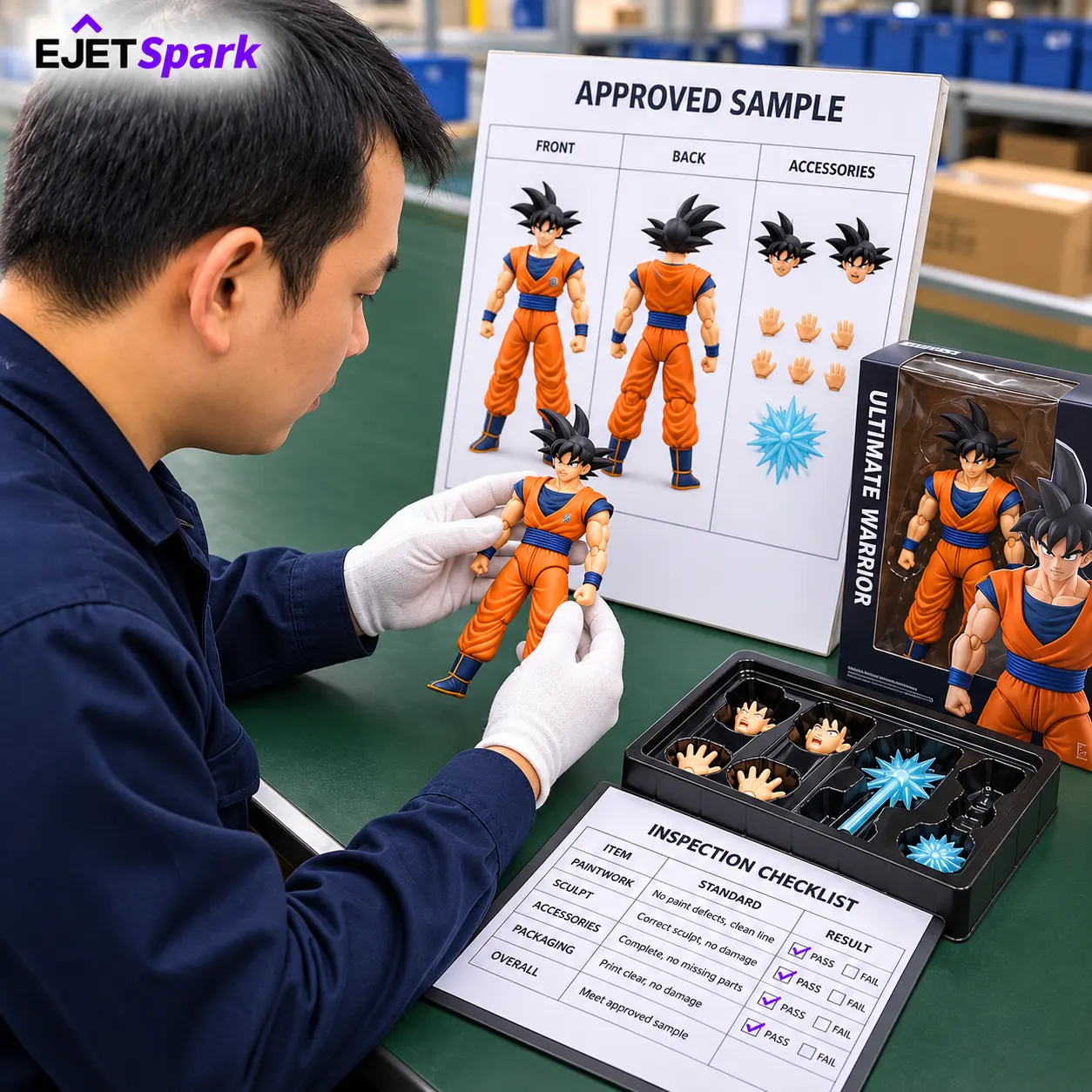
Use a written inspection checklist rather than approving samples with “looks good.” Define acceptable paint finish, assembly, accessories, packaging condition, and printed information. Photograph the approved sample and keep its series and version details with the purchase order.
Ask your inspection provider to evaluate both the merchandise and the packing configuration:
Retail boxes match the ordered series and labeling version.
Seals are intact and show no unexplained alteration.
Sampled figures meet the agreed finish and assembly criteria.
Included cards and accessories match the product specification.
Carton quantities and shipping marks match the packing list.
Protective packing follows the agreed specification.
Agree in advance how inspection samples will be opened and accounted for. Do not let the inspection process create uncertainty about which units remain suitable for sale as unopened stock.
Put defect handling in writing before shipment. Specify the evidence required, reporting period, and available remedies, such as replacements or credits. Ask who pays related freight and whether packaging damage is treated differently from a defective figure.
Check destination-market safety requirements
For U.S. sales, establish the product’s applicable requirements before placing the order. CPSC states that toys intended primarily for children aged 12 and under require applicable third-party testing and a Children’s Product Certificate. For overseas-manufactured products, the importer has responsibilities for identifying applicable requirements.
Ask a qualified laboratory or compliance adviser to review the actual product, intended audience, materials, components, packaging, and marketing. Match supporting reports to the specific product being purchased. Do not accept an unrelated report simply because it contains a familiar standard name.
Your review should also address relevant small-parts warnings, lead and phthalate requirements, and tracking labels where applicable. CPSC identifies these as additional considerations beyond the federal toy safety standard. A general supplier statement should not replace product-specific review.
Keep compliance records alongside the invoice, purchase order, and batch information. If you sell into other markets, obtain destination-specific advice rather than assuming U.S. documentation answers every requirement. Resolve missing documentation before dispatch, when you still have practical options to change or cancel the affected order.
Turn your shortlist into a controlled first order
Send the same request for quotation to each candidate. Include your business locati0n, selling channels, preferred series, quantities expressed in clear units, delivery destination, and documentation requirements. Ask suppliers to identify exclusions rather than replying only with a headline price.
Use this sequence:
Confirm account eligibility. Establish which products and channels the supplier will support.
Review documents. Check seller identity, claimed authorization, and product-specific compliance support.
Approve samples. Record the accepted finish, accessories, and packaging.
Compare complete quotations. Normalize quantities, delivery terms, payment milestones, and total costs.
Place a manageable trial order. Limit the number of series and define inspection and defect remedies.
Review performance before expanding. Track received condition, sales, customer issues, and supplier responsiveness.
Apply the same process to independent toy distributors. Ask them to explain their supply chain and provide evidence for any authorization claims. Evaluate the documented offer rather than assuming either a direct brand account or an intermediary is automatically the better choice.
For wholesale collectible toys, a disciplined first order should answer two questions: can this supplier deliver what was agreed, and does the assortment work for your customers? Expand only when your own results support the decision.
Choose the supplier that fits your business
Use POP MART, 52TOYS, TOP TOY, and Rolife as a focused starting shortlist, then compare actual offers against your assortment and purchasing requirements. Prioritize clear product documentation, realistic order quantities, inspectable quality, and understandable total costs over an attractive catalog alone.
Before paying, make sure the products, quantities, delivery responsibilities, and remedies are written down. The right blind box bulk purchase is not simply the cheapest order; it is one you can verify, receive, sell, and replenish with confidence.
Frequently Asked Questions About Blind Box Toys Wholesale Suppliers in China
What are blind box toys, and why are they popular?
Blind box toys are collectibles packaged in opaque boxes, so the buyer does not know which specific toy they are receiving until they open it. This element of surprise adds excitement and encourages collectors to purchase multiple boxes to complete their collections.
What factors should I consider when selecting a blind box toy supplier?
When choosing a supplier, consider factors such as product quality, pricing, minimum order quantities (MOQ), intellectual property (IP) authorization, and the availability of diverse product assortments that align with your target market.
How can I verify a supplier's IP authorization?
To verify a supplier's IP authorization, request documentation that confirms their rights to sell the products. Reach out directly to the brand's official business contact for verification and ensure that the supplier can provide necessary credentials.
What are the typical minimum order quantities for wholesale blind box toys?
Minimum order quantities can vary by supplier and product type. It’s essential to inquire about the specific MOQ for each series or SKU before placing an order to ensure it fits your inventory and budget.
How do I determine the landed cost of wholesale toys?
To calculate the landed cost, sum the costs associated with purchasing the toys, including product price, shipping, insurance, customs duties, and any other related fees. This total will give you the actual cost of receiving saleable inventory.